How to Find Genuine Builders & Developers to Buy or Develop Your Land (2026)
How to Find Genuine Builders & Developers to Buy or Develop Your Land (2026)
An owner with 5 acres of prime suburban land relies on the local broker network to figure out how to find developers to buy land. Instead of securing a clean, profitable deal, the owner is subjected to months of opaque lowball offers and time-wasters. Eventually, they sign an "exclusive agreement" with a so-called developer who ties up the land but does nothing with it. Meanwhile, a middleman quietly pockets a massive margin. The land is excellent—but the owner never reached a single genuine, capable developer.
In Indian real estate, the gap between a landowner and a legitimate institutional builder is historically guarded by a maze of middlemen. Whether you are looking for an outright sale or a highly profitable Joint Development Agreement (JDA), exposing your land to the right buyer is the difference between a multi-crore success and years of frozen assets.
Here is the 2026 guide for landowners on how to bypass the broker maze, vet a developer’s true capacity, and get matched directly with verified institutional buyers.
Quick Answer: To find genuine developers for your land, you must first get your title and revenue records perfectly clean. Understand your land's development potential by checking its zoning, FSI, and infrastructure corridors. Decide whether you want an outright sale or a Joint Development (JD). Instead of handing control to a single local broker, list your land on a verified matching platform to reach multiple institutional developers directly. Before signing any agreement, thoroughly vet each developer's delivery track record, RERA history, and financial capacity. Always compare multiple offers, and never hand over a blanket General Power of Attorney (GPA) up front.
Why Finding Genuine Developers is Hard (The Broker Problem)
The traditional land transaction market in India suffers from extreme information asymmetry. Landowners rarely have a direct line to the boardrooms of tier-1 developers or institutional funds.
When you attempt to sell large parcels through fragmented broker networks, you inevitably face:
The "Hidden Buyer" Tactic: Brokers often shield the identity of the developer to protect their commission, preventing you from researching who you are actually doing business with.
Opaque Lowball Offers: Without multiple institutional developers bidding on your land simultaneously, you have no way to establish its true open-market value.
Fake or Overleveraged "Developers": Many local entities posing as developers lack the capital to complete a project. They intend to secure your land, leverage your title to borrow money, or "flip" the development rights to a larger builder.
The Exclusive Lock-In: Brokers or unverified builders will pressure you to sign a Memorandum of Understanding (MoU) with an exclusivity clause, freezing your ability to talk to other buyers while they endlessly stall.
Local Broker vs. Verified Developer Matching
Aspect
Traditional Broker
Verified Matching (TalkingLands)
Reach
Limited to one individual's personal contact network.
Direct exposure to multiple verified developers and enterprises.
Transparency
Opaque; the actual buyer's identity is often hidden.
Direct, transparent communication with the buyer.
Developer Verification
None. You must blindly trust the broker's recommendation.
Matched with enterprises that have a verified track record.
Cost
Large commissions and hidden middleman cuts.
Free to list your land.
Control
The broker drives the timeline and the narrative.
You retain complete control of every conversation.
Speed
Slow, sequential, and highly manual.
Matched with requirements in minutes.
How to Find Genuine Developers (The 7-Step Process)
Attracting a top-tier developer requires presenting your land as a frictionless, risk-free asset. Here is how you prepare and connect:
Get Your Title & Records Clean: Tier-1 developers will not touch fragmented, disputed land. Before seeking a buyer, trace your 30-year chain of title, ensure all legal heirs are updated in the revenue records, and clear any encumbrances. Run your own property through a Land Due Diligence Checklist.
Know Your Land's Potential: Understand what a developer can legally build. Check the official master plan to find the zoning of your property and understand your Floor Space Index (FSI). A plot zoned "Residential" with high FSI commands a completely different valuation than an agricultural green-belt parcel.
Define Your Deal Structure: Decide immediately if you are seeking an outright sale (lump sum cash, clean exit) or a Joint Development Agreement (JDA) where you share the built-up area or sales revenue for higher long-term upside.
Reach Multiple Verified Developers: Do not rely on one local middleman. Use a direct-matching platform to expose your land's profile to multiple institutional buyers simultaneously. This creates a competitive environment.
Verify the Developer: Once you connect with a developer, audit them. Check their RERA registration history to ensure they deliver projects on time. Assess their financial capacity and review their previous joint development executions.
Compare Offers & Negotiate: When multiple developers know your land is in play, you can compare revenue-sharing ratios, upfront goodwill deposits, and construction timelines to secure the best deal.
Sign with Legal Safeguards:Never hand over a blanket General Power of Attorney (GPA) upfront. Ensure your agreement strictly limits the developer's power to securing approvals and building the specific project. Include strict completion timelines and heavy financial penalty clauses for delays. (Always consult a qualified property lawyer before signing).
Red Flags to Avoid
Walk away from the negotiating table if you encounter any of these traps:
The "Exclusive Tie-Up" Trap: A developer or broker demands you sign an agreement preventing you from speaking to other buyers for 6-12 months, without paying a substantial non-refundable deposit.
Verbal-Only Offers: If a developer refuses to put their proposed JD ratio or purchase price on a formal term sheet, they are merely testing the waters and wasting your time.
Demanding a GPA Before Due Diligence: A legitimate builder will conduct their title diligence before asking for development rights. If they ask for a GPA immediately, they may be trying to quietly leverage your property.
Hidden Buyers: If a broker refuses to arrange a direct, face-to-face meeting with the actual developer principals, do not proceed.
What Developers Actually Look For in Your Land
To effectively pitch your property, you must understand how institutional acquirers evaluate it. They want:
Flawless Title: The land must be free of partition suits, minor heir disputes, and undisclosed bank mortgages.
The Right Location & Corridor: Proximity to upcoming expressways, metro terminals, industrial hubs, or established IT corridors.
Correct Zoning & FSI: The land must be legally designated for residential, commercial, or industrial use in the master plan—not trapped in a restrictive buffer zone.
Scale & Shape: A workable size and a contiguous, regular geometric shape (avoiding narrow "ransom strips" that block layout planning).
Proper Access: A plot must have a wide, legally recognized access road. A massive parcel with only a 10-foot dirt path entrance is useless for a major apartment project.
The Faster Way: Direct Verified Matching
Finding a genuine builder does not require months of endless site visits with speculative middlemen. You can cut the entire broker network out of the equation.
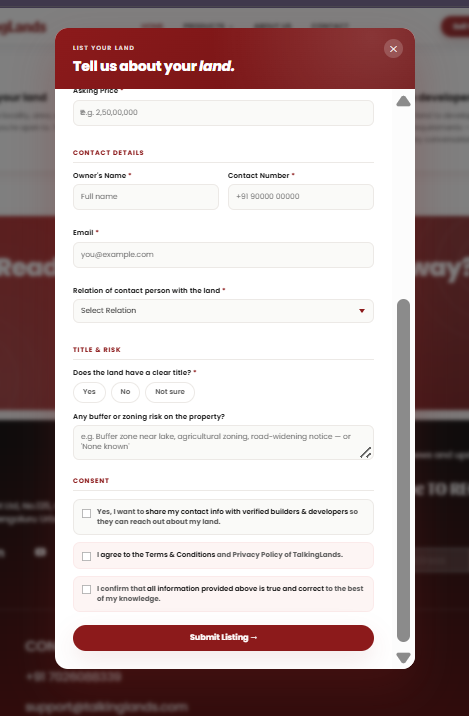
By listing your property on TalkingLands LandSell, you digitize your asset and present it directly to the people who write the cheques. The platform verifies your land’s basic parameters and instantly matches it with the specific procurement requirements of verified developers and enterprises. You list it once, you get matched, and you stay in complete control of every conversation—without paying any middleman cuts.
Free to List · Large Land & JD Only
Skip the Brokers. Get Matched With Verified Developers.
List your land in under two minutes and get matched directly with verified enterprises and developers for joint development or outright purchase — no middlemen, no noise. You stay in control of every conversation.
The most effective way is to bypass traditional local brokers and list your property on a verified land-matching platform. Ensure your title records are perfectly clear, define whether you want an outright sale or a joint development, and let the platform match your parcel directly with the procurement teams of institutional developers.
2. How to sell land to a builder?
To attract a reputable builder, you must present a risk-free asset. This means having an unbroken 30-year chain of title, ensuring your revenue records (like the RTC or 7/12) are fully updated, confirming your land is zoned for development, and ensuring it has a legally recognized, wide access road.
3. What is an exclusive tie-up and why avoid it?
An exclusive tie-up is an agreement where you promise a broker or builder the sole right to buy or develop your land for a set period (e.g., 6 to 12 months). You should avoid this unless backed by a massive, non-refundable deposit, as bad actors will use this to "lock" your land and prevent you from speaking to better buyers while they stall.
4. How do I verify a developer?
Before signing any agreement, check the developer’s track record on the state RERA (Real Estate Regulatory Authority) portal. Look for a history of project delays, financial defaults, or heavy consumer litigation. Ask to visit their completed joint development projects and speak to previous landowners they have partnered with.
5. Should I do JD or sell outright?
This depends entirely on your financial goals. Sell outright if you need immediate, lump-sum liquidity and want a clean exit with zero project execution risk. Opt for a Joint Development Agreement (JDA) if you are willing to wait 3 to 5 years, want to avoid paying massive upfront capital gains taxes, and desire a higher overall return via a share of the finished apartments or sales revenue.
6. Is it free to list my land?
Yes. On specialized platforms like TalkingLands LandSell, owners of large land parcels can list their property and get matched with verified enterprises and developers completely free of charge, with no hidden middleman commissions.
.png)
.png)



-p-2000.png)
.png)

.png)