.png)
Bengaluru–Hosur Metro (2026): The Karnataka–Tamil Nadu Cross-Border Link & Yellow Line to Attibele
A real estate investor rushes to buy a premium 2-acre plot near the Karnataka-Tamil Nadu border. The broker's pitch is irresistible: the new "Bengaluru–Hosur cross-border metro" has been announced, and land values are about to skyrocket as the two states unite their transit grids into one seamless line.
The reality, however, is heavily fractured by state borders and administrative red tape.
Karnataka has explicitly rejected a single, direct interstate metro line. While the Yellow Line extension to Attibele has secured Detailed Project Report (DPR) approval, it is not yet under construction. Meanwhile, Tamil Nadu’s ambitious push for a Hosur-Bommasandra line is an entirely separate proposal. Paying a massive "metro premium" today on the assumption of a seamless, operational interstate network is purely speculation.
Here is the 2026 reality of the Bengaluru–Hosur metro corridor—what Karnataka is actually building, why the direct interstate line was rejected, and how to verify land on this route before trapping your capital.
Quick Answer: The "Bengaluru-Hosur Metro" actually consists of two distinctly separate initiatives. First, Karnataka's BMRCL is planning a southern extension of the operational Yellow Line from Bommasandra to Attibele (~10.5 km, 9 stations). The DPR is approved, and tenders are expected soon. Second, Tamil Nadu proposed a direct Hosur–Bommasandra cross-border metro (~23 km, 12 stations). However, Karnataka rejected a direct interstate operation due to complex taxation, administrative, and technical hurdles. The likely compromise is a "build-to-border" model where both states terminate their respective lines at Attibele and connect via a skywalk or interchange. Both projects are currently at the DPR/proposal stage. Do not pay an active metro premium until construction officially begins.
What's Actually Happening (Two Separate Efforts)
To evaluate property along this high-growth industrial corridor, buyers must separate genuine infrastructure planning from political posturing. There is no single "Bengaluru-Hosur Metro" entity. There are two competing efforts and one rejected proposal:
- Karnataka's Reality: The BMRCL is solely focused on extending its existing grid up to its state border (Attibele). This is a concrete, active plan.
- Tamil Nadu's Push: The TN government strongly proposed a unified link to connect its booming Hosur industrial hub directly into Bengaluru's IT ecosystem.
- The Rejected Interstate Line: A single train running seamlessly from a Karnataka station into a Tamil Nadu station was technically and administratively vetoed by Karnataka.
Bengaluru–Hosur Metro: The Two Efforts
.png)
The Yellow Line → Attibele Extension (The Concrete Part)
For landowners on the Karnataka side of the border, the BMRCL’s Yellow Line extension is the primary growth catalyst.
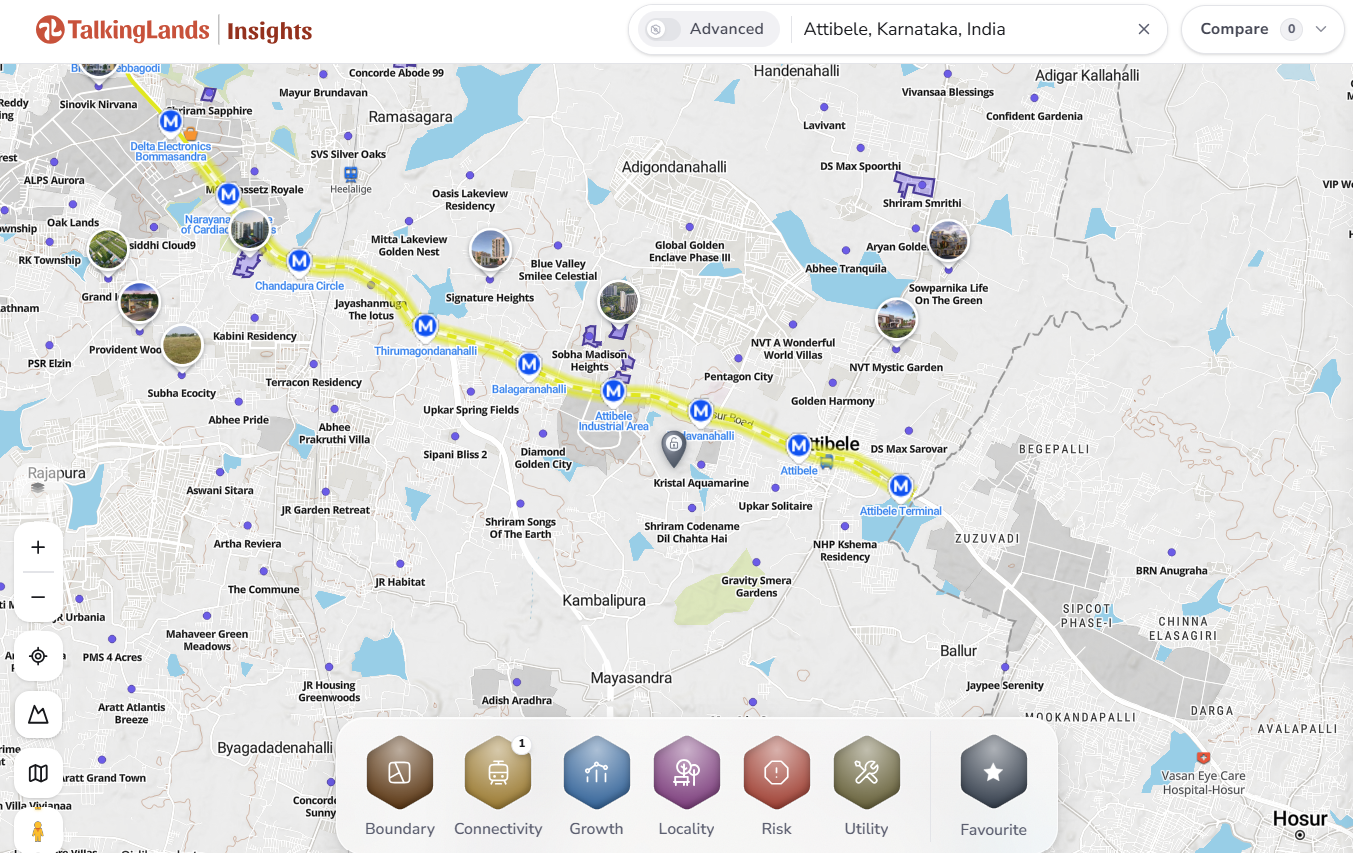
Currently, the Yellow Line terminates at Bommasandra. To service the massive industrial workforce traveling down the Hosur Road corridor, the state government approved a DPR for a ~10.5 km southern extension.
The 9 Proposed Stations:
- Narayana Institute of Cardiac Sciences
- Chandapura Circle
- Hale Chandapura
- Thirumagondanahalli
- Balagaranahalli
- Attibele Industrial Area
- Yadavanahalli
- Attibele
- Attibele Terminal
Note: While the DPR is approved, physical construction has not yet commenced. Ground realities and exact station locations remain subject to final tender alignments.
Tamil Nadu's Hosur Push & Why Karnataka Said No
The Tamil Nadu government aggressively championed a ~23 km unified metro line running from Hosur directly into Bommasandra (with roughly half the track falling in each state's territory).
However, Karnataka authorities definitively rejected the interstate model. Operating a single train across state borders triggers severe logistical roadblocks:
- Taxation & Revenue: How is ticketing revenue split? Which state collects the GST on commercial advertising inside the stations?
- Administrative Jurisdiction: Which state's police force has jurisdiction over crimes committed on a moving interstate train?
- Technical Integration: BMRCL and CMRL (Chennai Metro) operate on different procurement and signaling standards.
The Workaround: The accepted compromise is a "build-to-border" model. BMRCL builds south to Attibele. Tamil Nadu builds north to its side of the border. Commuters will likely disembark at Attibele, cross an approximate 100-meter skywalk or designated interchange, and board the neighboring state's train.
Why the Corridor Matters (Real Estate Dynamics)
Despite the administrative friction, this remains one of the most vital economic arteries in South India.
Hosur has evolved into a mega-hub for Electric Vehicles (EVs) and electronics manufacturing (hosting giants like Tata Electronics, Ola Electric, and Ather). Just a few kilometers north sits Electronic City and Bommasandra, Karnataka's established IT and biotech core.
Every day, a massive cross-border workforce travels along the Hosur Road → Chandapura → Attibele → Hosur axis. A high-capacity transit link will dramatically reduce highway congestion and trigger high-density residential and commercial real estate demand along the immediate highway frontage.
Areas That Could Benefit (If It Proceeds)
If both states execute their respective build-to-border plans, several micro-markets will see exponential structural growth:
- Karnataka Side: Chandapura will transform from a budget residential suburb into a primary transit-oriented hub. Bommasandra will solidify its commercial standing, and Attibele and Anekal will absorb heavy warehousing, logistics, and affordable residential demand.
- Tamil Nadu Side: Hosur will see accelerated industrial land appreciation as its connectivity to Bengaluru's talent pool becomes seamless.
The Speculation Trap: Verify Before You Buy
Because the "Bengaluru-Hosur Metro" dominates real estate headlines, brokers are weaponizing the news to demand exorbitant land premiums. Avoid these traps:
- DPR Does Not Equal Built: A Detailed Project Report is a planning document. Until the government allocates the budget and physical piling work begins, you are buying a promise, not a metro station.
- The Interstate Mirage: If a seller promises that your plot will benefit from a "seamless train from Hosur to Silk Board," they are ignoring Karnataka's explicit rejection of the interstate line. The friction of an interchange at Attibele alters commute dynamics.
- The State Border Factor: A plot sitting 500 meters south of the border is governed by Tamil Nadu land revenue laws; a plot 500 meters north is governed by Karnataka laws. Stamp duties, zoning regulations, and agricultural Green Belt restrictions differ drastically. You cannot apply Karnataka market assumptions to Tamil Nadu land.
How to Verify a Plot
To protect your capital along the Attibele-Bommasandra corridor, execute spatial due diligence:
- Check the CDP Zoning: Ensure the plot is zoned for commercial, industrial, or residential development under the local Master Plan. Find out how to check the zoning of a property before assuming you can build a warehouse or apartment complex.
- Confirm Position vs. Metro Alignment: Measure the plot's true driving distance to the proposed Yellow Line extension stations.
- Verify the State Jurisdiction: Confirm exactly which side of the state border the survey number falls on.
- Title Due Diligence: Unbroken ownership records are mandatory regardless of metro proximity.
Verify Corridor Claims with TalkingLands Insights
You cannot confirm if a plot near Chandapura or Attibele is safely zoned or genuinely near a proposed metro station by relying on a broker's verbal assurances.
With TalkingLands Insights (Bangalore), you can execute a digital verification for plots on the Karnataka side of the border. Drop your Survey Number into the platform to visualize the plot on a live map.
Activate the Connectivity Layer to see the mapped metro alignments and highways relative to your parcel. Toggle the Growth Layer to spot Industrial Corridors, and check the Boundary Layer to view the official Master Plan zoning—so you instantly know if the land is legally buildable before you pay a "metro premium."
-p-2000.png)
Frequently Asked Questions
1. Is the Bengaluru-Hosur metro definitely happening?
The project is progressing as two separate state-led initiatives rather than one unified interstate line. Karnataka has approved the DPR to extend its metro to Attibele. Tamil Nadu is proposing its own line from Hosur to the border. However, physical construction has not yet commenced for either project.
2. Will the Yellow Line extend to Attibele?
Yes, BMRCL plans to extend the currently operational Yellow Line southward from Bommasandra to Attibele. The Karnataka state government has approved the Detailed Project Report (DPR) for this extension.
3. How many stations will the Yellow Line extension have?
The proposed ~10.5 km Karnataka extension from Bommasandra to Attibele will feature 9 stations, including major nodes like Chandapura Circle, Attibele Industrial Area, and the Attibele Terminal at the state border.
4. Did Karnataka reject the interstate metro?
Yes. Karnataka rejected Tamil Nadu’s proposal for a direct, seamless interstate metro train running between Hosur and Bommasandra due to complex administrative, taxation, and operational jurisdiction issues. Both states will likely build to their respective sides of the border and connect via an interchange.
5. Is it safe to buy land near the proposed metro right now?
Buying land based solely on an unbuilt, proposed metro alignment is speculative. It is safe only if the land is priced at current market value without an excessive "metro premium," possesses clear title, and is legally zoned for development under the Master Plan rather than locked in a green belt.
6. When will the Bengaluru-Hosur metro be built?
As of 2026, no official completion date has been set. Both the BMRCL Attibele extension and the Tamil Nadu Hosur proposal remain in the DPR, planning, or pre-tender stages.
.png)

.png)