.png)
Buying a piece of land with a panoramic view of the Arabian Sea or the Bay of Bengal is the ultimate real estate dream. Whether you are an individual buyer looking to build a private retirement villa, or an institutional hospitality fund planning a 50-room luxury beach resort, coastal real estate commands the highest premiums in the country.
But coastal real estate also carries the highest regulatory risk in India.
The ocean is not a static boundary; it is a violent, shifting ecological force. To protect both the fragile marine environment and the people building near it, the government tightly controls exactly where, what, and how you can construct near the sea. If you purchase a beach-facing plot without understanding the coastal regulation zone rules, your entire investment could be legally paralyzed.
Every year, multi-crore luxury villas and massive hospitality projects across Goa, Kerala, and Maharashtra face catastrophic demolition orders. Why? Because the developers relied on local Panchayat approvals and broker promises, completely ignoring the federal coastal regulation zone notifications. In India, environmental zoning supersedes all local municipal building approvals. If your plot sits on the wrong side of the invisible High Tide Line (HTL) buffer, no amount of local political influence can save your structure from the bulldozers.
Before you deploy capital into a beachfront asset, you must master the geographic mathematics of the crz rules in india. Here is the ultimate 2026 guide to understanding the zones, calculating the No Development Zone (NDZ) setbacks, and safely navigating the clearance process.
The Coastal Regulation Zone (CRZ) refers to the coastal stretches of India's 7,500+ km shoreline—along seas, bays, estuaries, creeks, rivers, and backwaters—where the influence of the tide is experienced. The government declares the land area from the High Tide Line (HTL) up to 500 meters on the landward side as a highly regulated environmental zone.
The rules governing this coastal belt have evolved through three major federal notifications: 1991, 2011, and the current framework based on the 2019 amendments, which are actively enforced today in 2026. The core objective of these rules is twofold: to prevent reckless concrete construction from destroying fragile ecosystems (like mangroves and coral reefs) and to protect coastal communities from rising sea levels and cyclonic storm surges.
To achieve this, the government classifies all coastal land into four distinct, heavily monitored zones.
.png)
The strictness of the crz rules in india depends entirely on the ecological sensitivity and the existing population density of the land.
For decades, the golden rule of Indian coastal real estate was simple: you cannot build anything within 200 meters of the High Tide Line (HTL) in rural areas. This 200-meter barrier was known as the absolute No Development Zone (NDZ).
However, the 2019 coastal regulation zone notifications introduced a massive paradigm shift that completely changed the valuation of coastal land. The government realized that treating all rural areas exactly the same was stifling local tourism and housing. They mathematically split CRZ-III (Rural Areas) into two distinct sub-categories based on population density, directly altering the answer to the question: can you build within 200m of high tide line crz?
The answer in 2026 is: Yes, but ONLY if your plot sits in a CRZ-III A zone.
Here is the exact spatial math you must verify before buying:
If the rural coastal village where you are buying land has a population density of more than 2,161 people per square kilometer (as per the 2011 census), it is classified as CRZ-III A.
If the rural coastal village has a population density of less than 2,161 people per square kilometer, it is classified as CRZ-III B.
You cannot simply buy a coastal plot and start pouring concrete. Even if your land sits safely behind the 50-meter or 200-meter NDZ buffer, you must pass through the crz zoning clearance process. Bypassing this process is the primary reason fully constructed luxury resorts are ordered to be demolished by the National Green Tribunal (NGT) or the Supreme Court.
The crz clearance process is multi-tiered and requires intense spatial documentation.
The foundation of your clearance is the official Coastal Zone Management Plan (CZMP) map. These are hyper-detailed spatial maps prepared by authorized agencies (like the National Centre for Sustainable Coastal Management - NCSCM) and approved by the Ministry of Environment, Forest and Climate Change (MoEFCC). You must superimpose your property's exact layout polygon onto the official CZMP map to prove mathematically which CRZ category your land falls into.
Who approves your project depends on your zone:
To apply for clearance, developers must submit a massive digital packet, including:
If your clearance is granted, it is legally valid for a period of seven years to complete the construction.
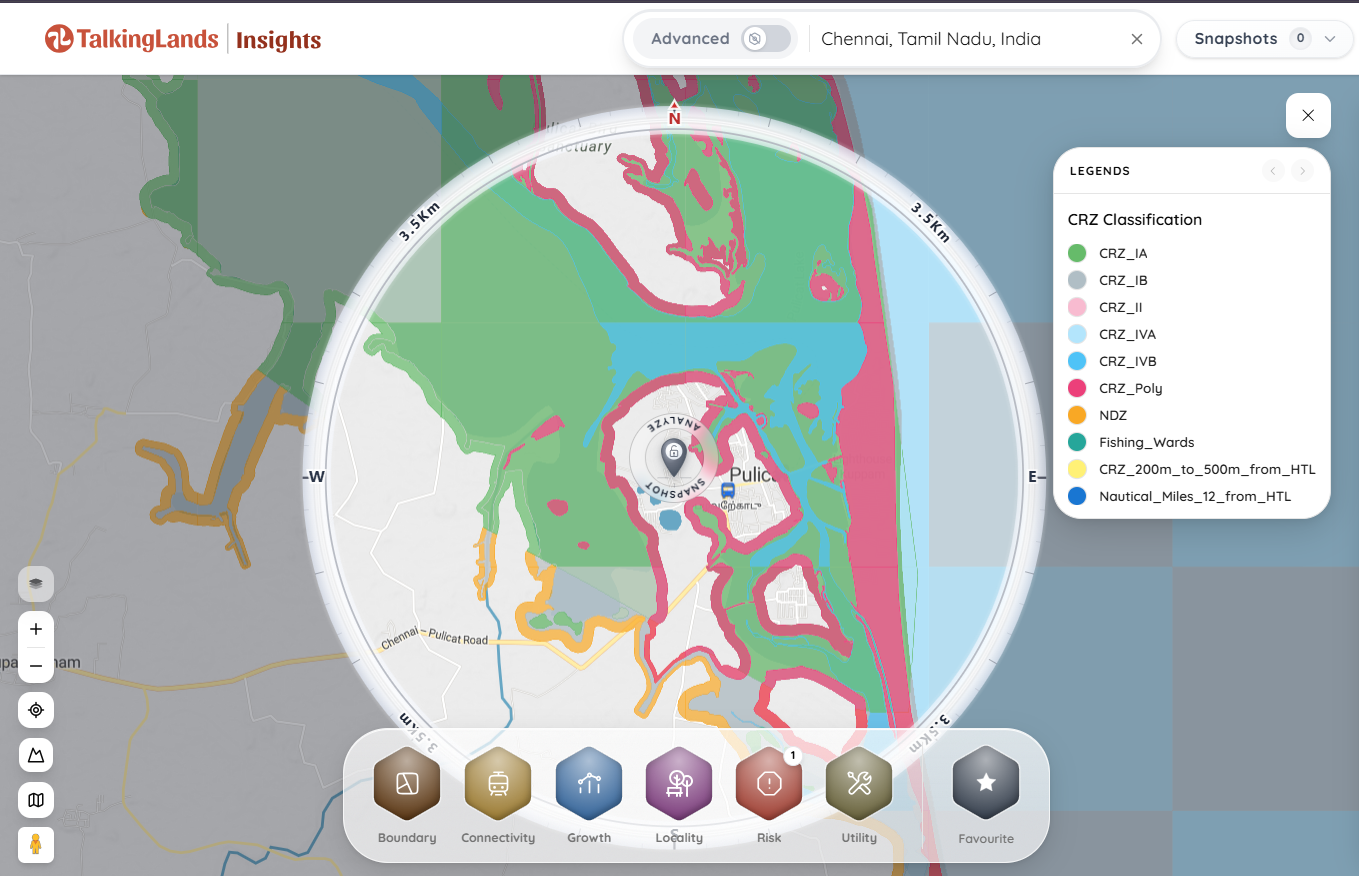
Brokers selling coastal real estate are masters of visual deception. They will take you to a plot during low tide, point to the distant water, and assure you that the property is "hundreds of meters away" from the sea.
But the High Tide Line (HTL) is not defined by where the water is today; it is a permanent, surveyed geographic coordinate defined by the highest reach of the sea during the spring tide.
If you guess the HTL with your eyes, you will lose your capital. Before you purchase a coastal plot, you must verify the spatial reality digitally using TalkingLands Insights.
By dropping the exact survey number of the coastal plot into our spatial analytics engine, you immediately bypass verbal promises. Our platform overlays the official government boundaries, the authorized CZMP master plans, and the strict CRZ buffer lines directly onto a live, high-resolution satellite feed. You can instantly measure the precise geometric distance from your plot's front boundary to the official High Tide Line.
If the digital map reveals your plot falls within the 50-meter CRZ-III A buffer, or the 200-meter CRZ-III B buffer, you instantly know the land is a toxic asset.
Owning real estate by the ocean is a magnificent achievement, but it requires uncompromising, data-driven due diligence. The coastal regulation zone rules are not mere guidelines; they are strict federal laws designed to protect the integrity of the Indian coastline.
Do not rely on outdated local Panchayat approvals or broker guarantees. Understand the difference between CRZ-III A and CRZ-III B, respect the No Development Zones, and always navigate the formal crz clearance process. Before you transfer a single rupee for a sea-facing asset, demand the survey number, run the spatial data, and mathematically prove that your dream home is legally cleared to exist on the map.
1. What is the difference between the High Tide Line (HTL) and Low Tide Line (LTL)?
The High Tide Line (HTL) is the line on the land up to which the highest water line reaches during the spring tide. The Low Tide Line (LTL) is the lowest point the water recedes to during the ebb tide. The space between them is the highly protected intertidal zone (CRZ-I B). All CRZ regulatory setbacks and NDZ buffers are measured inland starting from the HTL.
2. Can I build a house within 200 meters of the sea in India?
Yes, but only under specific conditions. You can build within 200 meters if the land is classified as CRZ-II (developed urban areas) or CRZ-III A (densely populated rural areas where the NDZ is reduced to 50 meters). If the land is in a sparsely populated CRZ-III B area, construction within 200 meters is strictly prohibited.
3. What happens if I build a property violating CRZ rules?
Structures built in violation of CRZ notifications are illegal. State Coastal Zone Management Authorities (SCZMAs) are empowered to issue immediate stop-work orders, deny essential utilities (water and power), and issue demolition notices. The Supreme Court of India and the National Green Tribunal (NGT) routinely order the razing of massive luxury resorts and apartment complexes that violate HTL buffers.
4. How do I get CRZ clearance for a residential plot?
You must submit an application to your local State Coastal Zone Management Authority (SCZMA). The application must include the official Coastal Zone Management Plan (CZMP) map showing your plot's exact coordinates, proving it sits outside the No Development Zone (NDZ). Local town planning authorities cannot issue a building plan sanction until this CRZ clearance is granted.
5. How can I safely check if a plot is inside a No Development Zone before buying?
Do not rely on visual estimates or measuring tapes on the ground. Use an advanced digital spatial platform like TalkingLands Insights. By entering the property's survey number, the tool will overlay the official CRZ master plan buffers directly over a satellite map, instantly showing you if the plot intersects a non-buildable 50m or 200m NDZ limit.



.png)

.png)