.png)
It is a painful rite of passage for many Pune real estate investors. A buyer is pitched a premium plot or commercial asset advertised as "right next to the upcoming Hinjewadi metro station." They gladly pay a massive 30% connectivity premium, expecting property values and rental yields to skyrocket once the trains run.
A year later, the reality sets in. The targeted station opening is pushed back by another construction phase. Worse, when they actually walk the route, they find their plot is a 20-minute hike from the finalized station entrance, blocked by an uncrossable highway service road. Finally, they pull the master plan and realize their "commercial" plot is actually zoned for agricultural use. The metro premium they paid has evaporated entirely.
Alongside the massive Pune Ring Road, the Pune Metro is the single greatest catalyst for real estate wealth creation in the region. In 2026, with the core lines operational and the crucial IT-corridor line nearing its phased launch, the market is hot. But paying a premium without executing spatial due diligence is a recipe for stranded capital.
Here is your complete 2026 guide to the Pune Metro network, the exact stations, the areas set to boom, and how to digitally verify your plot's true distance and zoning before you invest.
Quick Answer: The Pune Metro network currently consists of two operational lines built by Maha Metro: Line 1 (Purple Line) connecting PCMC to Swargate (~16.6 km, 13 stations), and Line 2 (Aqua Line) connecting Vanaz to Ramwadi (~14.7 km, 16 stations). The highly anticipated Line 3 (Hinjewadi to Civil Court/Shivajinagar) is currently under construction, with a phased opening targeted through mid-to-late 2026. Before paying a "metro premium" for any property, you must digitally verify its true walking distance to a finalized station, check its Draft PMRDA DP 2041 zoning, and verify the land's Satbara.
The Pune Metro is transforming a city historically notorious for two-wheeler traffic jams into a transit-oriented metropolis. The network is divided between two different implementing authorities:
(Note: Various extensions—such as Line 1 from PCMC to Nigdi, or Swargate to Katraj—are in active proposal or early preliminary stages. Until track work is physically visible, buyers should treat extensions as speculative).
.png)
While Lines 1 and 2 service the historic civic and residential cores, Line 3 is the economic engine of the Pune Metro.
For decades, the Hinjewadi Rajiv Gandhi Infotech Park has been infamous for severe traffic bottlenecks, forcing IT professionals to endure hours of daily commuting. Line 3 completely rewires this geography. Starting at Megapolis Circle in Hinjewadi Phase 3, the fully elevated line travels through Wakad, Baner, and Balewadi, finally terminating at the Shivajinagar Civil Court interchange.
Opening Timeline (Targets):Mega-infrastructure dates frequently shift. PMRDA / Maha Metro targets indicate a phased launch for Line 3. The first phase (approx. 12 stations covering the Hinjewadi to preliminary city limits stretch) is targeted for ~June/July 2026. The remaining sections connecting to the Civil Court hub are targeted for ~October/December 2026. Crucially, all timelines are strictly subject to final statutory safety certifications (CMRS).
The true value of transit real estate lies in interchanges. The Pune Metro features a master hub that ties the entire city together:
If you are evaluating real estate, the following corridors are experiencing massive capitalization due to metro integration:
This is the highest-appreciating belt. Wakad and Baner were already premium residential markets; the arrival of Line 3 transitions them into highly liquid, high-rental-yield transit hubs. Commercial plots near the upcoming Wakad and Balewadi stations are primed for Grade-A office and retail development.
With the line fully operational, the industrial workers of Pimpri-Chinchwad have direct, frictionless access to the city core. On the southern end, areas surrounding the Swargate underground terminus are seeing aggressive redevelopment as old structures are replaced with high-density commercial assets.
Kothrud and Vanaz in the west have solidified their premium residential status. On the eastern side, Ramwadi serves as the critical jump-off point for the massive IT workforce traveling to Kharadi and Viman Nagar, triggering strong residential demand in the immediate eastern fringe.
Do not pay a 25% to 40% markup on land simply because a broker prints a metro logo on a brochure. Avoid these devastating traps:
To protect your capital, you must combine spatial intelligence with official paper records:
You cannot confirm station distances, highway alignments, or Draft PMRDA zoning by standing on a plot of land and guessing.
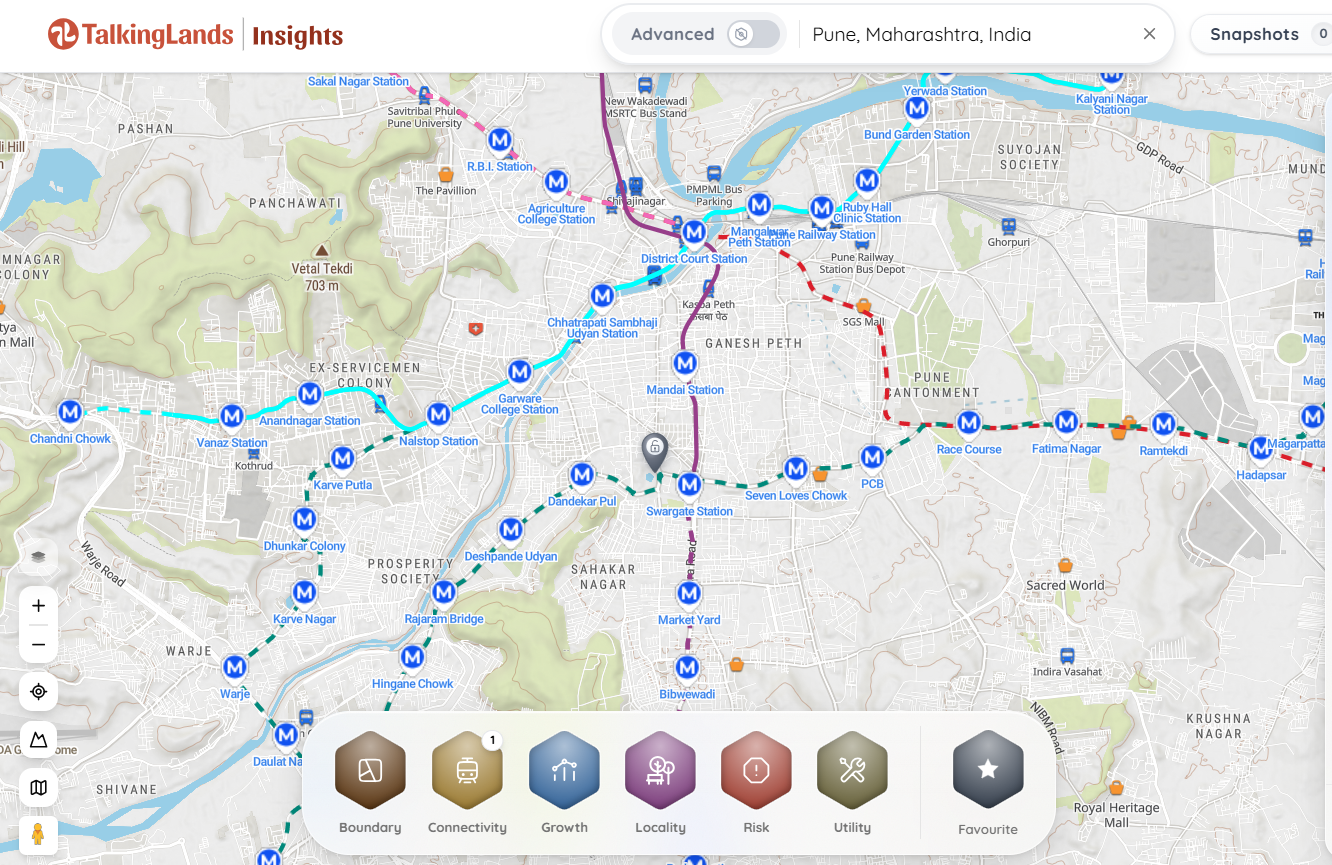
With TalkingLands Insights (Pune), you can execute a flawless digital verification. Drop your Survey/Gat Number onto the platform to visualize the plot on a live satellite map. Activate the Metro & Highways Layer to see the exact alignment and distance to finalized stations. Check the Draft PMRDA DP 2041 Zoning to ensure buildability, and—for covered rural villages—view the Satbara Land Parcel boundary to confirm the exact physical dimensions of the property. For official ownership data, retrieve the verified 7/12 extract via Patra.
Currently, the Pune Metro network consists of three primary lines. Line 1 (Purple Line) and Line 2 (Aqua Line) are fully operational and managed by Maha Metro. Line 3 (the Hinjewadi-Shivajinagar line) is currently under construction under a PPP model.
No, as of mid-2026, Line 3 is strictly under construction. It is undergoing phased testing, with the initial stretch targeted for operational launch around mid-to-late 2026, subject to final statutory safety certifications (CMRS).
The western IT corridor—specifically Hinjewadi, Wakad, Baner, and Balewadi—will see the most transformative impact due to Line 3. Additionally, the industrial nodes of Pimpri-Chinchwad (PCMC) and southern hubs like Swargate are experiencing massive transit-oriented growth due to the operational Purple Line.
Civil Court (in Shivajinagar) serves as the master interchange hub for the entire Pune Metro network. It is the only station where the Purple Line, Aqua Line, and the upcoming Line 3 intersect, allowing commuters to switch routes seamlessly across the city.
Yes, transit-oriented development yields some of the highest residential and commercial appreciation. However, buyers must ensure the property is legally buildable and not situated in a restricted green zone under the Draft PMRDA DP 2041, and that the walking distance to the station is realistically viable.
You can verify the exact spatial relationship using platforms like TalkingLands Insights. By entering the property's Survey/Gat Number, the system overlays the plot's boundary onto a map featuring the finalized metro alignment, allowing you to measure the true physical distance to the station entrance while simultaneously checking the land's zoning.



.png)
.png)