Key takeaways
- A digital twin of a property is a 3D model of a real project on its actual site, linked to live data on every plot or flat.
- It is different from a virtual tour, which photographs a space that exists, and from a render, which is a static picture.
- Twins answer “what is available, where and at what price” well. They do not answer “is the land approved” or “is the title clear”.
- Dimensions in a twin are indicative. The sale agreement and official schedule decide what you actually buy.
- KPMG noted in October 2026 that developers in Hyderabad and Bengaluru use virtual replicas of planned townships to test traffic, wind and heat before building.
- Before you book from a twin, check the land under it: zone, satellite view, risks and records.
- → What a digital twin of a property is
- → Why twins are arriving in Indian real estate now
- → Twin vs virtual tour vs render vs brochure (table)
- → What a property twin shows: plots, floors, townships
- → Ask the twin: what it can and cannot tell you
- → For developers: what a good twin needs
- → How to check the land under a twin on TalkingLands
- → FAQs
Real estate in India has long been sold on brochures, site plans and a visit to a model flat. That is changing. More projects now share a single link that opens the whole site in 3D: every tower, every floor and every plot, placed on satellite imagery of the real land, with what is sold and what is left. The industry calls this a digital twin. This guide explains what one is, how it differs from a virtual tour, what it shows buyers, and what it can never prove.
What a digital twin of a property is
The term comes from engineering, where a digital twin is a virtual model kept in step with a real object. In property it means a 3D model of a project placed on its true location and linked to live data. Tap a plot and you see its number, size, facing and price. Pick a floor in a tower and you see which flats are open and their floor plans.
Three things separate a twin from a pretty 3D picture. It sits on the real site, so roads, neighbours and open land around it are what you would see on the ground. It is interactive, so each plot or unit is a record you can open. And it is live, so availability changes when the developer’s inventory changes.
The figures above come from TalkingLands Reveal product footage of Kumar Apartments, a project near Anekal, and from the disclaimer shown on each unit.
Why twins are arriving in Indian real estate now
Several shifts have come together. KPMG in India wrote in October 2026 that developers in Hyderabad and Bengaluru use virtual replicas of planned townships to simulate traffic movement, wind flow and heat island effects before construction begins, citing IQI. The same note describes buyers doing 360-degree inspections and comparing projects without travelling, and some developers handling much of a purchase remotely.
Global money is pushing the format too. In April 2024, CoStar Group agreed to buy Matterport, the 3D capture company, for about USD 1.6 billion, saying consumers spent over 20 per cent more time on Apartments.com listings that had 3D tours. Matterport had earlier announced a collaboration with Propstack to offer 3D virtual tours of Indian commercial and residential properties.
The idea has also reached city planning. Former Infosys CFO Mohandas Pai has proposed a digital twin of Bengaluru to study five years of traffic data and fix congestion hotspots. For buyers, though, the useful twin is the one of the project they are about to pay for.
Twin vs virtual tour vs render vs brochure
These four get used interchangeably in ads. They are not the same thing.
| Format | What it is | On the real site? | Live availability? | Best for |
|---|---|---|---|---|
| Digital twin | Interactive 3D model of the whole project, unit by unit | Yes, on satellite or 3D base map | Yes, linked to inventory | Choosing a plot or flat, comparing options, sharing with family |
| Virtual tour | 360-degree photos or scans of a space that already exists | Only the inside of the space | No | Ready homes, model flats, resale |
| 3D render or walkthrough | Artist’s images or video of the finished project | Usually not to scale with the surroundings | No | Getting a feel for design and amenities |
| Brochure and site plan | Printed or PDF layout with unit tables | Drawn layout only | No, a snapshot in time | Official reference alongside the agreement |
TalkingLands offers both a twin product, Reveal, and a virtual tour service, because they solve different problems. A ready villa is better shown as a tour. A 200-plot layout is better shown as a twin.
What a property twin shows: plots, floors, townships
Here is what the three common project types look like in a twin, using real product footage.
Plotted layouts. Every plot is drawn on the layout over satellite imagery. In the Hosachiguru Unnati footage, tapping plot 135 opens a card with plot type, area and facing (a 5,400 sq ft west-facing villa plot) and the total price. Parks, roads and amenities sit in their true positions, so you can see what your plot actually backs onto.
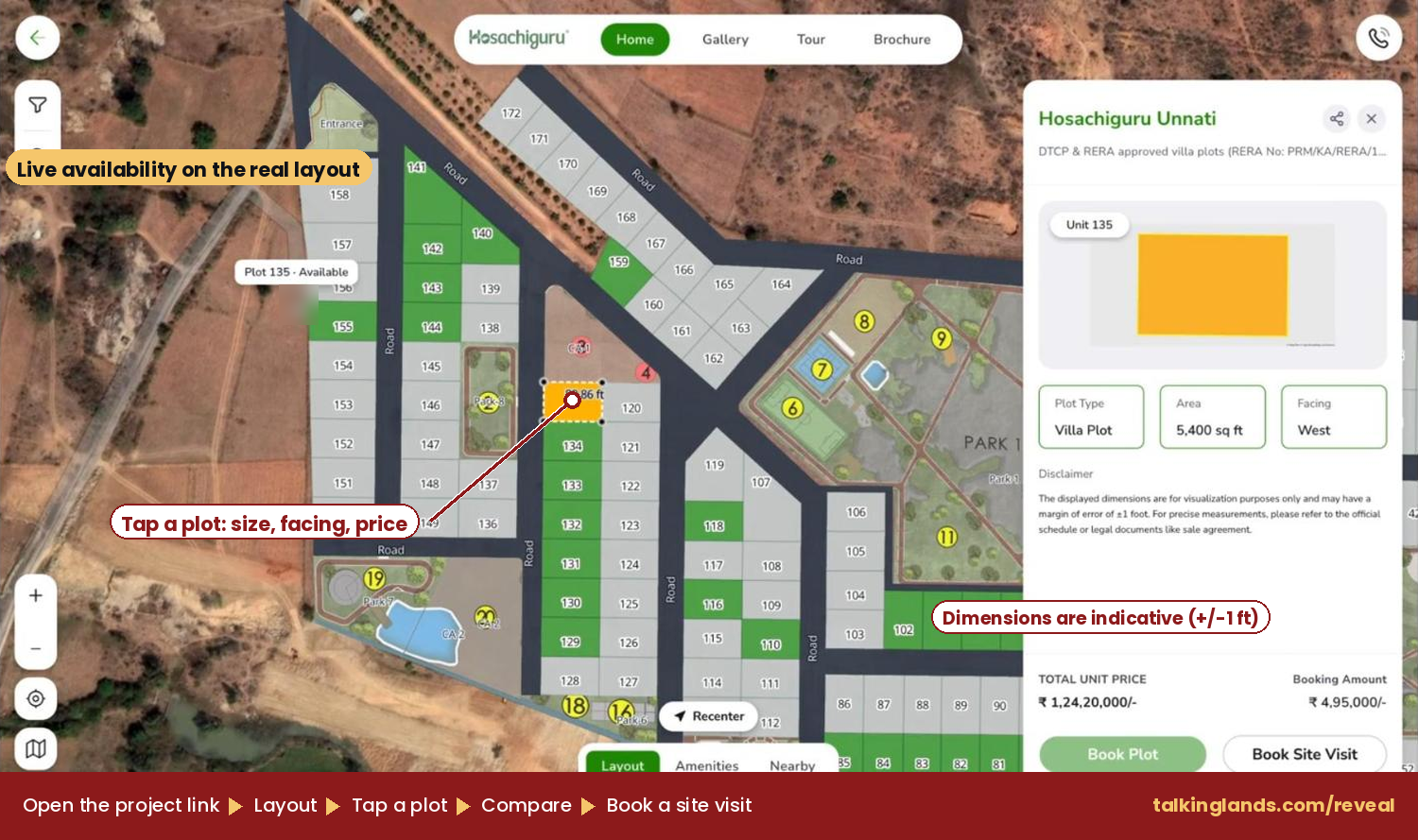
A plotted layout as a digital twin: tap any plot for its size, facing and price. Real product footage, TalkingLands Reveal.
Apartments, floor by floor. Towers are modelled in 3D on the site. Pick a floor and the flats on it light up; open one and you get the floor plan and figures. In the Jade Apartments footage, unit 2-402 shows as a 3 BHK with 1,840 sq ft super built-up and 1,172 sq ft carpet area. That gap between super built-up and carpet is exactly the kind of detail a twin puts in front of a buyer early.
Large townships. A township like Kumar Apartments, 23.64 acres and 1,080 units in the footage, shows towers, amenities and open spaces together, with a count of available units. Nearby tabs list metro stations, schools and main roads with distances.
Ask the twin: what it can and cannot tell you
Tap a question a buyer usually asks. The answer says whether a twin can settle it.
What can a digital twin answer?
The pattern is clear. A twin is excellent at the “which one” question and silent on the “is it safe” question. Zoning, approvals, title and risks such as lake buffers or high-tension lines sit in public records and maps, not in the developer’s 3D model. Our guides to finding the zoning of a property and property legal verification cover those checks.
For developers: what a good twin needs
For a developer, a twin is a sales tool that works when the site office is closed. TalkingLands Reveal pairs the 3D twin with analytics that read how each buyer explores the project, which units they revisit and compare, and ranks who is most likely to convert. A good twin needs four things:
- The true site. The layout must sit on the real boundary, or buyers lose trust the moment they visit.
- Live inventory. A sold plot shown as available costs more goodwill than no twin at all.
- Clear disclaimers. State that dimensions are indicative and that the agreement governs.
- One shareable link. Buyers forward links to family. Brochures, videos and site updates belong on the same link.
Reveal’s page says a project can go live within a day. Developers can book a demo on their own project.
How to check the land under a twin on TalkingLands
A twin shows you the project the developer plans to deliver. TalkingLands Insights shows you the land it sits on, from public records and maps. Use both before you pay a token.
- Search the project location on Insights, using the address, village or survey number from the twin or brochure.
- Switch to Satellite and confirm the boundary matches the twin and what you saw on site.
- Open Boundary and switch on Master Plan. Click the plot to see its zone, such as Residential or Agricultural Land.
- Turn on Risk layers to see lake buffers, drains, power lines and flood areas near the site.
- Click Get Report for a location report, then take everything to your lawyer for title and approvals.
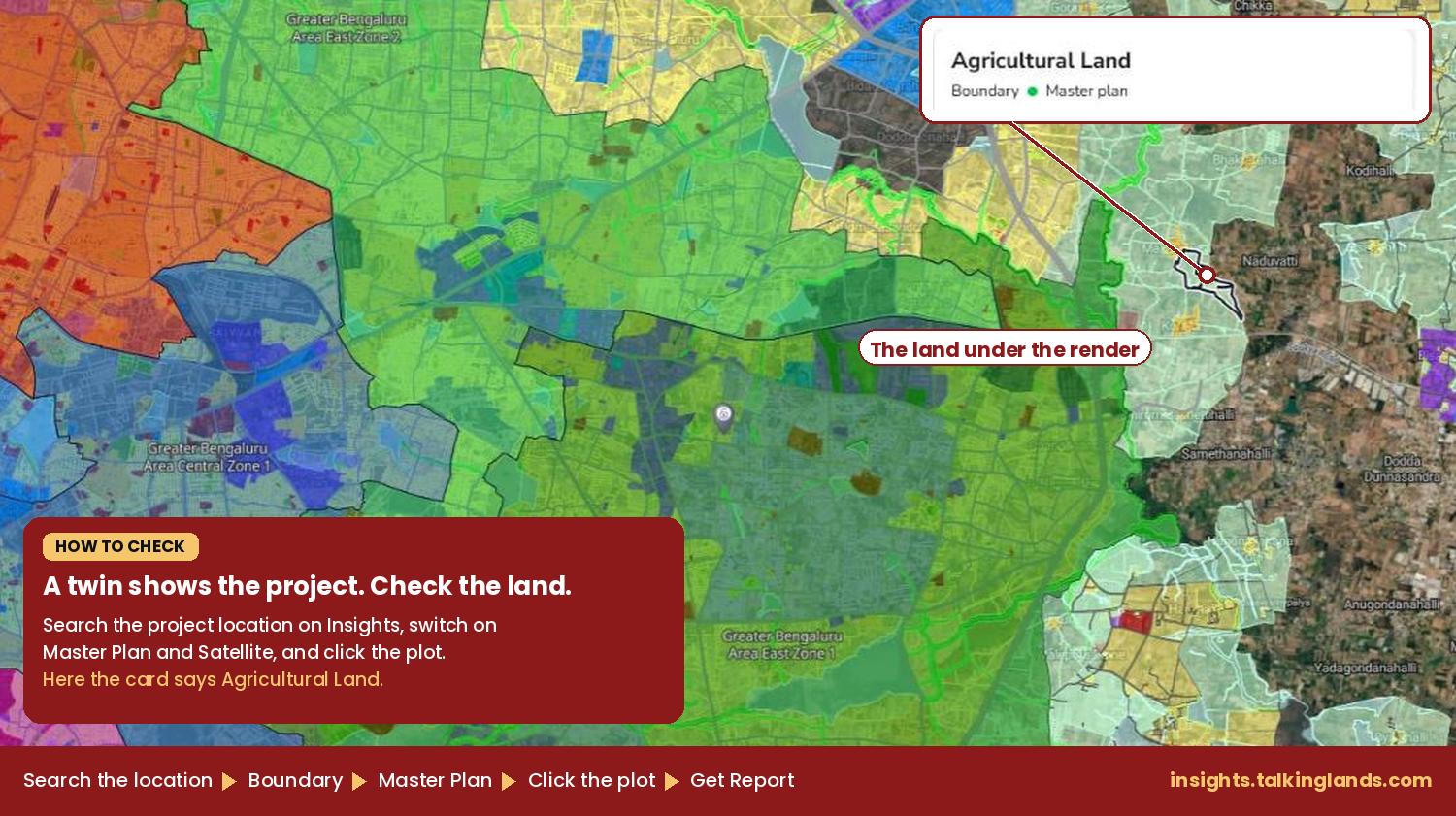
The land check a twin cannot do: here, a plot at the city edge shows as Agricultural Land on the master plan.
What it shows: satellite imagery, survey and village boundaries, master plan zones, risk layers and location reports. What it does not show: the developer’s inventory or prices, whether a specific layout was approved, or whether the title is clear.
Love the twin? Check the land first.
Search any project location on TalkingLands Insights and see its zone, risks and boundaries on one map. Sign up free and get 5,000 coins.
Frequently asked questions
It is a 3D model of a real project placed on its actual site, linked to live data such as which plots or flats are available, their size, facing and price. Buyers can explore it from a phone or laptop before visiting.
No. A virtual tour shows the inside of a space that already exists, usually as 360-degree photos. A digital twin models the whole project on its real location, including plots or units that are not built yet, and updates as inventory changes.
No. A twin shows what the developer has loaded into it. Approvals, zoning, title and court cases have to be checked separately, on records and maps such as TalkingLands Insights, and by a lawyer.
Treat them as indicative. Product footage of TalkingLands Reveal carries a disclaimer that displayed dimensions may have a margin of error of about one foot and that the sale agreement or official schedule should be relied on.
The site boundary, layout and building plans are placed on satellite imagery or a 3D base map, and each plot or unit is linked to an inventory record. With TalkingLands Reveal, the company says a project can go live within a day.
Reported evidence is limited in India. Internationally, CoStar said buyers spent over 20 per cent more time on apartment listings that had 3D tours when it agreed to buy Matterport in 2024. Treat any sales uplift claim as something to measure for your own project.
Disclaimer: This article is general information as of November 2026 and not legal or investment advice. Project figures are taken from TalkingLands Reveal product footage and are shown as examples only. Always rely on the sale agreement, RERA records and a qualified property lawyer before you buy.