.png)
When buyers look for a secure, government-developed real estate investment in the city's booming northern corridor, one name keeps surfacing in North Bengaluru: Dr. Shivarama Karanth Layout.
After years of legal battles, environmental hurdles, and massive land acquisition efforts, the project is finally moving from paper to reality. With the BDA opening applications to the general public in late-July 2026, interest has peaked entirely. Buyers, farmers, and investors are all trying to make sense of this massive layout: where it begins, where it ends, which sector is where, and what each parcel sits on.
Quick Answer: Spanning over 3,300 acres across 16 revenue villages, Dr. Shivarama Karanth Layout is divided into 9 massive sectors. With approximately 30,000+ total plots, public applications officially opened in late July 2026 following Karnataka High Court clearance. Whether you are buying an officially allotted site or purchasing a "farmer share" plot on the secondary market, you must rigorously verify the sector, survey number, and buffer zone status before paying an advance.
Following the latest directives from the Karnataka High Court in 2026, the BDA has rapidly accelerated the layout's development and allotment phases. If you are looking to acquire a site this year, here is the reported ground reality:
(Note: All pricing, plot counts, and timelines are based on reported 2026 government updates and are subject to final BDA gazette notifications. Always verify the current status before transacting).
Dr. Shivarama Karanth Layout sits in the rapidly growing Yelahanka belt of North Bengaluru. Its geography is highly strategic, designed to absorb the city's outward expansion toward the Kempegowda International Airport.
The layout's sprawling footprint is bordered by three major arterial corridors:
The layout spans roughly 3,300 acres, absorbing land from 16 distinct revenue villages. Because of its sheer size, the BDA has segmented the project into 9 manageable administrative sectors. Knowing which sector your prospective plot falls into is critical for understanding its entry points, infrastructure timeline, and proximity to major roads.
(The 16 Master Villages: Avalahalli, Byalakere, Ganigarahalli, Goniagrahara, Harohalli, Jakkasandra Kaval, Kallathammanahalli, Kempanahalli, Kempapura, Lakshmipura, Meesaganahalli, Ramagondanahalli, Shashetti, Shyamarajapura, Venkatala, and Veerasagara).
With 2026 marking the launch of the public allotment wave, the market dynamics around this layout have shifted rapidly.
First, Farmer Shares are entering the resale market. Because the Supreme Court mandated that land-losing farmers be compensated with developed sites first, thousands of these premium plots are now available for purchase on the secondary market. Buyers can acquire these sites without participating in the BDA lottery, but they command a steep premium.
Second, the connectivity is unmatched. The proposed Peripheral Ring Road (PRR) cuts through the vicinity, while expanding Namma Metro lines and the thriving airport corridor have steepened the capital appreciation curve for this entire belt.
A 3,300-acre layout overlapping 16 villages is not a simple due-diligence exercise. The layout has seen decades of litigation regarding land acquisition dropouts, environmental boundaries, and unapproved private layouts mixed within the government footprint. Before committing to a BDA allotted site or a farmer share, you must verify:
You cannot confirm survey number boundaries, environmental buffers, or exact sector lines just by looking at a vacant patch of dirt in Yelahanka.
TalkingLands Insights lets you enter the specific village and survey number to instantly visualize the plot on a live satellite map.
You can overlay the exact cadastral boundary, check it against the BDA Master Plan zoning, and activate the risk layers to ensure your plot isn't sitting inside a restricted lake or drain buffer. On the same screen, you can pull Ownership Intelligence (live RTC/Pahani holdings and court cases) to ensure the farmer share or resale title is absolutely clean before you pay your token advance.
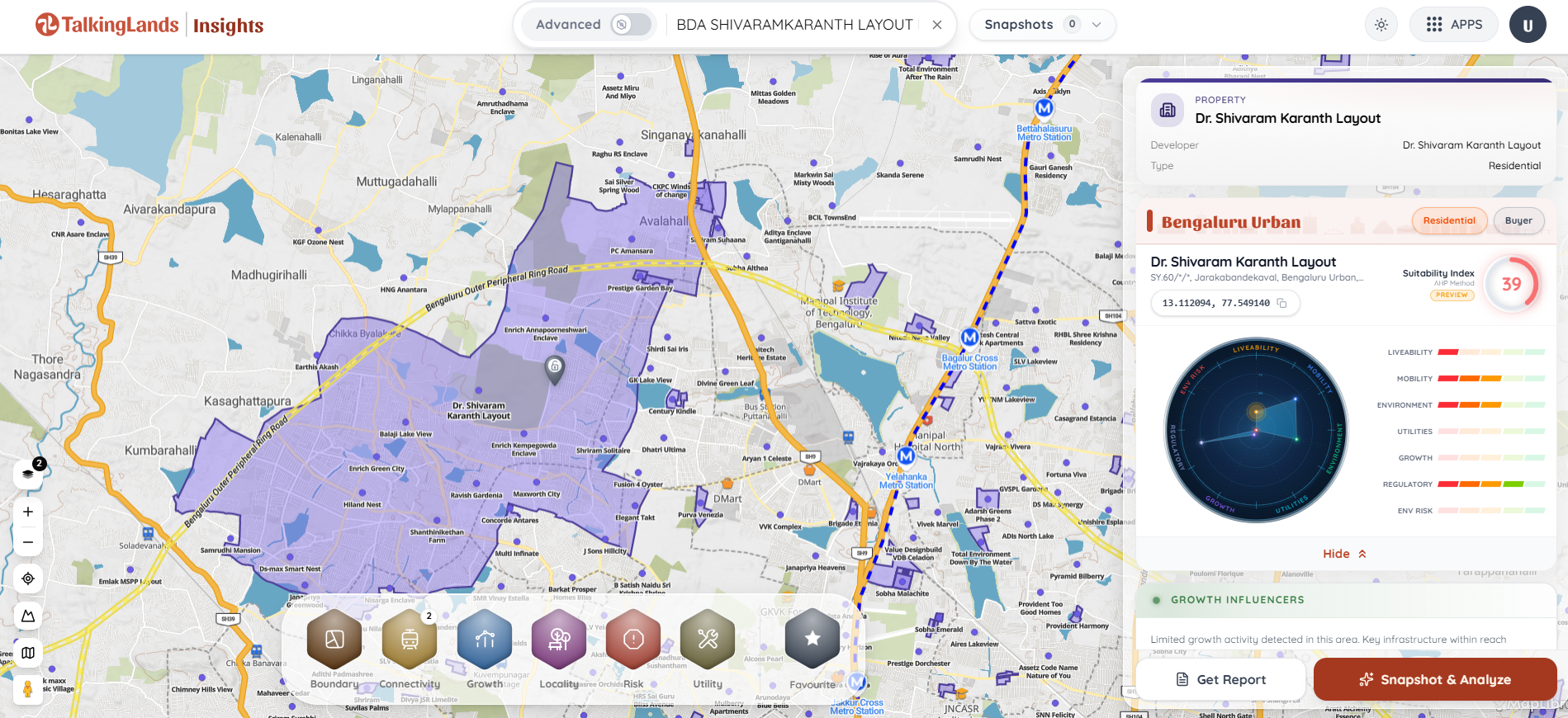
The layout is situated in the Yelahanka belt of North Bengaluru. It is strategically bordered by the Yelahanka–Doddaballapura Main Road, Thanisandra Main Road, and Hesaraghatta Main Road, offering prime access to the airport corridor.
It spans approximately 3,300 acres, making it one of the largest BDA projects in a decade. It encompasses land from 16 different revenue villages and is officially divided into 9 distinct administrative sectors for phased development.
When the BDA acquires private land to build a layout, they compensate the original farmers by returning a percentage of fully developed sites to them. These "farmer shares" are completely legal, secure titles that owners often sell on the secondary market before public BDA allotments are completed.
As of late 2026, the BDA has reportedly fixed the initial allotment price at approximately ₹4,900 per sq. ft. for standard dimension sites, pricing a standard 30x40 site at roughly ₹58.8 Lakh (excluding registration and application fees).
With the High Court permitting applications in mid-2026, the formal allotment process takes several months. Given that civil infrastructure is reported to be ~80% complete, successful allottees who finalize their payments can expect physical possession and registration to commence within late 2026 to early 2027.
Yes, provided you do strict due diligence. A legitimate farmer share plot comes with a BDA-endorsed allotment letter and clean mutation records. However, buyers must rigorously verify the survey number to ensure it hasn't been double-allotted and that it sits outside any ecological buffer zones.
Do not rely purely on paper documents. You must cross-reference the plot's exact survey number and sector alignment using spatial mapping tools like TalkingLands Insights to verify its boundaries against the BDA Master Plan and confirm live ownership data.



.png)
%20(1).png)
.png)