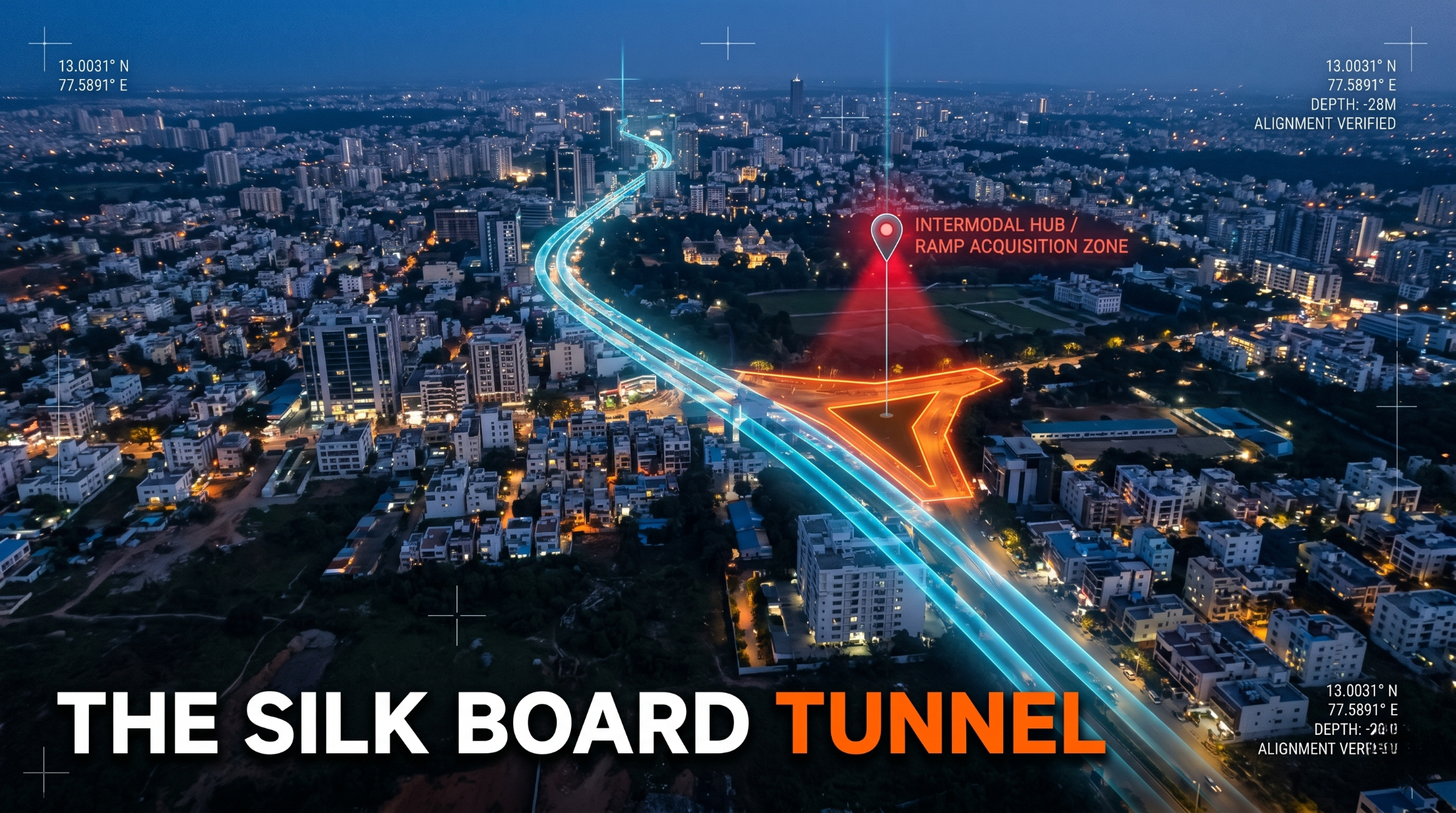
The Infrastructure Play of the Decade
If you opened the Economic Times yesterday, you already know the stakes. The 16.75-kilometer Hebbal-Silk Board twin-tube tunnel is no longer just a political talking point—it is a live, highly volatile commercial reality sitting right on the Chief Minister's desk.
Designed to shrink the agonizing 90-minute commute down a 35-minute breeze at 40-60 km/h, the project is officially moving. B-SMILE (Bengaluru Smart Infrastructure Ltd) floated the tenders, and the Adani Group has emerged as the lowest bidder (L1) at a staggering ₹22,267 Crore.
This bid is roughly ₹4,600 Crore above the government’s initial ₹17,698 Crore estimate. Because of this massive cost escalation, the project is currently locked in an intense cabinet-level battle. But institutional investors aren't waiting for the political dust to settle. They know that infrastructure of this magnitude fundamentally rewrites the commercial zoning rules of a city.
A 16.75km tunnel underground does not directly impact surface real estate. The wealth is entirely concentrated at the surface-level entry and exit ramps. If you are looking to deploy capital in central Bangalore over the next 36 months, this is your blueprint.
The 5 Golden Exits: Where to Deploy Capital
The tunnel operates on a modified BOOT (Build-Own-Operate-Transfer) model. The government provides 40% Viability Gap Funding (VGF), and the private concessionaire funds the remaining 60%. To make this profitable, the tunnel will feature five primary intermodal hubs and surface junctions.
These five hubs are the epicenter of the upcoming real estate boom:
1. Hebbal (Esteem Mall)The Northern gateway. Hebbal is already a massive choke point, but it acts as the undeniable throat of the Airport corridor. With the short tunnel/flyover to Mehkri Circle already gaining administrative traction, commercial real estate demand at the Esteem Mall junction will surge as it becomes the primary toll plaza for elite southbound commuters.
2. Palace Grounds (Mekhri Circle)The central distribution node. Properties located around the Sadashivanagar and Jayamahal fringes will see premium residential values skyrocket. Commuters living here will have the luxury of dropping directly into the tunnel to bypass the entire CBD.
3. Race Course / Seshadri RoadThe CBD access point. This exit splits the tunnel into two distinct tender packages. Commercial office space around Seshadri Road and the surrounding Majestic/Gandhinagar zones will experience a massive revival, as logistics and transit times for executives shrink to zero.
4. LalbaghThe controversial Southern anchor. The alignment famously passes beneath the 3,000-million-year-old Lalbagh rock. Real estate surrounding the botanical gardens, specifically toward Jayanagar and Basavanagudi, will command aggressive premiums as heritage areas are suddenly linked directly to the North.
5. Central Silk Board (KSRP Quarters)The Southern gateway. Silk Board is the most notorious traffic junction in India. By dropping a massive tunnel exit here, the government is funneling high-speed traffic directly into the HSR Layout and Electronic City corridors.
The Toll Trap & Premium Commuter Economics
You must underwrite your investments based on who will actually use this road.
The Detailed Project Report (DPR) estimates the toll for using the tunnel road could be as high as ₹19.42 per km. That translates to roughly ₹325 for a single one-way trip from Hebbal to Silk Board.
This is not a mass-transit solution. Two-wheelers and auto-rickshaws will likely be barred. This is a highly exclusive, premium transit corridor designed for the upper-middle class, corporate executives, and private cabs. If you are developing residential assets near the entry/exit hubs, your product must target high-income demographics (HNIs). Do not build budget apartments near a luxury toll road.
The "Double Infrastructure" Anomaly (Phase 3A)
Here is the anomaly that makes this specific alignment so lucrative: The tunnel mimics the exact same alignment as the proposed Namma Metro Phase 3A (Red Line) running from Sarjapur to Hebbal.
Mobility experts argue that building a metro and a toll tunnel on the exact same route cannibalizes traffic. For the real estate investor, it is a goldmine. Areas near Silk Board, Lalbagh, and Hebbal will possess "double infrastructure." They will have premium high-speed road access for the wealthy, and high-volume mass transit for the workforce. Finding commercial plots situated between a tunnel ramp and a Phase 3A metro station is the holy grail of 2026 land-banking.

.png)

.png)