.png)
e-Khata in Karnataka: How to Get, Download & Check It Online (2026 Guide)
The Document That Froze Bengaluru's Registrations
You have finalized the buyer for your apartment in Whitefield or your site in Yelahanka. The bank has cleared the buyer's home loan, the token advance is sitting in your account, and your slot at the Sub-Registrar's office is booked. You arrive with a folder full of physical sale deeds, tax receipts, and your classic paper Khata certificate.
Then, the Sub-Registrar glances at the computer screen and delivers a devastating blow: the transaction cannot be processed. Your physical records are legally invalid for title registration. Without a government-authenticated, digitally signed e-Khata generated from the centralized portal, the software physically locks the Sub-Registrar out from creating a new sale deed. Your deal is instantly frozen.
This scenario has played out for thousands of property owners across Bengaluru. Following the comprehensive rollout of the e-Aasthi and centralized municipal property tax systems, the government made digital e-Khatas strictly mandatory for all real estate registrations.
What was meant to eliminate manual corruption initially triggered massive processing delays and a severe registration slowdown across the city. Suddenly, getting an e-Khata transformed from a backend administrative step into an urgent, high-anxiety bottleneck.
Whether you are trying to sell a property, secure a mortgage, or update your ancestral land holdings, this is the definitive 2026 guide to understanding the e-Khata framework in Karnataka: how it differs from traditional classifications, the exact documents you need, a step-by-step application guide, and how to instantly verify your property's municipal records.
Quick Answer: An e-Khata is a digitally generated, electronic property account certificate issued via Karnataka's centralized municipal portals (like the e-Aasthi platform for BBMP). It is now legally mandatory for registering any property sale deed in Bengaluru. To get it, you must locate your property via its unique PID or Ward number, upload your structural deeds, encumbrance certificates, and identity proofs, and generate a verified digital copy. For a frictionless check, you can look up your property's real-time e-Khata status and request documents directly through TalkingLands Insights.
What is an e-Khata?
A Khata is essentially a property identification ledger maintained by the local municipal corporation (like the Bruhat Bengaluru Mahanagara Palike - BBMP). It identifies who is legally responsible for paying property taxes for a specific asset and maps the property's size, location, and built-up area.
Historically, a Khata consisted of two physical paper documents: the Khata Certificate (confirming the property exists in the ledger) and the Khata Extract (detailing the property's dimensions and usage assessment).
An e-Khata is the modern electronic replacement for these physical papers. It is generated through automated, centralized software systems like e-Aasthi (for core city limits) or integrated urban portals across Karnataka. It features a unique QR code, a digital government signature, and standardizes your property data across the entire state framework, completely eliminating manual ledger alterations at local ward offices.
The Core Confusion: e-Khata vs. A-Khata vs. B-Khata
A massive source of search traffic and panic stems from buyers confusing the format of the document with the legal classification of the property.
- A-Khata and B-Khata are Classifications: An A-Khata property is fully legal, possesses all plan sanctions, and complies with zoning laws. A B-Khata property has structural deviations, lacks occupancy certificates, or is built on unauthorized revenue land, meaning it is placed in a secondary register purely for tax collection.
- e-Khata is a Format: An e-Khata is simply the digital version of a property ledger entry. An A-Khata property receives an A-e-Khata, and a B-Khata property receives a B-e-Khata.
To clear up the confusion once and for all, use this structural cheat-sheet before initiating an application:
A-Khata vs. B-Khata vs. e-Khata
(To read the deep legal history of these designations and calculate potential financial regularisation liabilities, read our comprehensive guide on A-Khata vs B-Khata in Bengaluru and access the Akrama-Sakrama Fee Calculator).
.png)
Documents Needed to Secure an e-Khata
Before logging onto the municipal portal, ensure your data files are scanned and compiled perfectly. Missing paperwork or low-resolution uploads are the number one cause of long processing rejections.
You must assemble:
- Primary Title Deed: Your registered absolute Sale Deed, Partition Deed, or Gift Deed.
- Encumbrance Certificate (EC): A fresh EC tracing transactions from April 1, 2004, to the current date. (Learn how this syncs with modern sub-registrar tools via our Kaveri 2.0 Registration Guide).
- Property Tax Receipts: Your latest property tax paid receipts along with your historic 10-digit Property Identifier (PID) number.
- Identity Verification: The owner's Aadhaar card and structural passport-sized photographs.
- Physical Proof: A high-resolution geotagged photograph showing the actual structure or vacant plot from the street level.
How to Get & Download an e-Khata Online (Step-by-Step)
The digital application process operates through a multi-stage approval workflow designed to catch errors transparently:
Step 1: Property Identification
Navigate to the official e-Aasthi or state municipal portal (bbmpeasi.karnataka.gov.in or the designated urban local body link). Use the "Search Property" module by selecting your specific Ward number and inputting your 10-digit PID number.
Step 2: Reviewing the Draft e-Khata
If your property details match the historical digitized database, the portal will generate a Draft e-Khata. This draft is a preliminary document displaying the owner's name, land extent, and structural boundaries. Read this copy forensically.
Step 3: The Correction & Upload Window
If you find typographical spelling errors or size mismatches, this is the stage to select "Apply for Corrections." Upload your scanned supporting structural documents (Deeds, EC, Aadhaar) to route the file to the local Ward Officer for verification.
Step 4: The Public Notice Period
Once the Ward Officer passes the digital application, the system publishes the draft e-Khata for a mandatory public notice window (typically 7 to 15 days) to allow any family members or financial objectors to flag title disputes.
Step 5: Final e-Khata Download
If zero objections are received, the system locks the file and issues the Final e-Khata. You will receive an SMS link to download the clean, QR-coded PDF document. You can print this out directly for your upcoming Sub-Registrar registration slot.
(Note: If you are an heir processing ancestral property, you must combine this step with a formal Khata Transfer application to clear the chain of title).
Common Problems & How to Fix Them
Navigating the portal is rarely flawless. Watch out for these common issues:
- Property Not Found in Records: This is incredibly common for older layouts or properties where taxes were paid manually at banks via physical challans. If your PID pulls a blank screen, you must log a request with your ward application counter to manually map your historic receipts to the digital master grid.
- Name & Extent Mismatches: If the portal spells your name as "Ramkrishna" but your Sale Deed reads "Ramakrishna," the system will block your registration. You must upload your primary deed to the corrections module to overwrite the municipal typo.
- The Partition Plot Gap: When a massive parent survey number is split into smaller sites among heirs, the new sub-divided PIDs often take months to reflect online. Ensure your structural subdivision drawings (Pre-Mutation sketch) are uploaded explicitly to trigger the generation of fresh individual e-Khatas.
The Faster Way: TalkingLands Insights
Navigating government servers during peak property sale seasons is highly frustrating due to frequent server crashes and slow page loads. Furthermore, checking a municipal portal tells you nothing about whether the property is physically safe to build on.
TalkingLands Insights provides a streamlined, spatial-first alternative.
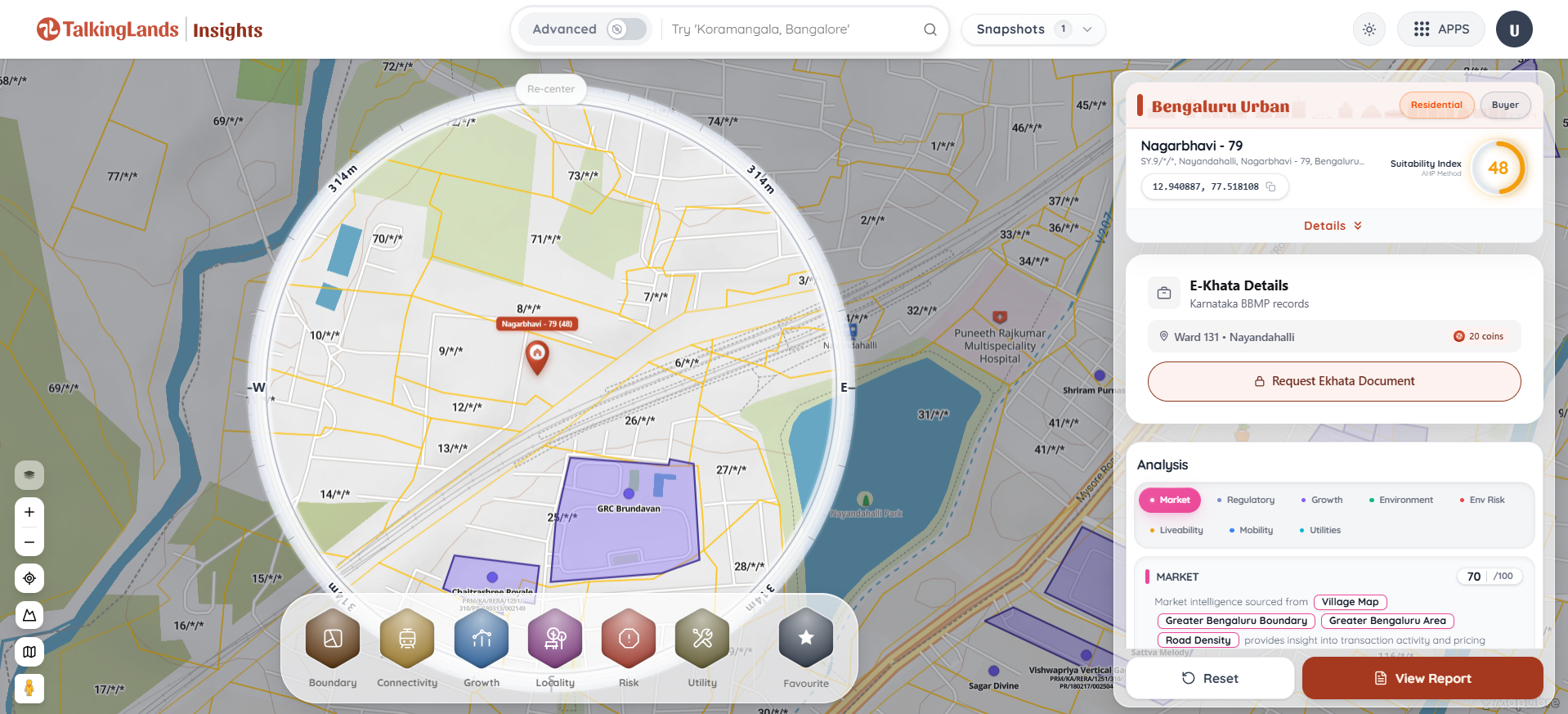
Through our specialized platform interface, you can instantly look up E-Khata Details mapped to specific wards across Karnataka's centralized municipal grids using your property identifiers.
Instead of jumping between multiple unlinked portals, TalkingLands aggregates your due diligence into a single screen:
- Municipal Tracking: Instantly check your e-Khata metadata status, ward numbers, and property tax records.
- Document Requests: File a direct request to retrieve authenticated document extracts seamlessly.
- Comprehensive Integration: On the exact same interface, cross-reference your municipal e-Khata with its official Survey Number boundary, trace its live agricultural RTC ownership holdings, check for active civil court cases, and map invisible environmental risks like lake and forest buffers.
You go from basic municipal records to a total asset safety assessment in a fraction of the time.

Frequently Asked Questions
1. Is an e-Khata mandatory for property registration in Bengaluru?
Yes. The Karnataka government has made a final digitally signed e-Khata absolute and mandatory for registering any real estate sale deeds or title transfers within municipal boundaries. The Sub-Registrar's online software will physically block the transaction if a valid e-Khata is not synced.
2. Can I get an e-Khata for a B-Khata property?
Yes, you can obtain a B-e-Khata. An e-Khata is simply the digital format of your property record, so both A-Khata and B-Khata properties must be migrated to the e-Khata system. In fact, under the ongoing 2026 "Bhu Guarantee" regularisation drive, qualifying B-Khata properties must first be converted into an e-Khata before they can be officially upgraded to an A-Khata at the slashed 2% fee.
3. How long does it take to secure a final e-Khata online?
If your underlying property records are perfectly digitized and contain zero name or measurement errors, a draft e-Khata can be generated quickly. However, due to the mandatory 7 to 15-day public objection notice window and manual verification of corrections by local ward officers, the entire pipeline typically takes 2 to 4 weeks.
4. What is the difference between an e-Khata and a traditional Khata Certificate?
A traditional Khata Certificate is a physical piece of paper issued manually by a local municipal ward accountant, which is vulnerable to printing errors or unauthorized modifications. An e-Khata is an electronically authenticated document pulled from a secure centralized cloud database, complete with a verified QR code and digital signature.
5. Can I complete a property registration if my e-Khata displays a minor name error?
No. The centralized property registration platform runs strict data matching algorithms. If there is even a minor single-character spelling mismatch between the name on your identity proofs, your sale deed, and the municipal e-Khata entry, the software will trigger an error. You must execute a correction request before booking your registration slot.
6. Can I use Google Maps to find my property's e-Khata or PID details?
No. Google Maps tracks geographical road data, local directions, and satellite imaging context. It possesses zero integration with Karnataka's municipal property tax databases or local urban local body land ledgers. You must use specialized proptech platforms like TalkingLands or official e-Aasthi government portals.
.png)

.png)