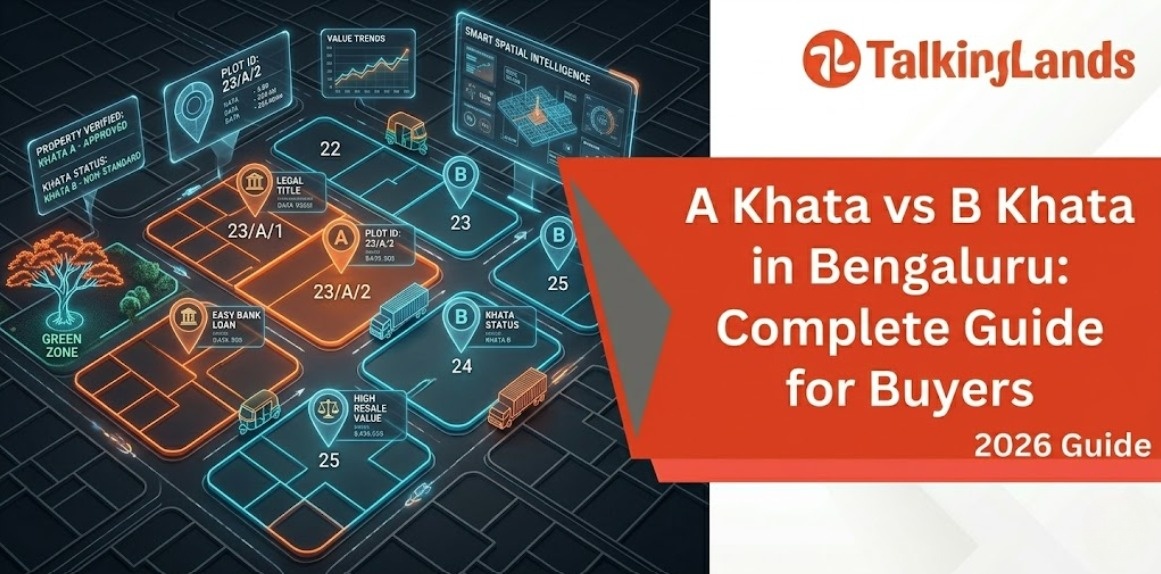
If you're buying property in Bengaluru—a flat, an independent house, or even a plot—there's a phrase you'll hear over and over: "Is it A Khata or B Khata?".
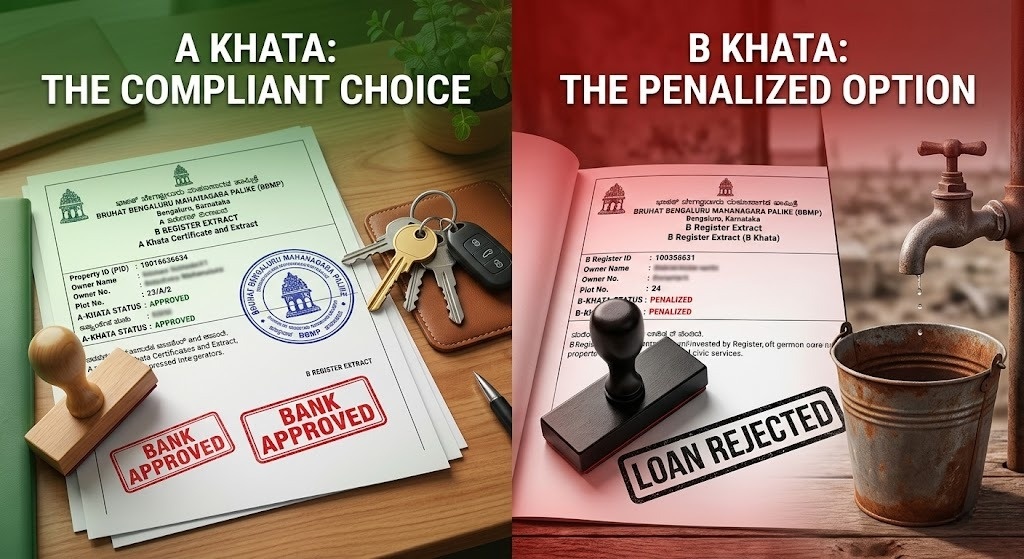
Most first-time buyers nod along, sign the papers, and only realise the difference later—when their home loan gets rejected, when a Cauvery water connection is denied, or when they try to resell and the offers come in 15–20% lower than expected. This guide breaks it down properly, in plain language, so you can make a confident decision before you part with any money. To truly safeguard your investment, generating detailed property reports bangalore is highly recommended to uncover the actual legal standing of your land.
First, What is the Khata?
The Khata (literally "account") is a revenue document maintained by the BBMP—Bruhat Bengaluru Mahanagara Palike, Bengaluru's civic body. It identifies the property owner for the purpose of paying property tax.
The Khata is not a title document and does not prove ownership. What it does prove is that the property is recognised by BBMP, taxes are being paid, and the property is legally fit to be transacted, mortgaged, and built upon. That single distinction—recognised by BBMP, or not—is where the two categories of Khata, called A Khata and B Khata, go their separate ways.
Frequently Asked Questions (FAQ)
1. Can a B Khata property be converted to an A Khata?
Yes, in many cases, a B Khata property can be converted to an A Khata under the Akrama-Sakrama scheme or by paying the pending betterment charges, property taxes, and regularisation penalties to the BBMP. However, this is subject to government approvals and the extent of the building's deviations from the sanctioned plan.
2. What is the difference between a Khata Certificate and a Khata Extract?
A Khata Certificate is required for registering a new property or transferring ownership. A Khata Extract is a detailed document that specifies property details like size, location, built-up area, and property tax assessment, primarily used to obtain trade licenses or loans.
3. Is it safe to buy a B Khata property with cash?
While you won't face the hurdle of bank loan rejections if you buy with cash, you still absorb all the long-term risks: lower resale value, potential denial of civic amenities like Cauvery water, and the looming threat of municipal action if the building has severe code violations.
4. Why is the Occupancy Certificate (OC) so important?
An Occupancy Certificate is a document issued by the civic authority (like BBMP) certifying that a building has been constructed according to the approved plans and is safe for habitation. Without an OC, the building is technically unauthorized, making it difficult to secure A Khata, loans, or permanent water and electricity connections.
5. Do I still need a lawyer if I have all the BBMP documents?
Absolutely. BBMP revenue documents only confirm tax status and municipal recognition; they do not prove legal ownership. A qualified property lawyer is required to perform a 30-year title search to ensure the seller has the legal right to sell the land and that there are no hidden encumbrances or family disputes tied to the property.
.png)

.png)