.png)
The Biggest Lie in Bangalore Real Estate
Let's get one thing straight before we go any further. If you walk into a broker's office in Bangalore and they slide a piece of paper across the desk saying, "Look, the Khata is in my seller's name, the title is perfectly clear," you need to get up and walk out.
That broker is either incompetent, or they are actively trying to scam you.
Every single day in this city, novice buyers lose crores of rupees because they fundamentally misunderstand what a khata bangalore actually is. They confuse the right to pay tax with the right of ownership.
I have seen families destroyed financially because they bought a premium plot based purely on a Khata certificate, only to realize the actual, legal title deed belonged to someone else entirely.
If you want to survive the Bangalore real estate market, you have to strip away the marketing fluff and understand the hard, brutal mechanics of property law. This guide will break down the exact difference between Title and Khata, why the Karnataka government forces you to have one, and how to execute a bulletproof khata transfer bangalore without getting taken for a ride.
The Illusion of Ownership: Title vs. Khata
To understand how property works in India, you have to understand the clash between Central and State governments.
Property ownership is governed by Central laws. When you buy a piece of land, inherit it, or receive it as a gift, that transfer of ownership is governed by the Transfer of Property Act and the Registration Act. When you register a Sale Deed at the sub-registrar's office, you get the "Title." The Title makes you the absolute owner.
But the Central government does not collect property taxes. That is the State government's job.
The State government (and its local bodies like the BBMP) needs a way to track who owes them money every year. They do not have the time or resources to constantly dig through complex, 40-year-old title deeds to figure out who owns what. So, they created a separate accounting system. They created the Khata.
"Khata" literally translates to "Account." It is nothing more than a tax ledger.
The "Different Name" Trap
Here is a scenario that plays out in Bangalore daily. A grandfather passes away, leaving a massive plot of land to his five sons. Legally, under the title, all five sons own an equal 20% share.
However, the local municipal ward office doesn't want to chase five different men for ₹5,000 in property tax. So, the brothers agree to put the Khata solely in the name of the eldest brother. The eldest brother is now the "Khata Holder."
Years later, the eldest brother gets greedy. He approaches a novice buyer. He shows them the Khata with only his name on it. He shows them the recent tax receipts he paid. The novice buyer thinks, "Great, his name is on the government tax record, he must be the sole owner." The buyer pays him directly.
The next day, the other four brothers file an injunction, freezing the land. The buyer loses everything. Why? Because the Khata did not grant the eldest brother the right to sell the property. It only granted him the right to pay the tax.
If It's Not A Title, Why Is It Mandatory?
You might be asking: If a Khata doesn't prove ownership, why does everyone in Bangalore obsess over it? Why is it practically impossible to buy or sell land without one?
Because the State of Karnataka made a highly specific, tactical legal move.
In Karnataka, any property transaction valued over ₹100 is legally required to be registered. To prevent mass fraud, unauthorized layouts, and tax evasion, the state government mandated that the Sub-Registrar cannot register a sale deed unless the seller produces a valid Khata.
It is a forced checkpoint. The government is essentially saying: "We will not let you use the Central legal system to transfer ownership unless you prove you are in our State tax system first."
This is why property verification bangalore always requires two parallel checks. You must trace the flow of the Title at the Sub-Registrar level (using Encumbrance Certificates), AND you must verify the flow of the Khata at the municipal level.

The Khata Transfer Playbook (A Case Study)
Let’s look at how this actually works in the real world.
Imagine a woman named Kamala. She owns a premium house in Jayanagar. She holds the absolute Title (she bought it via a registered sale deed twenty years ago), and she holds the Khata in her name.
Kamala decides she wants to give this house to her son, Raghav.
Step 1: The Title TransferKamala and Raghav go to the Sub-Registrar's office. They execute and register a "Gift Deed." At the exact moment that Gift Deed is signed and registered, the absolute ownership (the Title) transfers from Kamala to Raghav. Raghav is now the legal owner of the house.
Step 2: The Bureaucratic DisconnectBut wait. The Sub-Registrar's computer system does not automatically talk to the BBMP tax collector's computer system. So, while Raghav is the legal owner of the house, the BBMP still thinks Kamala owes them property tax. The Khata is still in Kamala's name.
Step 3: Executing the Khata TransferIf Raghav wants to eventually sell this house, or even just get the BESCOM electricity meter changed to his name, he has to manually update the municipal records. He has to initiate a khata transfer bangalore.
Raghav takes the registered Gift Deed, the latest Encumbrance Certificate (EC) proving the transfer, and his mother's old property tax receipts. He submits this entire file to his local BBMP ward office (or does it online via the E-Aasthi portal). The Revenue Officer verifies the legal Title transfer and manually updates the tax ledger.
Only then is a new Khata certificate issued in Raghav's name.
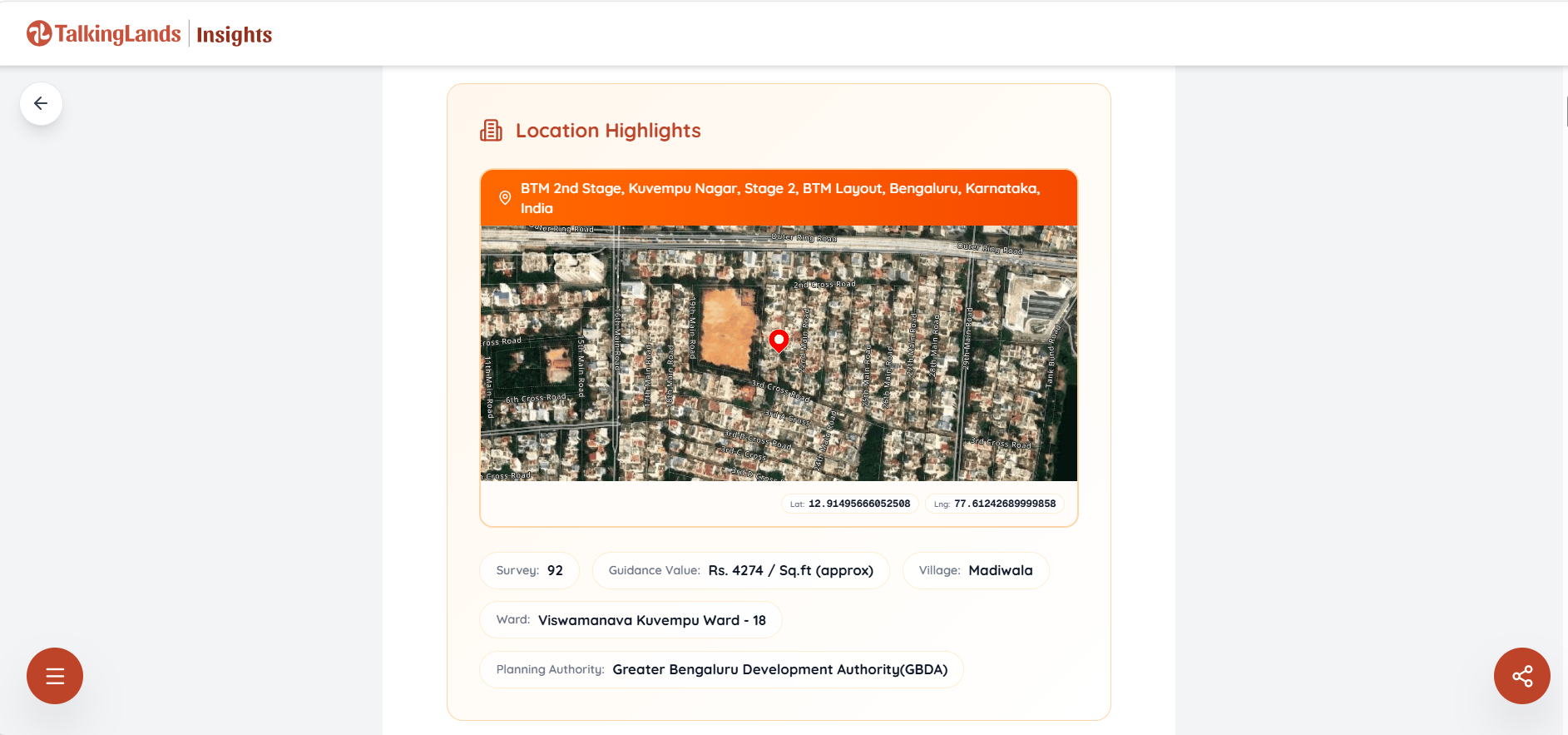
How to Verify the Truth (Using TalkingLands Insights)
Do not trust physical paper. Fake Khata certificates can be printed at any corner shop in Majestic. If you are buying a property, you must cross-reference the physical documents against digital revenue data and spatial polygons.
Here is how you do it.
A-Khata vs. B-Khata: The Developer's Dirty Secret
We cannot talk about the Khata system without addressing the elephant in the room: The B-Khata.
As Bangalore expanded rapidly, developers started buying up agricultural land on the outskirts (like Sarjapur and Whitefield). They didn't bother getting the legal permissions to convert the land for residential use (DC Conversion). They just divided the land into plots and built houses illegally.
The BBMP had a massive problem. There were thousands of illegal buildings stealing city water and using city roads, but because they were illegal, the BBMP couldn't issue them an official Khata to collect tax. The city was losing hundreds of crores.
So, the government created a loophole. They created a separate, secondary ledger called the "B-Register."
If your property is perfectly legal, approved by the BDA/BBMP, and built on legally converted land, you get an A-Khata.If your property violates zoning laws, lacks approvals, or is built on un-converted agricultural land, the BBMP enters you into the B-Register to collect tax. You get a B-Khata.
A B-Khata is basically a government receipt saying: "We know your building is technically illegal, but we are going to collect tax from you anyway."
The Brutal Rule for Buyers:Never buy a B-Khata property.Major nationalized banks (like SBI) will absolutely reject your home loan application for a B-Khata property. You cannot get building plan approvals to add an extra floor. The resale value is heavily compromised. Unscrupulous brokers will swear that the B-Khata can easily be upgraded to an A-Khata by paying a small bribe or waiting for the "Akrama-Sakrama" scheme.
They are lying. Upgrading a Khata is a brutal, expensive, and sometimes legally impossible process. Stick to A-Khata properties, and verify the status digitally.
Conclusion
Buying property in Bangalore is not for the faint of heart. The system is layered with bureaucratic traps designed decades ago.
Remember the golden rule: A Khata proves you pay the tax. The Title Deed proves you own the dirt. You need both to be flawless. Do not hand over a booking advance based on a physical Khata printout. Demand the survey number, pull the Encumbrance Certificate, and use spatial intelligence platforms to verify the ground reality matches the revenue records.
Invest your money based on cold, hard data.

Frequently Asked Questions (FAQ)
1. What is the difference between Title and Khata in Bangalore?
The Title (Sale Deed/Gift Deed) is the legal document that proves absolute ownership of the property under Central law. The Khata is merely an administrative revenue document issued by the local municipality like Bruhat Bengaluru Mahanagara Palike that identifies who is responsible for paying annual property tax. A Khata does not confer ownership.
2. Can the name on the Khata be different from the actual owner?
Yes. This is a common source of property fraud in Bangalore. In cases of joint ownership, the Khata might list only one individual for administrative convenience, even though the legal Title belongs to multiple owners. Never purchase a property solely based on the name appearing on the Khata.
3. Is it mandatory to have a Khata to register a property in Karnataka?
Yes. To reduce unauthorized developments and fraudulent transactions, the Karnataka government requires the seller to present a valid Khata certificate before the Sub-Registrar can execute or register a property transaction.
4. What is the difference between an A-Khata and a B-Khata?
An A-Khata is issued to legally compliant properties that possess all required approvals, including proper DC conversion and municipal clearances.
A B-Khata is maintained separately for properties that violate zoning laws or lack required approvals. B-Khata properties are considered high-risk and are generally ineligible for home loans from major nationalized banks.
5. How do I verify if a Khata is genuine before buying a property?
Do not rely solely on physical paper documents.
You should cross-check the exact survey number bangalore against official digital land records available through the Bhoomi Portal and use platforms like TalkingLands Insights to verify whether the recorded revenue owner matches the actual mapped property boundaries and spatial records.
.png)

.png)