.png)
The Namma Metro Phase 3 Impact refers to the predictable, data-driven appreciation in property values and rental yields triggered by the arrival of mass rapid transit infrastructure in previously underserved urban corridors.
The Cheat Code to Bangalore Real Estate Wealth
Let’s be brutally honest about the Bangalore real estate market: a beautiful, multi-crore villa outfitted with Italian marble doesn't mean a single thing if it takes you two and a half hours of bumper-to-bumper traffic to drive to your office.
In this city, traffic is not just an inconvenience—it is a fundamental economic driver. It dictates where multinational tech companies decide to lease Grade-A office space. It dictates where premium international schools open their campuses. And most importantly for you, it dictates exactly where property values explode. Over the last decade, we have watched the exact same geographical pattern play out during the rollout of Metro Phase 1 and Phase 2. The moment the Bangalore Metro Rail Corporation Limited (BMRCL) finalizes and announces a new alignment, land values within a 1.5 to 2-kilometer radius of the proposed stations go into an absolute frenzy.
If you are looking to deploy serious capital in 2026, understanding the bangalore metro impact property economics is your cheat code. You do not need to rely on broker rumors or "hot tips" from your neighbors. You simply follow the infrastructure money. The next massive wave of wealth creation is happening right now along the Namma Metro Phase 3 corridors.
However, buying property near a proposed metro line is like playing with fire. If you get it right, your ROI is astronomical, often beating the stock market. If you get it wrong—and accidentally buy land slated for a metro pillar, a BMRCL station parking lot, or a government buffer zone—your multi-crore investment drops to zero overnight. Here is the ultimate, institutional-grade, data-driven guide on how to safely navigate the namma metro phase 3 route to maximize your real estate returns in 2026.
The Blueprint: Deep Dive into the Phase 3 Alignments
To make money, you first need to know exactly where the money is flowing. The state and central governments have officially cleared the namma metro phase 3 alignment, injecting thousands of crores into massive, sprawling corridors that have historically been starved of mass transit.
Phase 3 is broadly split into two massive geographical plays, plus the highly anticipated, game-changing Phase 3A. Understanding the micro-market dynamics of each is critical for matching your investment strategy (capital appreciation vs. rental yield) to the right geography.
1. Corridor 1: The Western Outer Ring Road (ORR)
- The Route: Starting from JP Nagar 4th Phase in the South, this line sweeps across the entire western edge of the city. It cuts through Mysore Road, Nayandahalli, Nagarabhavi, and Peenya, finally ending at Kempapura, where it will seamlessly intersect with the Blue Line (the Airport line).
- The Impact & Strategy: This is a 32+ kilometer stretch that finally connects South Bangalore directly to the Kempegowda International Airport via the West. Historically, the Western ORR has been dominated by mid-tier residential layouts and heavy industrial zones (like Peenya).
- The ROI Play: This corridor is perfect for family end-users and long-term capital growth investors. By drastically decongesting the western ORR, the metro will turn historically isolated residential pockets into highly connected transit hubs. Property values in Nagarabhavi and Nayandahalli are poised for a massive 45% to 60% upward correction as the white-collar workforce realizes they can live here and commute to the Airport or South Bangalore seamlessly.
2. Corridor 2: The Magadi Road Stretch
- The Route: A 12+ km elevated stretch running straight from Hosahalli to Kadabagere.
- The Impact & Strategy: Let's not sugarcoat it—Magadi Road has been a sleeper market for an entire decade. Because it lacked a major IT park or mass transit lifeline, it offers some of the most affordable raw land parcels remaining within the city's reasonable limits.
- The ROI Play: This is your aggressive land-banking play. This metro line is the singular catalyst that will fully commercialize the Magadi corridor. Plotted developments here will see the highest percentage jump in the entire city. If you buy a plot here today at ₹5,500/sq.ft, the arrival of the metro is virtually guaranteed to push those prices toward the ₹10,000 mark as builders rush to construct high-density apartments near the new stations.
3. The Big Bonus: Phase 3A (Sarjapur to Hebbal)
- The Route: Cutting straight through the bleeding heart of Bangalore's IT corridor, linking Sarjapur Road, Agara, Koramangala, and Hebbal.
- The Impact & Strategy: This is the golden goose. This is the corridor that institutional funds, private equity, and Tier-1 developers are aggressively fighting over. Sarjapur Road already boasts a massive captive audience of high-earning tech professionals. Adding a mass transit line here will finally bridge the grueling traffic gap between East Bangalore's tech hubs and North Bangalore's airport economy.
- The ROI Play: Pure rental yield and premium capital preservation. If you want a property that generates massive monthly cash flow (yielding 5% to 7%), you buy an apartment along Phase 3A. Tech workers will pay a staggering premium to live within a 10-minute walk of an active metro station on this line to avoid the infamous Outer Ring Road traffic.
.jpg)
Phase 3 ROI Projection Matrix
Use the interactive visualizer below to compare the current price dynamics along these three distinct corridors and understand their projected 5-year growth trajectory based on historical BMRCL data
The Timing Strategy: The 3 Stages of Metro Appreciation
Many novice investors ask: "Is it too late to invest once the metro is announced?" The answer is no, but your timing dictates your profit margin. If we look at historical data from the Phase 2 extension into Whitefield (where property prices surged by 50% between 2022 and 2024), we see that real estate near a metro line appreciates in three very distinct, predictable waves:
- The Announcement Bump (10% - 15%): This happens the moment the government officially approves the Detailed Project Report (DPR). Speculators and institutional buyers move in, causing an immediate, albeit small, spike in local land values. Phase 3 is currently transitioning out of this stage.
- The Construction Surge (25% - 35%): This is the longest and most lucrative phase. Over a period of 3 to 4 years, as the civil contracts are awarded and massive concrete pillars actually start rising from the ground, the reality of the infrastructure sets in. Skeptical buyers who were waiting for proof finally enter the market, driving massive capital appreciation. This is the optimal window to buy.
- The Operational Premium (15% - 20%): This happens in the 6 months leading up to the inaugural train run, and the 12 months after. Capital appreciation slows down, but rental yields explode. Tenants are finally able to calculate their exact commute times, and landlords drastically raise rents for properties within walking distance of the active station.
If you are reading this in 2026, the Phase 3 corridors are entering the early Construction Surge. The massive ROI is still on the table, provided you don't step into a trap.
The Metro Trap: What Brokers Hide From You (Eminent Domain)
Here is the brutal, unspoken reality of buying property along a massive infrastructure corridor: the government takes exactly what it needs.
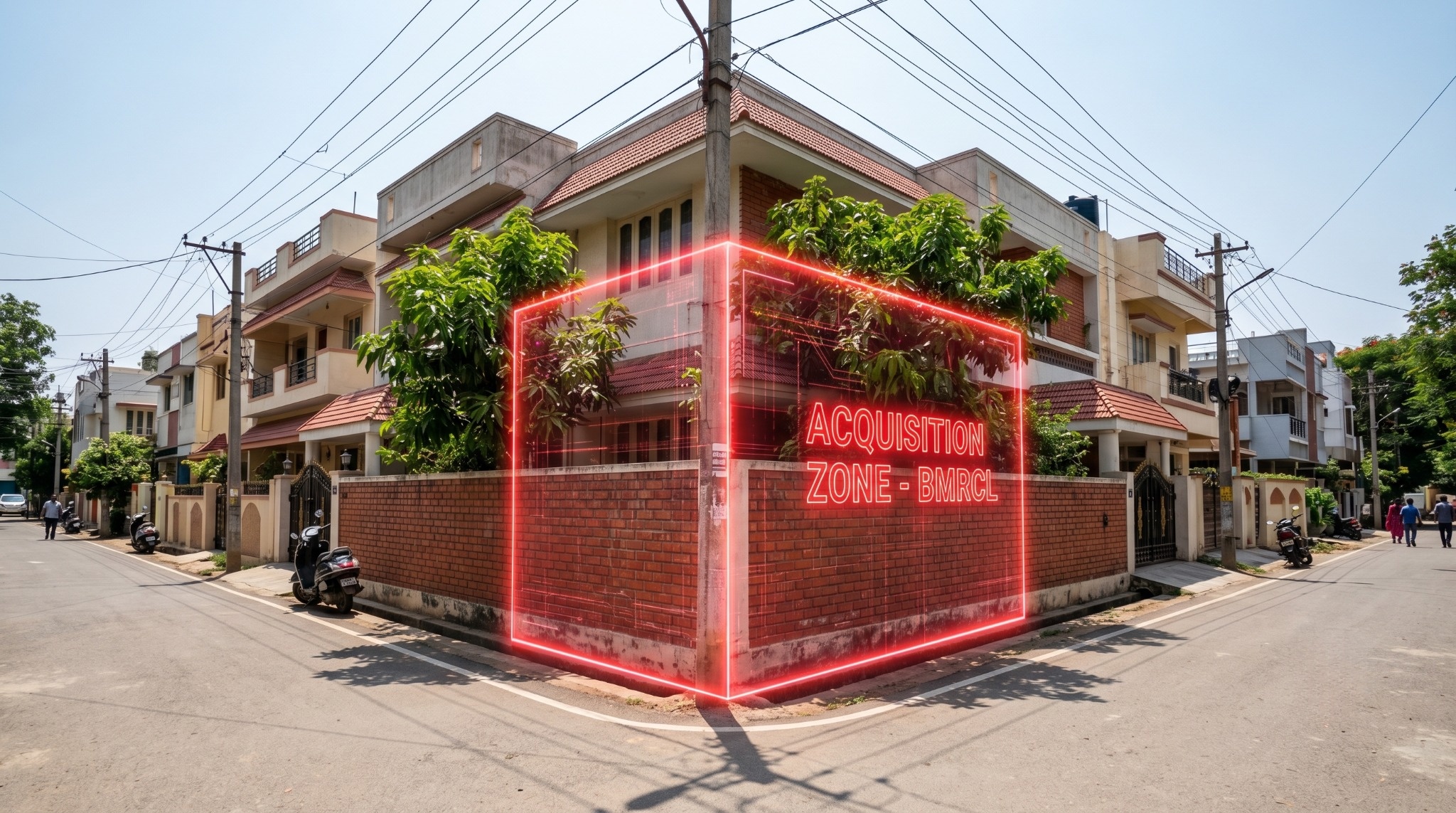
If a real estate broker is aggressively pushing you to buy an independent house or an empty plot that sits directly on the main road of the namma metro phase 3 route, your alarm bells should be ringing at maximum volume. Over the past decade, countless buyers have poured their life savings into a prime piece of commercial or residential land, only to receive a devastating legal notification from the Karnataka Industrial Areas Development Board (KIADB) or the BMRCL six months later.
The notification states that their land is being forcefully acquired under eminent domain to build a metro station, a public parking lot, a staircase, or simply to widen the road to accommodate the massive viaduct pillars.
The Financial Devastation of Land Acquisition
When the government acquires your land, they do not care what premium you paid the broker. They do not care about the "market value" you thought it had. The BMRCL compensates you based on the official Government Guidance Value. In many emerging corridors like Magadi Road, the official guidance value is often 40% to 60% lower than the actual cash market rate.
If you buy a plot for ₹1 Crore, and it falls inside the metro acquisition buffer, the government might forcibly acquire it and hand you a cheque for ₹50 Lakhs. Your investment is wiped out.
The Timing Strategy: The 3 Stages of Metro Appreciation
Many novice investors ask: "Is it too late to invest once the metro is announced?" The answer is no, but your timing dictates your profit margin. If we look at historical data from the Phase 2 extension into Whitefield (where property prices surged by 50% between 2022 and 2024), we see that real estate near a metro line appreciates in three very distinct, predictable waves:
- The Announcement Bump (10% - 15%): This happens the moment the government officially approves the Detailed Project Report (DPR). Speculators and institutional buyers move in, causing an immediate, albeit small, spike in local land values. Phase 3 is currently transitioning out of this stage.
- The Construction Surge (25% - 35%): This is the longest and most lucrative phase. Over a period of 3 to 4 years, as the civil contracts are awarded and massive concrete pillars actually start rising from the ground, the reality of the infrastructure sets in. Skeptical buyers who were waiting for proof finally enter the market, driving massive capital appreciation. This is the optimal window to buy.
- The Operational Premium (15% - 20%): This happens in the 6 months leading up to the inaugural train run, and the 12 months after. Capital appreciation slows down, but rental yields explode. Tenants are finally able to calculate their exact commute times, and landlords drastically raise rents for properties within walking distance of the active station.
If you are reading this in 2026, the Phase 3 corridors are entering the early Construction Surge. The massive ROI is still on the table, provided you don't step into a trap.
The Metro Trap: What Brokers Hide From You (Eminent Domain)
Here is the brutal, unspoken reality of buying property along a massive infrastructure corridor: the government takes exactly what it needs.
If a real estate broker is aggressively pushing you to buy an independent house or an empty plot that sits directly on the main road of the namma metro phase 3 route, your alarm bells should be ringing at maximum volume. Over the past decade, countless buyers have poured their life savings into a prime piece of commercial or residential land, only to receive a devastating legal notification from the Karnataka Industrial Areas Development Board (KIADB) or the BMRCL six months later.
The notification states that their land is being forcefully acquired under eminent domain to build a metro station, a public parking lot, a staircase, or simply to widen the road to accommodate the massive viaduct pillars.
The Financial Devastation of Land Acquisition
When the government acquires your land, they do not care what premium you paid the broker. They do not care about the "market value" you thought it had. The BMRCL compensates you based on the official Government Guidance Value. In many emerging corridors like Magadi Road, the official guidance value is often 40% to 60% lower than the actual cash market rate.
If you buy a plot for ₹1 Crore, and it falls inside the metro acquisition buffer, the government might forcibly acquire it and hand you a cheque for ₹50 Lakhs. Your investment is wiped out.
Conclusion
The Namma Metro Phase 3 is not just an infrastructure project; it is the largest, most predictable wealth-transfer event happening in Bangalore this decade. Emerging corridors like Magadi Road and the West ORR are about to experience the exact same explosive, life-changing growth that completely transformed Whitefield and Kanakapura Road in the years prior.
However, as any seasoned investor knows, high ROI always walks hand-in-hand with high risk. Do not let FOMO (Fear Of Missing Out) or aggressive broker tactics drive your multi-crore investment decisions.
Demand the exact survey number, check the spatial overlays, avoid the devastating BMRCL land acquisition traps, and park your money exactly where the data tells you to. Invest with intelligence, not emotion.
Frequently Asked Questions (FAQ)
What is the exact route for Namma Metro Phase 3?
Phase 3 primarily consists of two major corridors: The first runs along the western Outer Ring Road, starting from JP Nagar 4th Phase and ending at Kempapura (where it intersects the Blue Airport line). The second is a 12 km elevated corridor running from Hosahalli to Kadabagere along Magadi Road. Additionally, Phase 3A is a highly anticipated corridor that will connect Sarjapur to Hebbal.
How does the bangalore metro impact property prices?
Proximity to a metro station drastically improves connectivity, removing the burden of Bangalore's notorious traffic, which makes the area highly desirable for IT professionals and families. Historically, properties located within a 1.5 km radius of a new metro station see a massive 40% to 60% appreciation in capital values, alongside a massive surge in monthly rental yields, from the announcement phase to the operational phase.
Is it risky to buy property right next to a proposed metro station?
Yes, it is extremely risky. While being near a station is good, properties located immediately adjacent to proposed stations or directly on the main alignment are at a very high risk of government land acquisition. The BMRCL often forcibly acquires adjacent land for road widening, staircases, and parking lots. If your land is acquired, you are compensated at government guidance rates, which are usually far below the actual cash market price you paid, resulting in a massive financial loss.
Which Phase 3 corridor offers the best ROI for affordable plotted developments?
The Magadi Road corridor (Hosahalli to Kadabagere) currently offers the lowest entry prices among the Phase 3 alignments. Because this area has historically lacked Grade-A mass transit and large IT parks, the introduction of the metro will trigger aggressive, rapid commercialization. This makes it a prime target for high-percentage capital appreciation on plotted developments.
How can I check if my property is safe from Metro land acquisition?
You absolutely cannot verify this through a physical site visit or by looking at the current roads. You must obtain the property's exact survey number from the seller and use an advanced spatial intelligence tool, like TalkingLands Insights, to overlay your plot's exact boundaries against the officially notified bangalore metro corridor map and the CDP Bangalore zoning guidelines to ensure you sit safely outside the acquisition buffer.
.png)

.png)