.png)
Noise Pollution Rules & Silence Zones for Property (2026 Guide)
The Sunday Site Visit Trap
You visit a prospective residential plot on a quiet Sunday morning. The air is still, the nearby roads are empty, and the neighborhood feels like a tranquil sanctuary. Based on this peaceful experience, you pay a hefty advance to secure the land for your dream home.
Six months later, after you move in, the nightmare begins.
The plot is located just 300 meters from an industrial corridor and a major railway line. From Monday to Saturday, heavy freight trains rattle the foundation at 2:00 AM, and nearby manufacturing units generate a relentless, low-frequency hum that shatters your sleep. Alternatively, you might buy a commercial plot to build an entertainment venue, only to discover it sits inside a government-notified "Silence Zone" due to a nearby hospital—meaning you are legally barred from playing music or using loudspeakers, killing your business model instantly.
When buying real estate, buyers obsess over master plans, ownership documents, and water supply. Yet, they almost universally ignore one of the most critical factors of livability and legal compliance: noise pollution.
Whether you are building a family home near a highway or a commercial complex near an airport, understanding India's statutory noise pollution rules is non-negotiable. Here is the definitive 2026 guide to the legal decibel limits, the strict restrictions inside silence zones, the primary noise sources that destroy property value, and how to scientifically check your plot's noise exposure before you buy.
Quick Answer: India’s noise pollution rules (set by the CPCB) divide areas into Industrial, Commercial, Residential, and Silence Zones, each with strict day (6 AM–10 PM) and night (10 PM–6 AM) decibel limits. Residential zones are capped at 55 dB (day) and 45 dB (night). Silence zones (within 100 meters of hospitals, schools, and courts) have the strictest limits and ban loudspeakers and honking entirely. Before buying, you must check your plot's proximity to highways, railways, and flight paths using spatial mapping to ensure it isn't trapped in a high-noise corridor.
Why Noise Matters for Property Buyers
Treating noise as a mere "nuisance" is a mistake. In modern Indian real estate, noise pollution translates directly into financial and legal consequences.
- Livability & Health: The World Health Organization (WHO) and the Central Pollution Control Board (CPCB) classify continuous exposure to noise above 55 decibels (dB) as a severe health hazard. Chronic exposure to highway traffic or industrial noise leads to sleep deprivation, hypertension, cardiovascular issues, and severe stress. A house you cannot sleep in is functionally worthless.
- Resale Value: Property valuations are ruthlessly efficient. If a villa or apartment is plagued by the sound of approaching aircraft or heavy diesel locomotives, it will suffer a permanent 15% to 25% discount on the secondary resale market compared to identical properties shielded from the noise.
- Zoning & Usage Restrictions: If you purchase land that happens to fall inside a notified Silence Zone, your usage rights are severely crippled. You cannot construct a marriage hall, host outdoor events, or even operate heavy construction machinery during certain hours without inviting immediate police action and heavy municipal penalties.
The Law: Noise Pollution (Regulation and Control) Rules, 2000
In India, noise is legally classified as an air pollutant under the Environment (Protection) Act, 1986. The definitive legal framework governing it is the Noise Pollution (Regulation and Control) Rules, 2000, drafted by the Ministry of Environment, Forest and Climate Change (MoEFCC) and enforced by the Central Pollution Control Board (CPCB) and State Pollution Control Boards.
These rules establish two critical frameworks:
- Area Categorization: Land is divided into four strict categories: Industrial, Commercial, Residential, and Silence Zones.
- The Day / Night Split: The law recognizes that human tolerance for noise drops drastically at night. The rules define Day Time as 6:00 AM to 10:00 PM, and Night Time as 10:00 PM to 6:00 AM. Night-time decibel limits are heavily restricted to protect sleep cycles.
Ambient Noise Limits by Zone (CPCB Standards)
Note: The limits below represent the maximum permissible ambient noise levels, measured in dB(A) Leq (the time-weighted average of sound level).
.png)
The Strict Reality of Silence Zones
If you are buying a plot, you must know if it falls inside a Silence Zone. Under the 2000 Rules, a Silence Zone is defined as an area comprising not less than 100 meters around hospitals, educational institutions, and courts. (Certain religious places may also be notified by the competent authority).
Owning property inside this 100-meter radius comes with severe statutory restrictions:
- Total Ban on Loudspeakers: You cannot use public address systems or loudspeakers, even during the day, making the plot useless for event spaces, banquet halls, or open-air commercial venues.
- No Honking: Vehicular horns are strictly prohibited.
- Construction Restrictions: Using heavy, sound-emitting construction equipment during night hours is entirely banned, which can severely delay timeline-sensitive real estate development projects.
- Firecrackers: Bursting sound-emitting firecrackers is permanently prohibited.
The 5 Noise Sources That Hurt Property Value
When evaluating a land parcel, pay forensic attention to its proximity to these five primary noise generators:
- National & State Highways: Highways generate a continuous, rolling drone of heavy truck tires, air brakes, and high-speed wind displacement. The noise travels significantly farther than the official highway building setbacks. If your plot is within 300 meters of an un-barricaded highway, ambient noise will likely exceed residential limits.
- Railway Tracks: The low-frequency vibration and high-decibel horns of diesel freight trains can penetrate standard brick-and-mortar walls easily. Proximity to railway buffers is a massive red flag for residential buyers.
- Airport Approach Paths: A plot might be physically safe from the airport height restriction zones, but if it sits directly beneath the primary takeoff or landing flight path, you will be subjected to 90+ dB blasts every few minutes.
- Industrial Corridors: Heavy manufacturing zones run 24/7. The hum of industrial generators, exhaust fans, and heavy machinery loading docks obliterates night-time tranquility in adjacent residential layouts.
- Wholesale Markets & Logistics Hubs: These areas generate intense, chaotic noise from heavy commercial vehicle loading, shouting, and general congestion, peaking during early morning hours when residential zones are supposed to be quietest.
How to Check a Plot's Noise Risk Before Buying
Do not rely on a daytime site visit to judge noise levels. Noise pollution is a geographic and spatial problem, meaning it can be accurately mapped and predicted before you ever step foot on the land.
1. Identify the Master Plan Zoning
You must verify the official municipal zoning of the plot and its immediate surroundings. If your residential plot is zoned right next to a massive commercial or industrial grid, you are guaranteed to experience noise spillover.
2. Map Proximity to Infrastructure
You need to measure the exact linear distance from your survey number's boundary to the nearest national highway, railway line, or airport corridor.
3. Check the 100-Meter Silence Radius
Locate all major hospitals, prominent schools, colleges, and court complexes in the vicinity. If the edge of your plot falls within a 100-meter radius of their property lines, you are legally inside a Silence Zone.
Verify the Complete Spatial Reality Instantly
Sifting through municipal maps to measure distances to railways, highways, and silence-zone triggers is exhausting and prone to human error. You need precise, digital spatial intelligence.
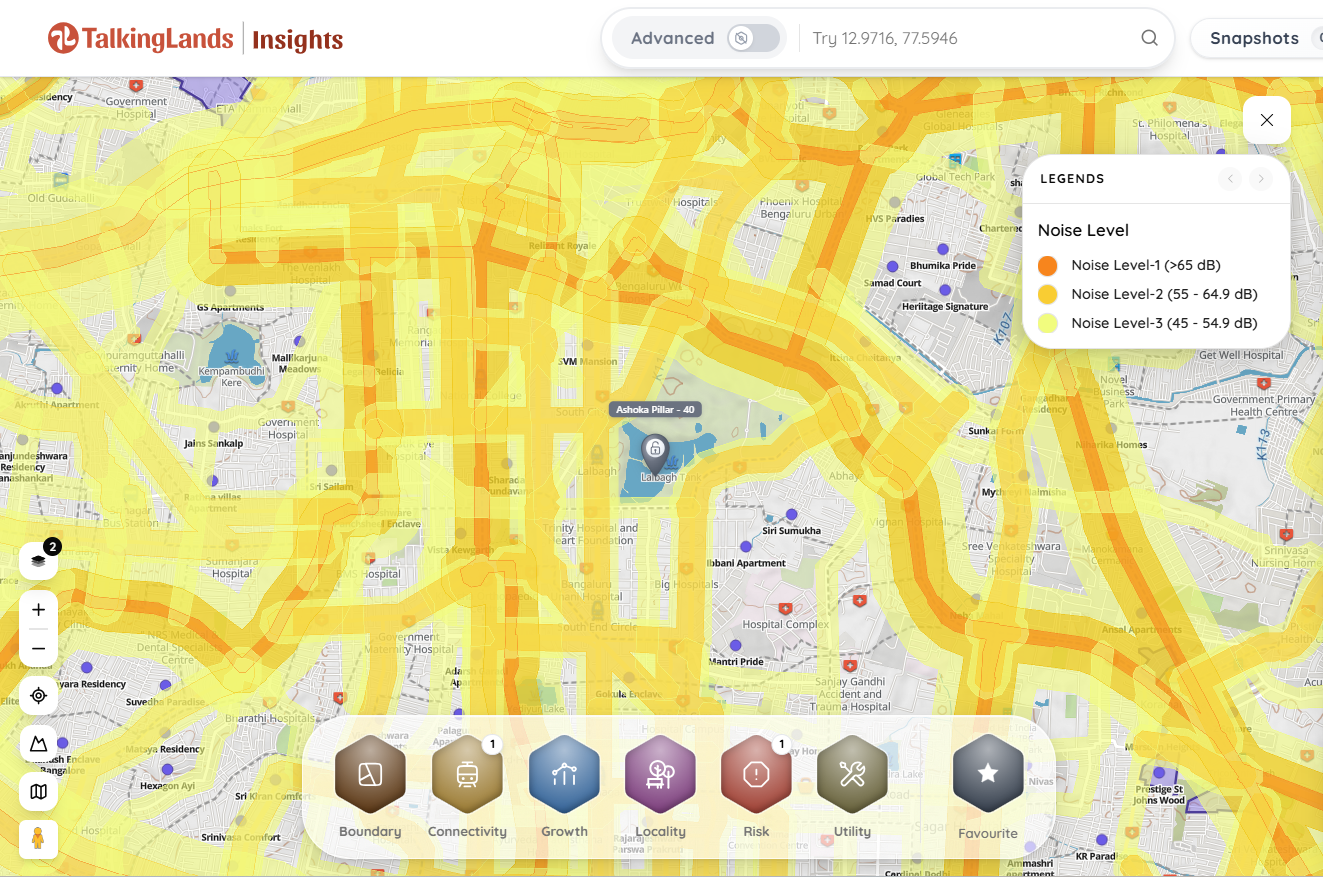
With TalkingLands Insights, verifying your plot’s exposure to environmental and infrastructure noise risks is seamless. By entering your survey number into our advanced mapping workspace, you can instantly overlay the plot's true cadastral boundary onto a live satellite map.
Activate the Infrastructure & Risk layers to immediately visualize exactly how close your plot sits to national highways, railway networks, and heavy industrial corridors. You can instantly see the physical reality of the land and protect your capital from a noisy, unlivable investment.
-p-2000.png)
Frequently Asked Questions
1. What are the permissible noise pollution limits in residential areas in India?
According to the CPCB Noise Pollution (Regulation and Control) Rules, 2000, the maximum permissible ambient noise level in a residential area is 55 decibels (dB) during the day (6:00 AM to 10:00 PM) and 45 decibels (dB) during the night (10:00 PM to 6:00 AM).
2. What exactly is considered a Silence Zone?
A Silence Zone is a legally notified area comprising a radius of not less than 100 meters around hospitals, educational institutions (schools/colleges), and courts. In these zones, noise levels are strictly capped at 50 dB during the day and 40 dB at night, and the use of loudspeakers and vehicular horns is banned.
3. How do noise pollution rules define Day and Night hours?
Under Indian environmental law, "Day Time" is officially defined as the 16-hour window from 6:00 AM to 10:00 PM. "Night Time" is defined as the 8-hour window from 10:00 PM to 6:00 AM, during which all ambient noise limits are significantly lowered to protect public health and sleep cycles.
4. Can I play loud music or use loudspeakers at night in a residential area?
No. Using a loudspeaker or a public address system without explicit written permission from the designated authority is illegal. Furthermore, they are strictly prohibited during night hours (10:00 PM to 6:00 AM) except inside closed premises like auditoriums or banquet halls.
5. Why should I check for noise pollution before buying land?
Continuous exposure to high noise levels from nearby highways, railways, airports, or industrial zones causes severe health issues (hypertension, sleep loss) and permanently depresses the resale value of the property. A daytime site visit often fails to reveal the true night-time noise reality.
6. Can construction equipment be used in a Silence Zone?
Using heavy, sound-emitting construction equipment or operating loud machinery during the night time is strictly prohibited in both residential areas and notified silence zones to prevent severe disturbance to local residents and patients.
.png)

.png)