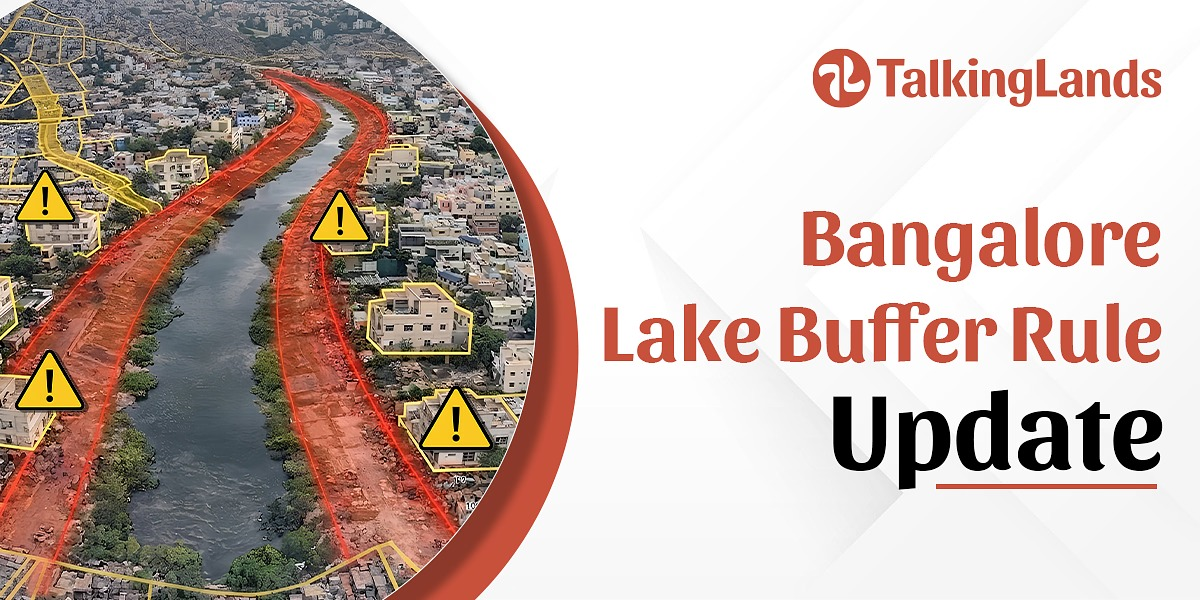
Bangalore, officially Bengaluru, has historically been celebrated as the "City of Lakes." At its ecological peak, the city boasted over 1,452 water bodies and nearly 80% green cover. Today, rapid urbanisation has dramatically reduced that number: by the 1970s, only around 760 lakes remained, and as of 2025, just 216 are still in existence.
This dramatic loss of Bangalore's lake ecosystem has made lake buffer zones one of the most debated topics in the city's urban planning and real estate landscape. A lake buffer zone in Bangalore refers to the protected strip of land around a water body where construction and commercial activities are restricted a critical safeguard for flood control, groundwater recharge, and environmental health.
In August 2025, the Karnataka government introduced a landmark change to the existing lake buffer rules through the Karnataka Tank Conservation and Development Authority (Amendment) Bill, 2025. This bill proposed replacing the earlier uniform 30-metre buffer zone for all lakes with a size-based, tiered system. After months of deliberation and two rounds of clarification sought by the Karnataka Governor, the revised law was finally approved in February 2026.
For property buyers in Bangalore whether investing near Ulsoor, Hebbal, Varthur, or any of the city's numerous lakes understanding this updated lake buffer zone in Bangalore is no longer optional. It is essential due diligence.
This comprehensive guide breaks down the new Bangalore lake buffer rules, explains how they differ from earlier regulations, identifies the real risks involved, and gives you a step-by-step process to check whether a property falls within a buffer zone for lakes in Bangalore.
A lake buffer zone is a legally defined no-construction perimeter around a water body. Under the pre-2025 framework, Section 12 of the Karnataka Tank Conservation and Development Authority (KTCDA) Act, 2014 prohibited any unauthorised construction, commercial, recreational, or industrial activity within 30 metres of the outer boundary of any lake or water body in the state.
The buffer zone for lakes acts as a transition zone between the water body and built-up areas. It is not merely a regulatory boundary it performs critical ecological and urban functions:
1. Flood Control
Lake buffer zones absorb excess rainwater and act as natural shock absorbers during monsoon flooding. When construction encroaches on these zones, stormwater has nowhere to dissipate, leading to urban flooding a problem Bangalore has experienced acutely in areas like Bellandur, Varthur, and RR Nagar.
2. Groundwater Recharge
The open land in the lake buffer zone in Bangalore enables rainwater and surface runoff to percolate into the soil and replenish groundwater tables. Environmental experts have noted that Bangalore's lakes are often clay-lined water bodies where recharge is slow, making wide buffer zones especially critical in the city.
3. Pollution Prevention
Buffer zones act as natural filters. When solid waste or pollutants are dumped near a lake, the buffer provides space for the contaminants to be filtered before reaching the water body. Narrowing this zone increases the direct pollution load on the lake.
4. Biodiversity and Ecology
The vegetated buffer zone around a lake provides habitat for birds, insects, and small animals. It also supports aquatic biodiversity by maintaining shoreline integrity. Lake protection groups such as Friends of Lakes (FBL) have consistently argued that buffer zones are not empty spaces they are vital ecological infrastructure.
The most significant change in the 2025–2026 update to Bangalore lake buffer rules is the shift from a uniform standard to a size-based, tiered buffer zone system.
Under the old rule, every single lake in Karnataka, regardless of whether it was a tiny 2-gunta pond or a 500-acre reservoir was required to maintain a uniform 30-metre buffer zone. This one-size-fits-all approach was often criticised by urban planners and developers as inflexible, particularly for small water bodies in densely developed areas where a full 30-metre buffer was difficult to enforce.
The new amended rules introduce buffer zone for lakes in Bangalore based on the area of the lake. The Karnataka government stated that this tiered approach was 'framed using a scientific approach' to facilitate the natural inflow of water into lakes of varying sizes. Officials said the change aims to strike a balance between lake protection and urban development needs, especially in rapidly growing cities where infrastructure expansion is critical.
1. What is the new lake buffer rule in Bangalore?
- The new Bangalore lake buffer rule, introduced through the Karnataka Tank Conservation and Development Authority (Amendment) Bill 2025 and approved by the Governor in February 2026, replaces the earlier uniform 30-metre buffer zone with a tiered, size-based system. Under the new rule, the lake buffer zone in Bangalore varies from zero metres (for lakes up to 5 guntas) to 30 metres (for lakes above 100 acres).
2. What are the updated buffer zone distances for lakes in Bangalore?
- As per the 2025–2026 amendment: up to 5 guntas = no buffer; 5 guntas to 1 acre = 3 metres; 1–10 acres = 6 metres; 10–25 acres = 12 metres; 25–100 acres = 24 metres; above 100 acres = 30 metres.
3. Why did the government change the lake buffer rules?
- The Karnataka government stated the change was made using a scientific approach to facilitate natural inflow into lakes of varying sizes, and to balance environmental protection with urban development and infrastructure needs especially for rapidly growing cities like Bangalore.
4. How does the new lake buffer rule affect property buyers?
- The new buffer zone for lakes in Bangalore may open up previously restricted land near smaller lakes for development. However, buyers face uncertainty due to ongoing NGT review, potential rule reversals, and the risk of reduced flood protection and environmental quality near properties with reduced buffer zones.
5. Can I buy property near a lake in Bangalore after the new rules?
- Yes, but with careful due diligence. Verify the lake's size and the applicable buffer distance. Confirm the property falls outside the buffer using official maps (Talking Lands, Karnataka Land Records portal) and secure an NOC from BBMP/BDA. Consult a property lawyer specialising in Karnataka water body regulations before finalising.
6. Is it safe to invest in properties near lakes in Bangalore?
- It depends on the specific lake and property. Properties near large lakes (above 100 acres) retain the established 30-metre rule and are more legally stable. Properties near smaller lakes now have reduced buffer requirements, but carry higher legal uncertainty due to NGT scrutiny and potential future rule changes. Environmental risks like flooding also vary by area.
7. How do I check if a property falls within a lake buffer zone?
- Use the Talking Lands portal (talkinglands.com) to access GIS-based property reports and map overlays showing lake buffer zones. Cross-verify with the Karnataka Land Records portal using the survey number. For final confirmation, consult a licensed government surveyor or property lawyer.
8. What documents should I verify before buying property near a lake?
- Key documents include: RTC (Pahani) extract, Title Deed, Encumbrance Certificate, Khata Certificate, Approved Building Plan with sanction date, RERA registration, Environmental Clearance (if applicable), NOC from BBMP/BDA/KLCDA confirming buffer zone compliance, Occupancy Certificate, and Survey Sketch.
9. Will property prices increase near lakes after the rule update?
Potentially, yes, properties near smaller lakes that were previously in the 30-metre restricted zone may see price appreciation as the reduced bangalore lake buffer zone makes them eligible for development. However, legal uncertainty and environmental risks may temper this appreciation. Monitor the NGT review outcome before making investment decisions.
10. Are bank loans available for properties near lake buffer zones?
- Bank loans are generally denied for properties that fall within a lake buffer zone or fail to comply with applicable regulations. Properties with clear title, valid occupancy certificates, and confirmed location outside the applicable lake buffer zone in Bangalore can typically obtain loans. Always verify loan eligibility before committing to a purchase near a water body.




.png)
%20(1).png)