Key takeaways
- FSI calculation: net plot area x permissible FSI = maximum built-up area. The hard part is knowing which FSI applies.
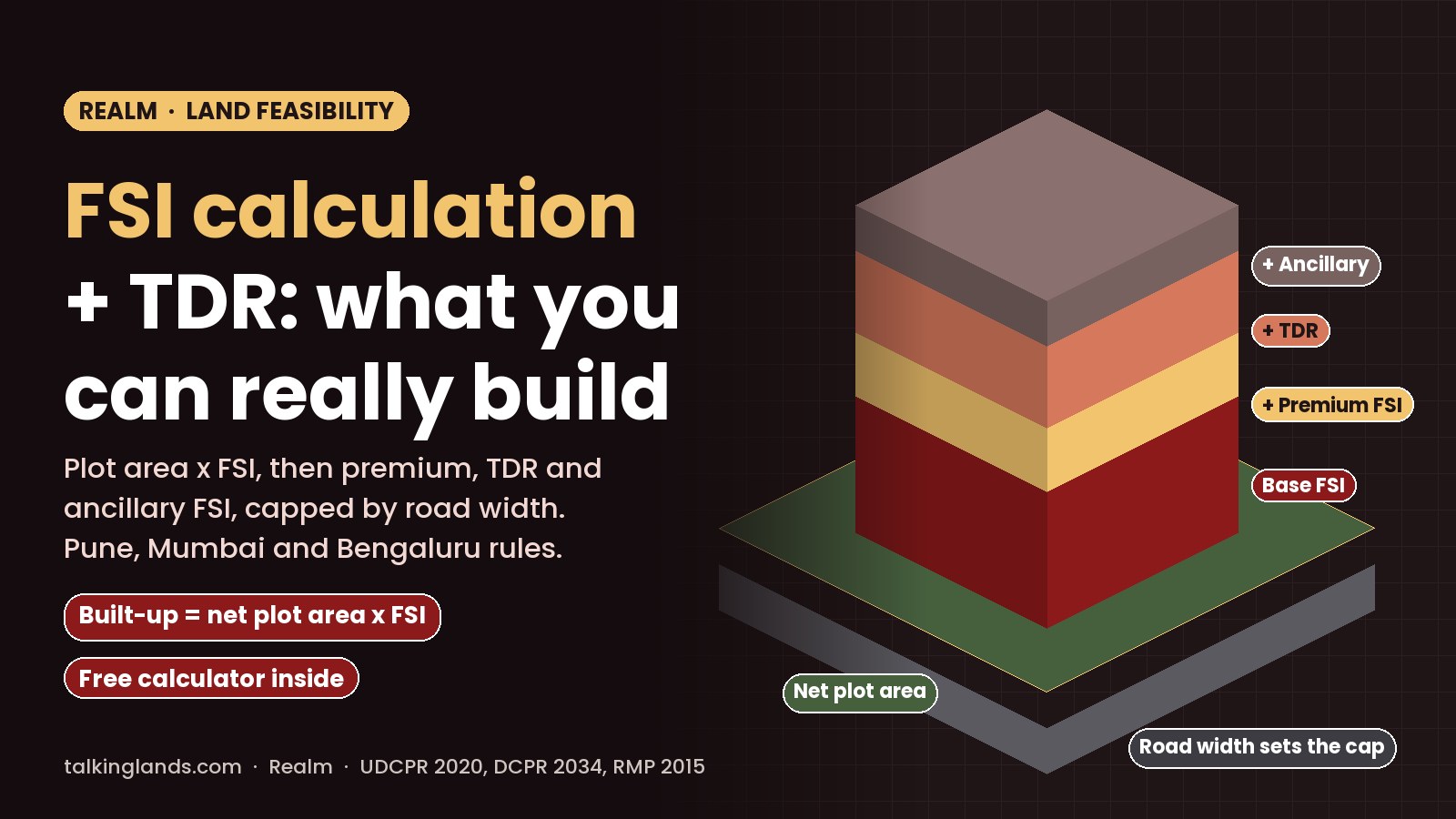
- Permissible FSI is a stack: base (free), premium (paid to the authority), TDR (bought from landowners) and, in Maharashtra, ancillary or fungible FSI.
- Road width caps the stack. Under Pune’s UDCPR 2020 the maximum for municipal corporations rises from 1.10 on roads below 9 m to 3.00 on roads of 30 m and above.
- Bengaluru works in multiples of base FAR: up to 0.6 times extra. Since a February 2026 amendment, upheld by the High Court in June 2026, roads of 9 m to below 12 m get that extra only through TDR.
- TDR is not square metre for square metre. UDCPR indexes it to land rates, so the same certificate buys more area on a cheaper plot.
How much can this parcel carry?
Enter the plot and your regulation’s FSI values, or pick a preset.
Indicative only. Check the local DCR. Presets use UDCPR 2020 and a 2018 summary of DCPR 2034, both amended since. Ancillary FSI carries its own premium. The Bengaluru preset uses the base FAR you typed. Built-up is not carpet area.
Run this on a real parcel in Realm →- → What FSI (FAR) means and the formula
- → How to calculate FSI, step by step
- → Premium FSI, TDR and fungible FSI
- → Pune, Mumbai and Bengaluru compared
- → How TDR is generated and loaded
- → Road width, setbacks and the real limit
- → Screening parcels on buildable area
- → How to run a feasibility check in Realm
- → Common mistakes
- → FAQs
A seller quotes a price per acre, but a developer is really buying floor area. Get the FSI calculation wrong and a parcel that looked cheap carries far less built-up area than the model assumed.
This guide shows the method, with the tables from Pune’s UDCPR 2020, Mumbai’s DCPR 2034 and Bengaluru’s RMP 2015 zoning regulations, and a calculator you can run on any parcel. If you are new to buying land for projects, start with our land acquisition process guide.
What FSI (FAR) means and the formula
Floor space index (FSI) is the ratio of total built-up area on all floors to the area of the plot. Floor area ratio (FAR) is the same ratio under another name: Maharashtra’s regulations say FSI, Bengaluru’s zoning regulations say FAR.
UDCPR 2020 defines it as the area covered by the outer line of the building on all floors divided by the net plot area. Two forms of the formula matter:
- FSI = total built-up area / net plot area (to check an existing or proposed building)
- Maximum built-up area = net plot area x permissible FSI (to value a parcel before you buy)
An FSI of 2.00 on a 1,000 sq m net plot allows 2,000 sq m of built-up area. Setbacks, coverage and height decide the shape; FSI decides the total.
How to calculate FSI, step by step
- Start from net plot area, not the deed area. Subtract road widening, reservations and amenity space as your regulation defines them; some rules compensate surrendered land with TDR.
- Find the zone and the road width. The abutting road width picks the row of the FSI table. In Maharashtra, check if the area is congested or non-congested.
- Read base FSI. The free entitlement, such as 1.10 under UDCPR Table 6-G or 1.33 in Mumbai’s island city.
- Add premium FSI up to the cap for that road width, and price it.
- Add TDR up to the cap, and price that too. Check slum TDR shares and indexation.
- Add ancillary or fungible FSI where allowed, on a premium.
- Check the physical fit: setbacks, height, fire access and parking.
The calculator runs steps 1 to 6; step 7 is your architect’s job.
Premium FSI, TDR and fungible FSI
- Premium FSI is sold by the planning authority. Under UDCPR 2020 the premium is 35 per cent of the land rate in the Annual Statement of Rates (ASR). In Bengaluru, premium FAR is charged at 50 per cent of the government-notified land value of the additional notional site area, with a floor of 28 per cent of that land value per sq m of the site, and it cannot be moved to another site.
- TDR is floor area earned by someone else, usually for giving land to the authority, and sold to you as a Development Right Certificate (DRC). The market sets its price.
- Ancillary or fungible FSI covers items such as staircases and balconies that used to be free of FSI. UDCPR allows ancillary area FSI up to 60 per cent of the FSI proposed for residential use (80 per cent for non-residential) on payment of a premium, which is 15 per cent of the ASR land rate in Pune and Thane. In Mumbai, the Knight Frank summary of DCPR 2034 applies 35 per cent fungible FSI on permissible FSI.
UDCPR fixes no order between premium FSI and TDR, so the choice is a cost question: premium per sq m against the TDR rate after indexation.
Pune, Mumbai and Bengaluru compared
Residential and mixed-use caps by road width. Maharashtra values are FSI points; Bengaluru values are multiples of base FAR.
| City and rule book | Abutting road | Base | Premium | TDR | Maximum before ancillary / fungible |
|---|---|---|---|---|---|
| Pune and other municipal corporations (UDCPR 2020, Table 6-G, non-congested) | Below 9 m | 1.10 | – | – | 1.10 |
| UDCPR 2020 | 9 m to below 12 m | 1.10 | 0.50 | 0.40 | 2.00 |
| UDCPR 2020 | 12 m to below 15 m | 1.10 | 0.50 | 0.65 | 2.25 |
| UDCPR 2020 | 15 m to below 24 m | 1.10 | 0.50 | 0.90 | 2.50 |
| UDCPR 2020 | 24 m to below 30 m | 1.10 | 0.50 | 1.15 | 2.75 |
| UDCPR 2020 | 30 m and above | 1.10 | 0.50 | 1.40 | 3.00 |
| Mumbai island city (DCPR 2034, per Knight Frank) | 9–12 m / 12–18 m / 18–27 m / above 27 m | 1.33 | 0.50 / 0.62 / 0.73 / 0.84 | 0.17 / 0.45 / 0.64 / 0.83 | 2.00 / 2.40 / 2.70 / 3.00 |
| Mumbai suburbs (DCPR 2034, per Knight Frank) | 9–12 m / 12–18 m / 18–27 m / above 27 m | 1.00 | 0.50 | 0.50 / 0.70 / 0.90 / 1.00 | 2.00 / 2.20 / 2.40 / 2.50 |
| Bengaluru (RMP 2015 zoning regulations, Table 27 as amended February 2026) | 9 m to below 12 m | As per RMP 2015 tables | Nil | Up to 0.6x base | 1.6x base FAR |
| Bengaluru | 12 m and above | As per RMP 2015 tables | Up to 0.4x base | Balance (0.2x base for the full 0.6x) | 1.6x base FAR |
Roads below 9 m get base FSI only. Councils and regional plan areas in Maharashtra have lower premium and TDR columns, and special schemes such as transit-oriented development allow more. For metro corridors see our Pune TOD zone FSI guide; for Mumbai’s redevelopment and cluster incentives see Mumbai redevelopment rules 2026.
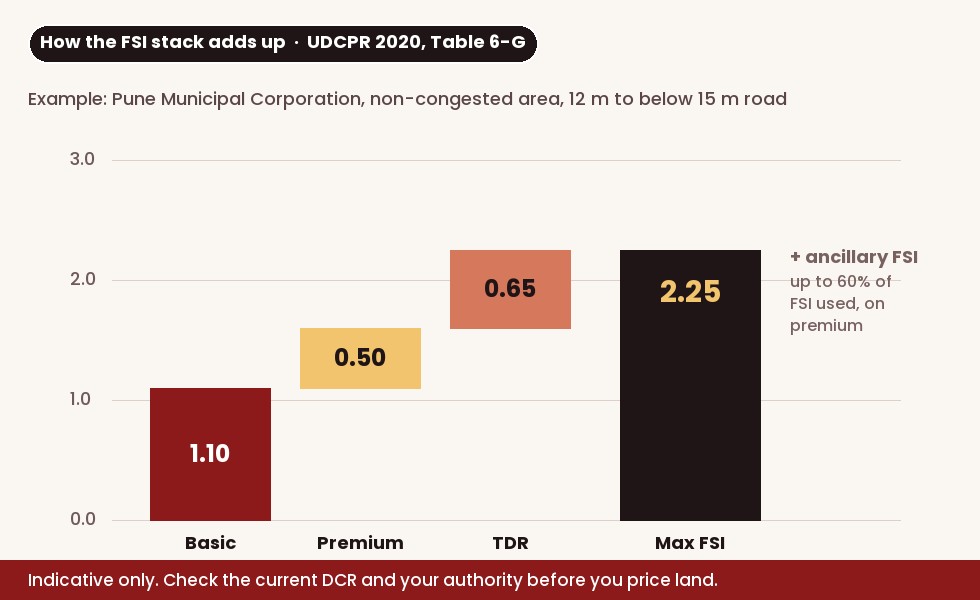
How the stack adds up on a 12 m to below 15 m road in a Maharashtra municipal corporation, from UDCPR Table 6-G. Ancillary FSI sits on top, on payment of premium.
How TDR is generated and loaded
TDR starts when a landowner gives up land the city needs, such as a plan road or reserved plot, and takes floor area instead of cash. Under UDCPR 2020:
- Surrendering land free of cost earns TDR of 2 times the surrendered area in non-congested areas and 3 times in congested areas.
- The DRC records the credit, where it was generated and that plot’s ASR land rate.
- On the receiving plot, usable TDR is indexed: X = (Rg / Rr) x Y, where Y is the TDR debited, Rg the generating plot’s land rate and Rr the receiving plot’s land rate.
- Of the TDR loaded, a minimum of 30 per cent and a maximum of 50 per cent must come from slum, urban renewal or amenity TDR, where it is available.
- TDR can be loaded only where the existing road is 9 m or wider.
Mumbai runs on similar lines. The Knight Frank summary says DCPR 2034 grants TDR of 2.5 times the surrendered reserved land in the island city and 2 times in the suburbs, and caps slum TDR at 20 to 50 per cent of what is loaded. In Karnataka, TDR is issued under Section 14-B of the Karnataka Town and Country Planning Act, 1961.
Road width, setbacks and the real limit
Knight Frank’s review of DCPR 2034 says the road-width link aims to stop tall towers on lanes that cannot serve them. For a land team that means:
- Frontage matters more than area. A plot on a wider road jumps a row. UDCPR counts the major road’s width for plots facing it, even with service-road access.
- Road widening can help. Land given up can earn TDR or in-situ FSI and may lift the plot into a better band.
FSI is only a ceiling. Setbacks, ground coverage, height limits, fire access and parking shrink what fits, and on small plots setbacks often bite first. Our guide to building setback rules in India covers how they are worked out.
Screening parcels on buildable area
A parcel quoted per acre has to become a land cost per sq m of buildable area before you can compare it. A typical screen:
- Zoning and land use on the master plan: residential, commercial, industrial or agricultural, and any reservation on the parcel. See how to find the zoning of a property.
- Road width and frontage, which set the FSI row.
- Net plot area after road widening, reservations and amenity space.
- Cost of the stack: premium at current rates, TDR after indexation.
- Title and approvals, which no FSI number can fix. Our land due diligence checklist covers the documents.
Buildable area also drives the split in a joint development deal. In Karnataka, read our guide to the joint development agreement first.
Doing this by hand for every lead takes days. That is the part software speeds up. For a comparison of tools, see the best land acquisition software in India.
How to run a feasibility check in Realm
TalkingLands Realm is land acquisition software for developers and land teams. Its product page lists map tools to draw a parcel boundary with automatic area calculation, 150+ data layers per parcel, AI land reports and an FSI / FAR feasibility report.
- Book a demo on the demo page and choose Realm.
- Draw the parcel as a polygon on the map; Realm calculates the area.
- Read the layers for zoning, roads, growth and risk around the parcel.
- Generate the feasibility report and compare the buildable area with the asking price.
- Verify the FSI values with your architect against the current DCR and the planning authority before you sign.
What Realm shows: the parcel, its area, the layers around it and a shareable feasibility report.
What it does not show: a sanctioned plan or a legal opinion. It does not certify title, approvals or the final FSI, which only the planning authority grants.
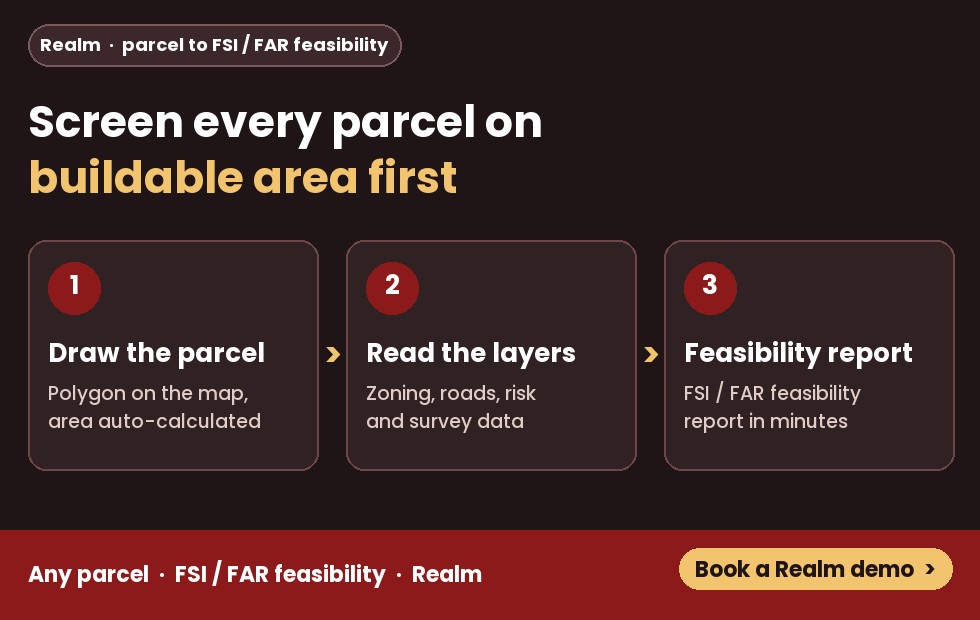
Realm’s flow from a drawn parcel to an FSI / FAR feasibility report, as listed on the Realm product page.
Common mistakes
Check buildable area before you bid
Draw any parcel in Realm, see the layers around it and get an FSI / FAR feasibility report your team can share.
Book a free Realm demoFrequently asked questions
Divide the total built-up area on all floors by the net plot area. To find what you may build, multiply net plot area by the permissible FSI. Net plot area is the plot after deductions such as road widening.
FSI is the ratio that sets how much floor area a plot can carry. TDR is floor area a landowner earns, usually for giving land for a road or reservation, and can sell. A developer loads it on another plot to build above base FSI, within the road-width cap.
Yes. Maharashtra's regulations say FSI and Bengaluru's say FAR. An FSI of 1.5 is sometimes written as 150 per cent.
Extra floor area bought from the planning authority. Under UDCPR 2020 the premium is 35 per cent of the ASR land rate. In Bengaluru, premium FAR is a multiple of base FAR and cannot be moved to another site.
Under UDCPR 2020 the TDR you can use is indexed to land rates: X = (Rg / Rr) x Y. Y is the TDR debited, Rg and Rr are the land rates of the generating and receiving plots. Cheap-area TDR gives fewer square metres on an expensive plot.
Yes. In Pune, Mumbai and Bengaluru the premium and TDR you can load rise with the abutting road width. Plots on roads below 9 m get only base FSI.
Software can measure the parcel, read the layers and run the arithmetic, which is what Realm's FSI / FAR feasibility report is for. Your architect still checks the final number against the current regulation.
This article explains how FSI, premium FSI and TDR are calculated, using the sanctioned UDCPR 2020 text, a Knight Frank summary of Mumbai’s DCPR 2034 and the Karnataka High Court’s June 2026 judgment quoting Bengaluru’s premium FAR notifications. All three rule books have been amended and change often, so every figure is indicative. This is not legal advice; confirm the current regulation with your architect, a lawyer and the planning authority before you buy land. Realm features are as listed on the TalkingLands Realm page; confirm them in a demo.