.png)
Land Acquisition Process in India: A Step-by-Step Guide for Developers (2026)
The 8-Figure Deal Collapse
Your land acquisition team identifies a pristine 50-acre parcel on the outskirts of the city. It is perfectly positioned for a new logistics park. Your scouts spend four months tracking down thirty different joint-family owners. Your legal team spends another two months clearing the fragmented titles. You negotiate the price, draft the agreements, and prepare to wire a massive, multi-crore advance.
Then, one day before signing, a spatial audit reveals a fatal flaw: the state government has recently notified a 100-meter National Highway expansion buffer that cuts directly through the center of the site, while the rear five acres sit inside a strictly protected Eco-Sensitive Zone. The land is completely unbuildable. Six months of manpower, legal fees, and aggressive negotiations are instantly wiped out by a single, overlooked geographical reality.
In India, the land acquisition process is the highest-stakes phase of any real estate or infrastructure project. Deals are routinely derailed by two things: bad data and process chaos.
Whether you are a tier-1 developer assembling land for a residential township, a private equity fund underwriting industrial assets, or an infrastructure firm navigating government acquisitions, relying on fragmented spreadsheets and outdated revenue maps is no longer viable. Here is the definitive 2026 guide to the land acquisition process in India, the critical difference between private assembly and the LARR Act, the hidden risks at each stage, and how enterprise developers are managing pipelines at scale.
Quick Answer: The land acquisition process in India operates under two primary modes. Private Assembly involves developers directly aggregating parcels from private landowners through title verification, negotiation, and sale deeds. Government Acquisition is executed under the RFCTLARR Act 2013 for public/PPP projects, involving Social Impact Assessments (SIA), mandatory consent (70-80%), and high compensation (up to 4x market value). Managing either process at scale requires moving off spreadsheets and using comprehensive Land Acquisition Management Systems (LAMS) to track pipeline stages, spatial risks, and legal due diligence simultaneously.
Why Land Acquisition is High-Stakes and Complex
Acquiring land in India is rarely a straightforward 1:1 transaction. It is an intricate legal and geographical puzzle.
- Crores at Risk: Land is the most capital-intensive component of any project. A single mistake in title clearance or zoning verification can lock up hundreds of crores in non-performing, unbuildable assets for decades.
- Extreme Fragmentation: A 100-acre project might require aggregating 40 different survey numbers from 150 different family members, each with varying demands, missing inheritance documents, and internal disputes.
- Overlapping Jurisdictions: Land is governed by a chaotic mix of state revenue laws, local municipal zoning rules, and central environmental regulations.
- Long Timelines: End-to-end assembly can take anywhere from 12 to 36 months. Without a centralized tracking system, teams duplicate efforts, brokers pitch the same land twice, and critical document deadlines are missed.
The Two Modes of Land Acquisition
To execute a project, enterprise teams must navigate one of two entirely different acquisition frameworks.
1. Private Assembly (Direct Purchase)
This is the standard process for private real estate developers, logistics operators, and commercial builders. The developer negotiates directly with private landowners on the open market. It is governed primarily by the Transfer of Property Act, 1882, state revenue laws, and the Indian Contract Act. The price is dictated purely by market forces, negotiation leverage, and the legal clarity of the title.
2. Government Acquisition (RFCTLARR Act, 2013)
When land is required for public infrastructure (highways, airports) or Public-Private Partnership (PPP) projects, the state acquires it compulsorily under the Right to Fair Compensation and Transparency in Land Acquisition, Rehabilitation and Resettlement (RFCTLARR) Act, 2013.
This Act replaced the colonial-era 1894 law and introduced stringent, pro-landowner safeguards:
- Social Impact Assessment (SIA): A mandatory study to assess how the acquisition will displace communities and affect local livelihoods.
- Consent Thresholds: For private projects utilizing government acquisition, 80% of affected landowners must consent. For PPP projects, the threshold is 70%.
- High Compensation: The Act mandates compensation up to 4x the market value in rural areas and 2x in urban areas, plus a 100% solatium (an additional premium for compulsory acquisition).
- 2026 Budget Update: Under the latest tax frameworks effective April 2026, compensation received by landowners under the RFCTLARR Act is completely exempt from income tax, making acquisition negotiations smoother for massive infra projects.
Private Assembly vs. Government (LARR) Acquisition
.png)
Step-by-Step: The Private Land Assembly Process
For private developers, the process of acquiring and aggregating land requires military-grade precision. Missing a step at stage two will inevitably cause a catastrophic failure at stage five.
Stage 1: Identification & Lead Sourcing
The process begins with local brokers, scouts, and aggregators pitching land parcels to the developer's acquisition team.
- The Risk: Broker Duplication. If you do not have a centralized Land Acquisition Management System (LAMS), two different brokers will pitch the exact same survey number a week apart, leading to double-brokerage disputes or severely damaged local relationships.
Stage 2: Spatial Screening (The "Kill" Stage)
Before lawyers are paid to read 30-year-old documents, the land must pass a geographic and spatial audit.
- What to Check: Teams must overlay the survey number boundaries against the municipal Comprehensive Development Plan (CDP) to confirm zoning. They must map the distance to highways, check for proposed government acquisition lines (like PRR/STRR), and scan for environmental buffers (lakes, Rajakaluves, forests).
- The Risk: Invisible Geometry. Buying a plot that looks perfect on paper but physically sits inside an unbuildable National Green Tribunal (NGT) buffer zone.
Stage 3: Title & Legal Due Diligence
Once the land is proven buildable, the legal team begins deep forensic land acquisition due diligence.
- What to Check: Tracing the mother deed back 30+ years, verifying Encumbrance Certificates (EC), ensuring the live RTC (revenue record) matches the seller’s name, checking for active civil litigation, and ensuring the land isn't granted (PTCL/SC-ST) land that cannot be alienated.
- The Risk: Ancestral Fragmentation. Missing a single legal heir's signature on a family partition deed, exposing the entire project to a future stay order.
Stage 4: Negotiation & Agreement to Sell (ATS)
The acquisition team negotiates the final per-acre rate based on the guideline value and nearby comparable transactions. An Agreement to Sell (ATS) is executed, and a token advance is paid to lock the land.
- The Risk: Time Lapses. If the developer's team loses track of the timeline and fails to execute the final deed before the ATS expires, the seller can legally walk away with the advance or demand a higher price.
Stage 5: Registration & Mutation
The final absolute Sale Deed is executed at the Sub-Registrar's Office (SRO). However, the acquisition is not truly complete until the revenue records are updated.
- What to Check: The developer must ensure the property undergoes mutation, officially replacing the old owner's name with the developer's corporate entity in the state's revenue ledgers. If the land is agricultural, they must immediately initiate the DC Conversion process to utilize it for development.
- The Risk: Delayed Mutation. Failing to mutate the records leaves the land vulnerable to fraudulent double-sales by the previous owner.
How Enterprise Developers Manage Acquisition at Scale
Historically, developers managed their land pipelines using chaotic WhatsApp groups, massive Excel spreadsheets, and physical filing cabinets. This led to lost leads, missed critical alerts, and fragmented data where the legal team didn't know what the spatial team had discovered.
Today, top-tier developers and PE funds deploy specialized land management software to control the chaos.
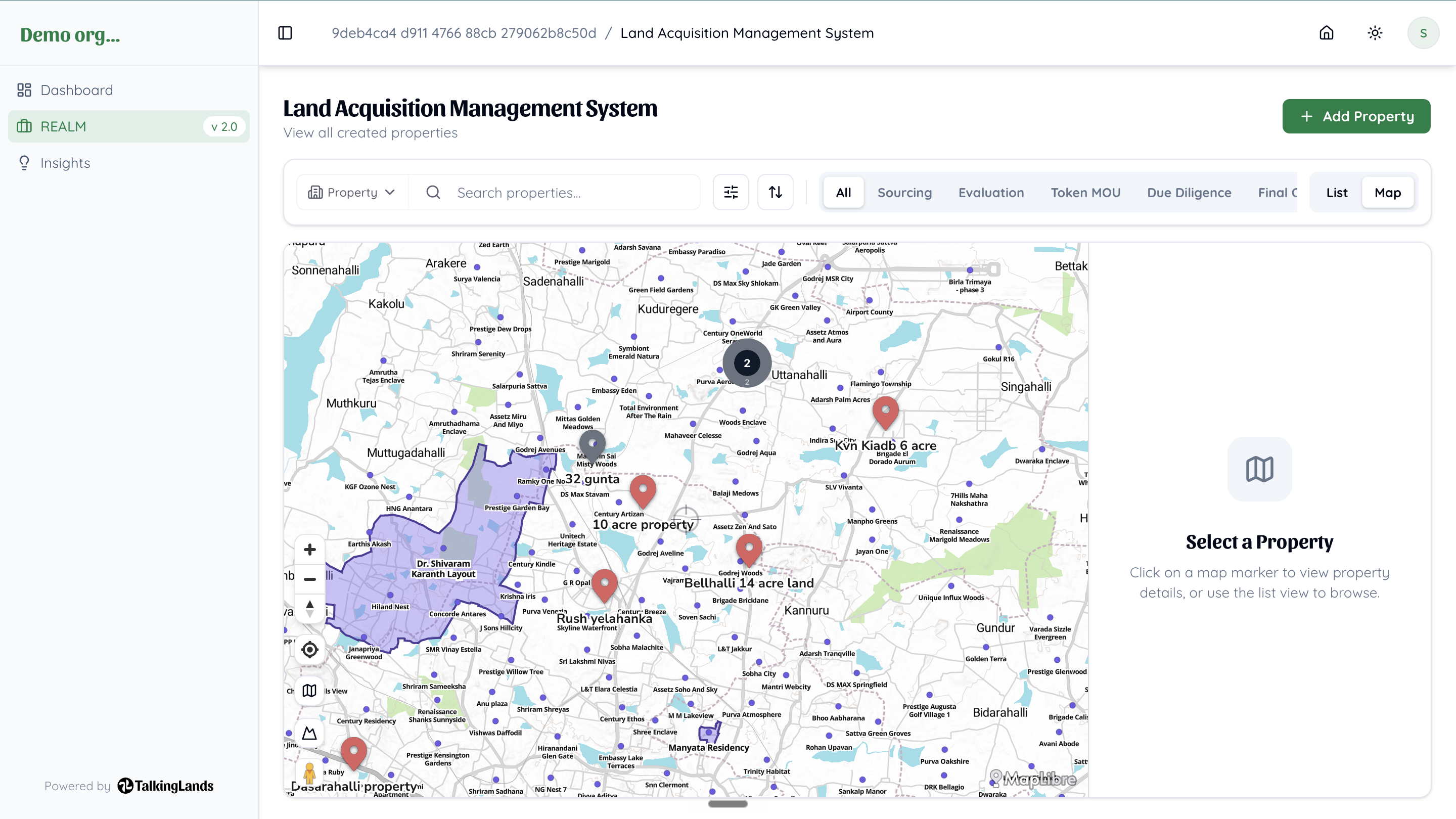
TalkingLands REALM is built specifically for the complexities of the Indian land acquisition process. It eliminates spreadsheets and replaces them with a unified, spatial-first pipeline.
With REALM, enterprise teams can:
- Centralize the Pipeline: Track hundreds of parcels across different acquisition stages (Lead → Screening → Legal → ATS → Acquired) in one unified dashboard.
- Instantly Detect Duplicates: The system automatically flags if a broker tries to introduce a survey number that is already in your pipeline.
- Run Spatial Screening in Seconds: Drop a survey number into the platform and instantly see master-plan zoning, eco-buffers, and highway setbacks before spending a single rupee on legal fees.
- Track Due Diligence: Store ECs, RTCs, and legal opinions directly on the digital land parcel, ensuring the legal and acquisition teams are always looking at the exact same data.

Frequently Asked Questions
1. What is the land acquisition process in India?
The land acquisition process involves identifying suitable land parcels, verifying legal titles and spatial boundaries, negotiating prices with owners, executing sale agreements, and finally registering and mutating the land into the buyer's name. For public projects, the government acquires land compulsorily under the RFCTLARR Act, 2013.
2. What is the RFCTLARR Act, 2013?
The Right to Fair Compensation and Transparency in Land Acquisition, Rehabilitation and Resettlement Act, 2013, is the central law governing compulsory government land acquisition. It replaced the 1894 Act and mandates Social Impact Assessments, high compensation multipliers (up to 4x for rural land), and mandatory rehabilitation for displaced communities.
3. How do private real estate developers acquire land?
Private developers acquire land through a process called "Private Assembly." They do not use government compulsory acquisition powers. Instead, they identify private landowners, conduct extensive title and spatial due diligence, and purchase the land directly on the open market through standard Sale Deeds under the Transfer of Property Act.
4. What are the biggest risks during land acquisition?
The primary risks include unbuildable land due to hidden environmental buffers or restrictive zoning, defective titles caused by missing legal heirs or undisclosed mortgages, and process inefficiencies where teams lose track of document expiry dates (like ATS validity) due to poor pipeline management.
5. Do I have to pay income tax on government land acquisition compensation?
No. Under the RFCTLARR Act, 2013, and clarified forcefully in the 2026 Union Budget updates, compensation received by individuals and Hindu Undivided Families (HUFs) for land compulsorily acquired by the government is completely exempt from income tax, regardless of whether it is agricultural or non-agricultural land.
6. Why do developers need a Land Acquisition Management System (LAMS)?
Acquiring large parcels often involves tracking dozens of overlapping survey numbers, managing multiple brokers, and coordinating between spatial, legal, and finance teams over several years. A LAMS (like TalkingLands REALM) centralizes this data, instantly flags duplicate leads, visualizes spatial risks, and keeps the pipeline moving efficiently.
.png)

.png)