.png)
The 500-Crore Blindspot
Institutional real estate is a blood sport. If you are a Tier-1 developer, a data center operator, or a logistics giant trying to secure 50 acres of prime land in India today, you are fighting a brutal war for inventory.
But here is the most shocking reality of the Indian commercial real estate market: Executive boards are making 500-crore capital deployment decisions based on broken, fragmented data.
Right now, your sourcing team is likely tracking 150 different land parcels on a massive, chaotic Excel spreadsheet. Your brokers are dropping pins on WhatsApp. Your legal team is running isolated document checks that take weeks. Your technical team is driving out to sites without realizing the land violates a master plan zoning law.
The left hand does not know what the right hand is doing. You end up negotiating against yourself through two different brokers on the exact same piece of land.
This archaic workflow is financial suicide. The era of manual land aggregation is over. In 2026, the firms dominating the market have quietly transitioned to institutional-grade land acquisition software india. They are not just finding land faster; they are underwriting geographical risk with surgical precision. Let's break down exactly why the Excel tracker is dead, and how modern site selection software real estate teams use is completely rewriting the rules of acquisition.
The Flaw in Traditional Due Diligence
Most development firms think their risk is mitigated because they hire expensive law firms to conduct due diligence. This is a fatal misunderstanding of how land fraud works in India.
Lawyers look at documents. They pull the Encumbrance Certificate (EC), trace the mutation register, and verify the title chain. If the paper trail is clean, they give you the green light.
But paper does not flood. Paper does not violate a National Green Tribunal (NGT) ruling.
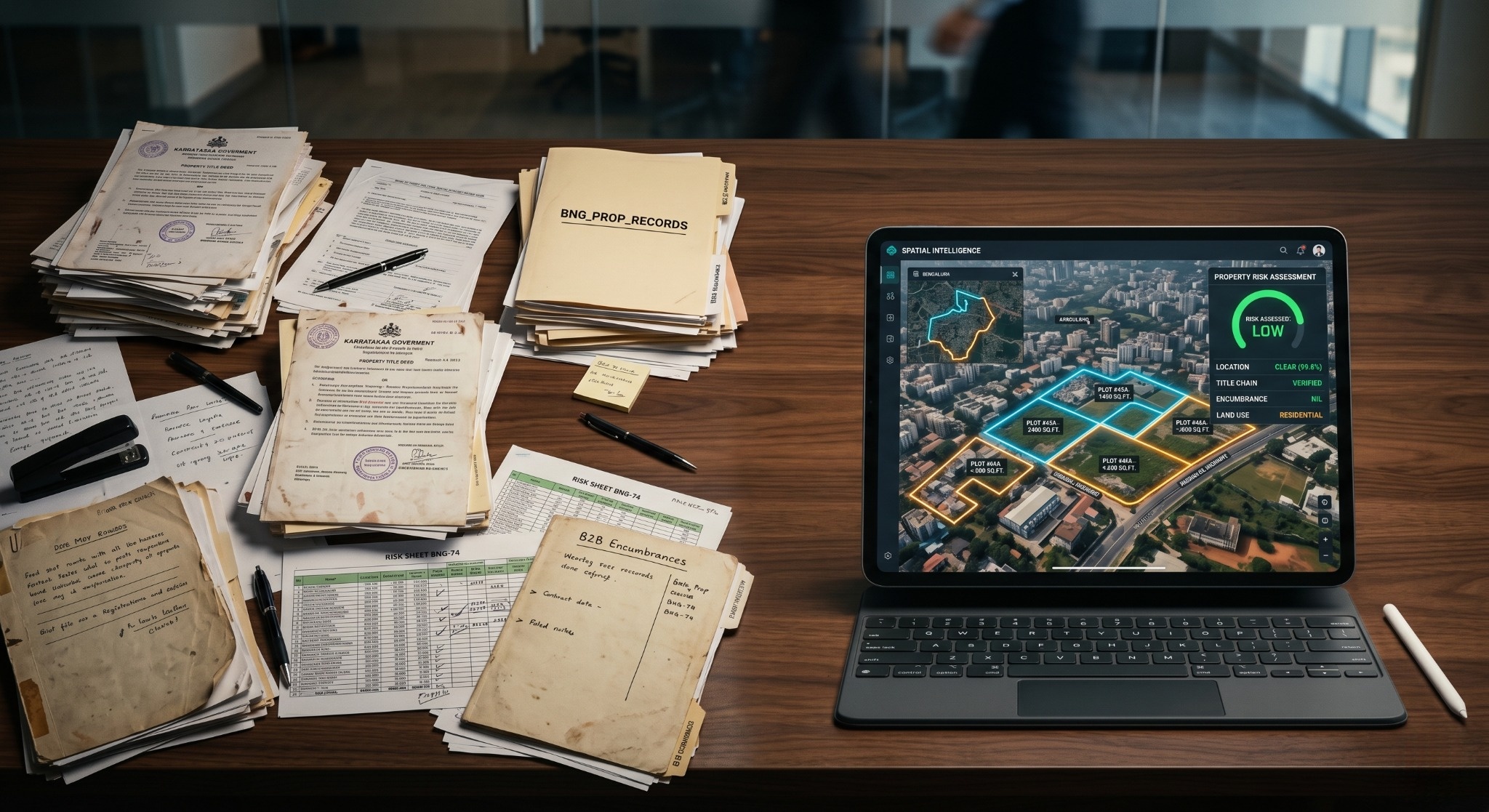
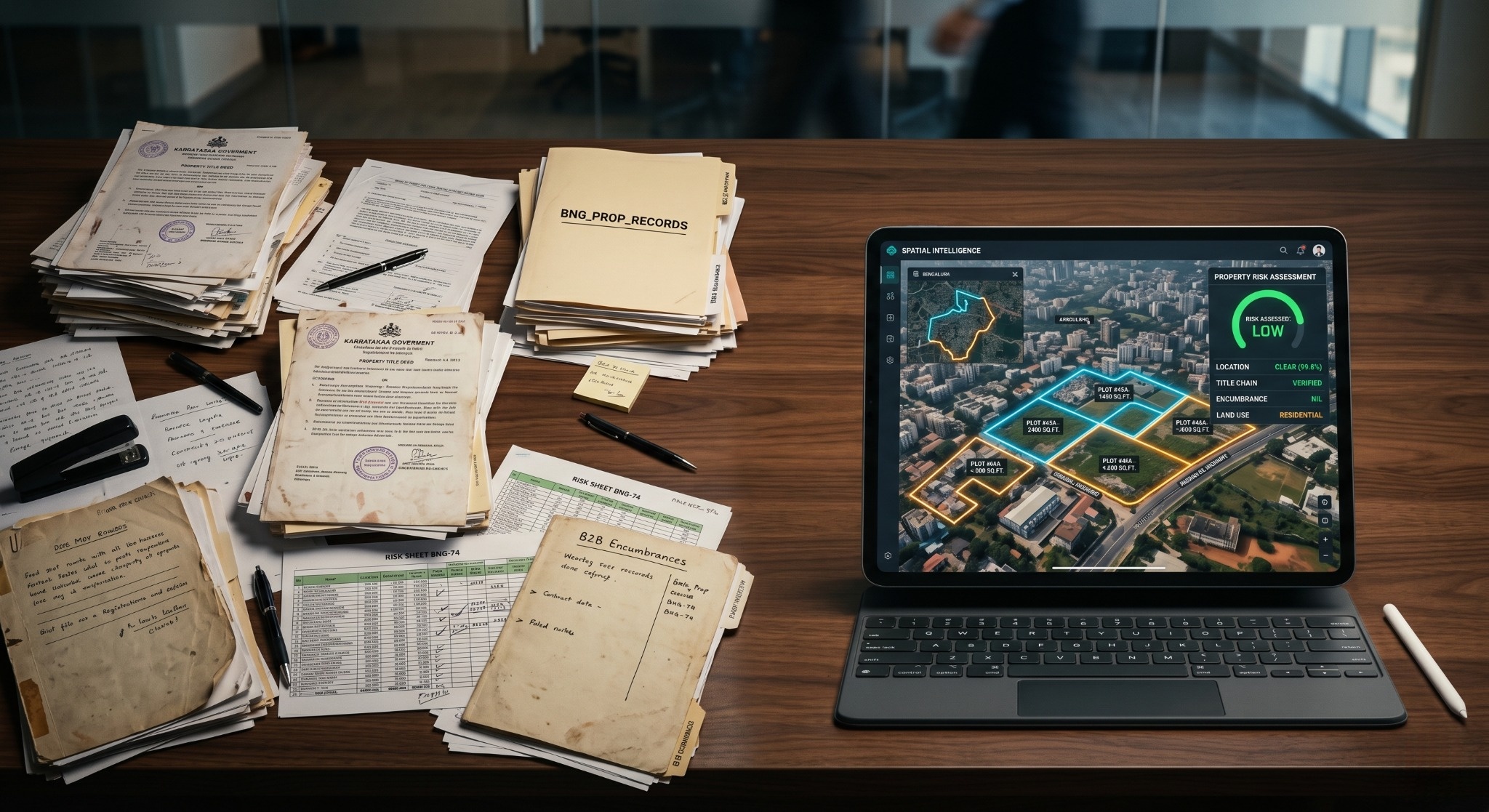
You can have a flawlessly clean title deed for a 10-acre parcel, wire a massive non-refundable advance to the landowner, and only later discover that 40% of the physical land sits directly inside a primary stormwater drain (Rajakaluve) buffer zone. Your architect's master plan gets rejected by the BDA. The project is dead. The capital is trapped.
Traditional legal checks are necessary, but they are geographically blind. This is why enterprise teams are abandoning basic document search engines and moving toward comprehensive real estate due diligence software. You need to overlay the physical legal document onto the actual topography of the earth.
Enter TalkingLands Realm: The Pipeline unified
If you want to scale your land bank, you need a single source of truth. This is exactly why we built TalkingLands Realm.
Realm is not a B2C property report tool. It is India's first end-to-end B2B land acquisition platform built exclusively for institutional acquirers. It merges a proprietary national survey number dataset with advanced spatial intelligence and pipeline management.
Here is what happens when you finally kill the Excel tracker and move your team onto a unified land management software india:
1. Instant Duplication Detection
Your sourcing manager logs a new 5-acre lead from Broker A in North Bangalore. Two days later, a junior executive tries to log the exact same parcel sent by Broker B. Realm instantly flags the duplicate based on the exact spatial polygon. You stop wasting time underwriting the same deal twice, and you stop accidentally driving up the seller's asking price.
2. Spatial Risk Overlays (The Deal Killer)
Before your legal team even opens a file, your sourcing team drops the survey number into Realm. The platform instantly overlays the exact property boundary against the official CDP (Comprehensive Development Plan) zoning maps, lake buffer zones, and infrastructure alignments (like Metro Phase 3 or Peripheral Ring Roads). If the land is zoned as an agricultural green belt when you need it to be commercial, you kill the deal in 30 seconds. You save millions in wasted legal fees.
3. End-to-End Deal Tracking
Realm visualizes your entire acquisition pipeline on a collaborative map. Your executive board can open the dashboard and see exactly which parcels are in "Sourcing," which are in "Due Diligence," and which are in "Negotiation." You can attach drone footage, legal documents, and elevation models directly to the specific polygon on the map.
The Cost of Inaction
What is the cost of buying a 10-acre parcel that gets frozen in litigation because you missed a master plan road-widening alignment? It is not just the lost capital. It is the lost time. It is the cost of your capital sitting dead while your competitors launch and sell out a premium villa project.
The commercial real estate landscape in India is digitizing at a ferocious pace. You cannot scale a modern proptech enterprise india using tools built for accountants in 1995. If you are serious about institutional site selection, you need software built specifically for the geography of Indian real estate.
Frequently Asked Questions (FAQ)
1. What exactly is TalkingLands Realm?
TalkingLands Realm is an institutional-grade B2B land acquisition and site selection software. It combines parcel-level land records, advanced spatial intelligence, ecological risk overlays, and a complete deal management pipeline into one unified map-based platform built specifically for Indian real estate developers and infrastructure funds.
2. How does Realm differ from document search engines like Landeed?
Document search engines are excellent for quickly retrieving basic legal paperwork (like an EC or Khata). However, they lack spatial context. Realm provides the documents AND the exact geographical polygon of the property, overlaying it against critical risk factors like Master Plan (CDP) zoning, lake buffers, and flood indexes—risks that flat documents cannot reveal.
3. Can Realm help prevent broker lead duplication?
Yes. This is a core feature for enterprise teams. When your sourcing team logs a new property into the Realm pipeline, the system uses spatial mapping to instantly flag if that exact land parcel (or a slightly overlapping variation) has already been submitted by another broker, saving you from negotiating against yourself.
4. Which industries use site selection software like Realm?
While heavily utilized by Tier-1 residential and commercial Real Estate Developers, Realm is also critical for Data Center operators, Logistics & Warehousing companies, Solar/Renewable energy farms, and large-scale manufacturing firms that require precise geographical analysis for massive land acquisitions.
5. Does using Realm replace my legal due diligence team?
No software replaces a qualified property lawyer. However, Realm drastically accelerates your legal team's workflow. By instantly flagging "deal-killer" spatial risks (like road-widening overlaps or zoning violations) before you even send the file to your lawyers, you save immense amounts of time and legal fees on dead-end properties.
.png)

.png)