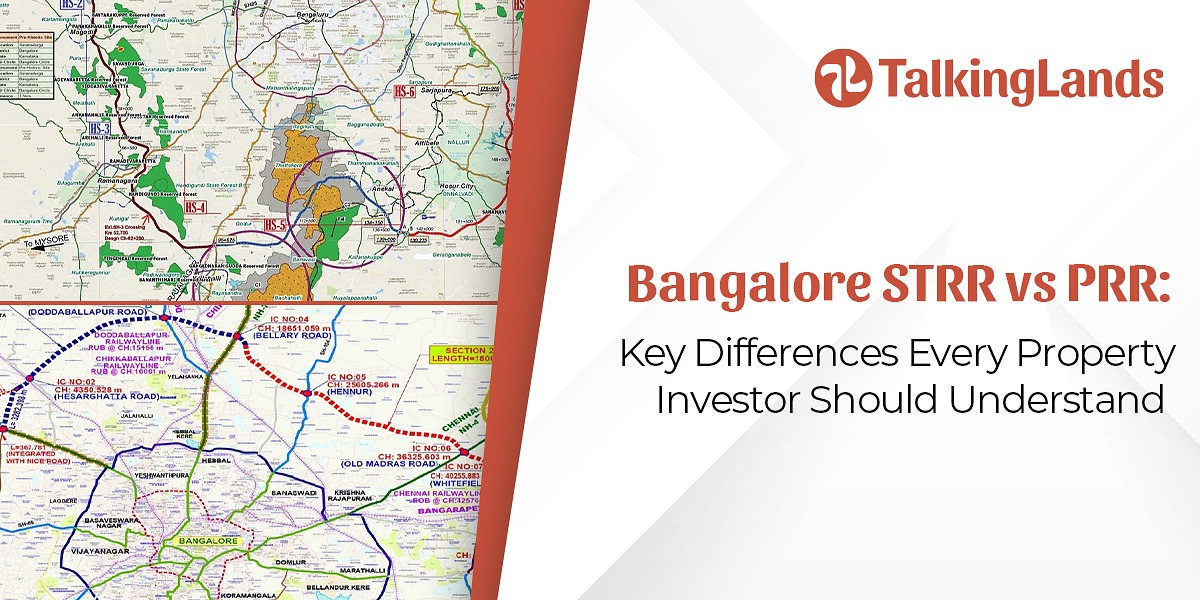
Bangalore’s growth story isn’t subtle anymore. It’s visible in traffic, in construction cranes, in how far the city has stretched over the last decade. Infrastructure has quietly been doing most of the heavy lifting here and more often than not roads decide where the next real estate wave goes.
Ring roads especially.
We’ve seen this before with the Outer Ring Road. Areas that once felt far suddenly became central. Prices followed. The same pattern is starting again but this time with two very different projects: STRR and PRR.
At first glance they sound similar. Both are ring roads. Both promise better connectivity.
But that’s where the similarity ends.
Understanding the Bangalore STRR vs PRR difference isn’t just useful, it can directly affect where you invest, how long you hold and what kind of returns you realistically expect.
The Satellite Town Ring Road or STRR is not really a “Bangalore road” in the usual sense. It sits far outside the city looping around multiple satellite towns and growth zones.
Planned and executed by the National Highways Authority of India, STRR is part of a larger national infrastructure push. Think of it less as a city project and more as an economic corridor.
It stretches close to 300 km. That’s massive.
It connects places like Doddaballapur, Devanahalli, Hoskote, Sarjapur and Ramanagara.
The idea is simple. Heavy vehicles and long-distance traffic shouldn’t be entering Bangalore at all. STRR creates a bypass so they don’t have to.
But here’s what actually happens.
Where logistics moves, land demand follows. Warehousing comes in. Then industries. Then residential pockets slowly begin forming around them.
Not immediately. But steadily.
PRR sits much closer to the city. And that changes everything.
Planned by the Bangalore Development Authority, the Peripheral Ring Road is meant to ease traffic inside Bangalore by creating a parallel high-speed corridor just outside the existing ORR.
It’s shorter around 65 to 75 km but far more directly connected to daily city life.
The route cuts through major growth zones like Yelahanka, skirts around Whitefield and connects to corridors like Sarjapur and Kanakapura Road.
On paper it’s about decongestion.
In reality it’s about expansion.
Because once commute times drop areas that felt “too far” suddenly don’t.
And that’s when residential demand kicks in.
STRR is designed to keep traffic out of Bangalore. PRR is designed to make movement within Bangalore easier.
That sounds obvious. It usually isn’t.
STRR supports freight, industry and long-distance connectivity. PRR supports daily commuters, IT employees and residential movement.
Different users. Different outcomes.
STRR operates on the outer edge almost like a second boundary for the region.
PRR sits just outside the current city limits closer to where people already live and work.
One is future-facing. The other is present-focused.
STRR falls under the National Highways Authority of India.
PRR is managed by the Bangalore Development Authority.
This matters more than most investors realise.
Central projects tend to move differently often faster in execution phases. City-led projects especially in Bangalore tend to face land acquisition delays.
That’s the catch.
STRR is nearly 300 km. PRR is about a fourth of that.
But scale doesn’t always equal impact.
STRR spreads its influence across regions. PRR concentrates it within high-demand urban belts.
STRR influences land first. Then development.
PRR influences housing demand almost immediately.
One builds value slowly. The other tends to accelerate it faster.
It’s a large outer ring expressway connecting satellite towns and enabling regional growth beyond the city.
A planned ring road closer to the city aimed at reducing traffic and improving connectivity between major corridors.
STRR operates at a regional level. PRR works at a city level. Their impact on real estate is very different.
Depends on your timeline. STRR suits long-term bets. PRR works better for quicker returns.
It increases land demand in outer areas over time especially near industrial and logistics zones.
It boosts residential demand almost immediately by improving connectivity.
Places like Devanahalli and Hoskote.
Corridors including Yelahanka and Sarjapur.
Not fully. Some stretches are operational while others are still under development.
Progress depends on land acquisition and approvals but its impact is expected to be significant once executed.




.png)
%20(1).png)