.png)
You find a beautiful plot on the fringe of a forest — clean air, birdsong, a view most buyers only dream of. The broker calls it a "nature retreat investment" and the price is well below city rates. You buy it, planning a farmhouse or a small resort.
Then your building plan is rejected. Your plot sits inside the Eco-Sensitive Zone (ESZ) of a national park, where construction is heavily restricted — and no amount of paperwork will change that.
This is one of the most under-appreciated traps in Karnataka land buying. The state is dotted with national parks and wildlife sanctuaries, and each is wrapped in a legally protected buffer where development is banned or tightly regulated. Whether you're eyeing land near Bannerghatta on Bengaluru's southern edge, or a scenic parcel near Bandipur, BR Hills or MM Hills, here's the 2026 guide to ESZ and protected-area rules — what's allowed, what isn't, and how to check a plot before you buy.
Quick answer: An Eco-Sensitive Zone (ESZ) is a legally notified buffer around a national park or wildlife sanctuary where development is restricted to protect the ecosystem. In Karnataka, each protected area has its own ESZ notification from the Ministry of Environment, Forest and Climate Change (MoEFCC), with buffers ranging from a few hundred metres to several kilometres. Inside an ESZ, mining and polluting industry are banned, most construction is regulated (needs clearance), and only farming and low-impact uses are freely permitted. Before buying near any forest, overlay the survey number on a Protected-Area map layer to confirm it isn't inside a restricted zone.
A Protected Area is a national park or wildlife sanctuary notified under the Wildlife (Protection) Act, 1972 — the highly protected ecological core.
An Eco-Sensitive Zone (ESZ) is the buffer wrapped around that core, notified by the MoEFCC under the Environment (Protection) Act, 1986. Think of it as a "shock absorber" that steps development down from the city to the forest, so pollution, traffic, and construction don't crash straight into wildlife habitat. The Supreme Court has directed that protected areas must have notified ESZs, and each park's zone is fixed by its own gazette notification — which is why the buffer distance differs from one park to the next.
For a land buyer, the key point is simple: once your plot falls inside an ESZ, the MoEFCC and forest authorities — not just the local planning office — have a say in what you can build.
For most buyers, the trap is the Regulated bucket: residential construction is often technically possible in an ESZ, but only within the ESZ Zonal Master Plan's caps (height, FAR) and after clearance from a district monitoring committee — a slow, discretionary process that kills most speculative plotted layouts. And if the plot sits in a prohibited pocket or on a wildlife corridor, no clearance will save it.
.png)
Karnataka has one of India's richest networks of parks and sanctuaries. For land buyers, the level of relevance varies a lot by location:
Each of these carries its own ESZ notification with a different buffer extent — so a "safe distance" near one park means nothing at another.
The pattern repeats everywhere: a seller offers "cheap, scenic, forest-view" agricultural land on a park's edge. Because the land looks like an ordinary open field, the buyer never realises it sits inside an ESZ. Years later — when they try to get a building sanction, a khata, or a loan — the authority references the ESZ notification and refuses. The result is frozen, unbuildable, un-resellable land. The scenery was real; the building rights were never there.
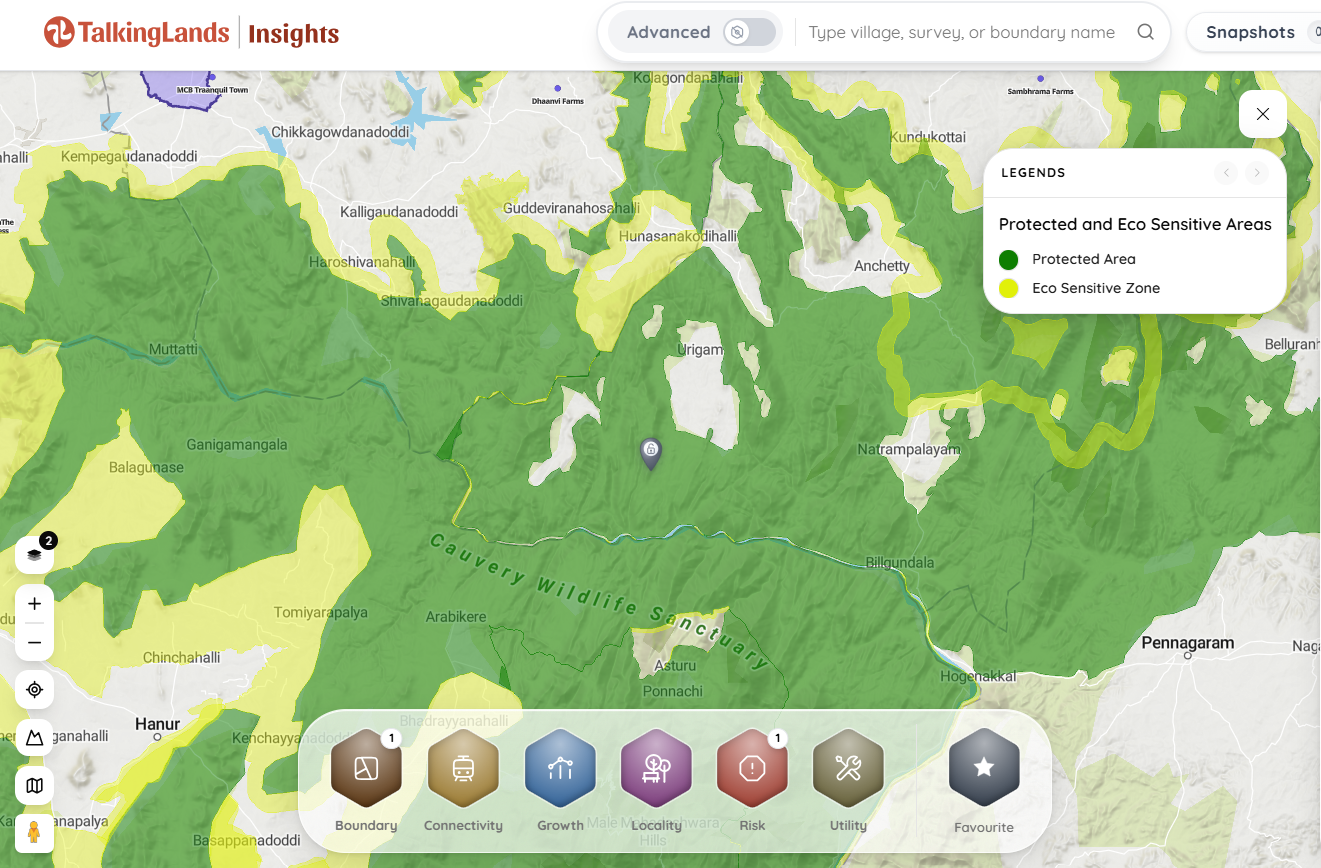
You cannot judge an ESZ boundary by standing on the plot — it's set by a gazette notification, not by how far away the trees look. Overlay the exact survey number on a spatial Protected-Area layer to see instantly whether the plot falls inside a protected area or its ESZ buffer, and cross-check zoning and other risks in the same view.
Reading MoEFCC notifications and matching them to your plot is near-impossible by hand. On TalkingLands Insights, drop the survey number, activate the Protected Area / Eco-Sensitive Zone layer, and see at a glance whether your plot is inside a park buffer — plus zoning, lake/drain buffers and other risks on the same screen — before you commit a rupee.
1. What is an Eco-Sensitive Zone (ESZ)?
An ESZ is a legally notified buffer around a national park or wildlife sanctuary, declared by the MoEFCC under the Environment (Protection) Act, 1986, to shield the protected area from pollution and unregulated development. Inside it, certain activities are banned and others are tightly regulated.
2. Can I build a house near a national park in Karnataka?
Sometimes — residential construction is usually "regulated," not banned, in an ESZ. But you must follow the ESZ Zonal Master Plan (height/FAR limits) and get clearance from the district monitoring committee. In prohibited pockets or on wildlife corridors, construction is not allowed at all.
3. How far does an ESZ extend?
It varies by park — each protected area has its own MoEFCC notification, with buffers ranging from a few hundred metres to several kilometres. There is no single universal distance; always check the notification for the specific park.
4. Which national parks near Bangalore affect land buyers most?
Bannerghatta National Park (South Bengaluru) is the most relevant, as its ESZ covers fast-developing belts like Jigani, Anekal and Bannerghatta Road. Bandipur, Nagarhole, Cauvery WLS, BR Hills and MM Hills mainly affect buyers in the southern forest districts.
5. What happens if I buy land inside an ESZ without knowing?
Your building plan can be rejected, you may be unable to get a khata or a loan, and any unauthorised structure in a prohibited zone can face demolition. The land often becomes frozen and hard to resell.
6. How can I check if a plot is inside an ESZ or protected area?
Overlay the survey number on a spatial Protected-Area layer (such as TalkingLands Insights) to see instantly whether it falls inside a park or its ESZ buffer, and verify the zoning at the same time.



%20(1).png)
.png)