.png)
You inspect a plot in the dry season — the ground is firm, the layout is clean, the roads are laid, and the price is noticeably lower than the plots two streets over. The broker assures you the area is "fully developed." You pay the advance.
What you couldn't see in February is that this exact spot becomes knee-deep water every monsoon, because it sits in a natural valley beside a stormwater drain that was quietly built over upstream, on land that was once part of a lake's tank bed. By the time you discover it, the foundation work has begun — and the cost of that mistake is now baked into your asset forever.
This is one of the most common and most expensive traps in Indian real estate, and it is especially brutal in Bengaluru, a city built on a chain of interconnected lakes. Buyers inspect land when it is dry and only discover the flooding after they have built. The damage is permanent: waterlogging, weakened foundations, ruined ground floors, rejected building plans, unsellable plots, and in buffer cases, demolition notices.
Learning how to check if land is in a flood zone before you transfer money is one of the most important steps in land due diligence — and the good news is that you no longer have to guess, rely on a broker's word, or wait for the rains to find out. With the right data, you can assess a plot's flood risk in minutes.
This is the complete 2026 guide to identifying flood-prone land in India: what actually causes it, the official data sources to check, the step-by-step verification process, and how to confirm any plot's flood risk before you commit your capital.
Quick Summary: To check if land is in a flood zone, assess four things — the plot's elevation (is it low-lying or in a valley?), its distance from lakes, tank beds and stormwater drains (Rajakaluve), the area's flooding history, and monsoon satellite imagery. The fastest, most reliable method is to overlay the plot's survey number on a Flood Index map layer that shows terrain, water bodies, and buffers in one view.
In many Indian cities, urban development has outpaced drainage planning by decades. Bengaluru is the clearest example: the city historically had hundreds of interconnected lakes (tanks), each linked to the next by natural stormwater channels called Rajakaluves. Rainwater would flow from higher tanks, through the drains, down to lower tanks, and the whole system balanced itself.
Over the last few decades, a large share of those lakes and drains have been encroached, narrowed, or built over. When you remove the path that water naturally takes, the water does not disappear — it simply finds the next lowest point and floods it. That "next lowest point" is very often a freshly developed layout sold to unsuspecting buyers as prime residential land.
This is why a plot that "never flooded" five years ago can start flooding now: an upstream lake got encroached, a drain got blocked, and the runoff rerouted onto previously dry ground. Flood risk in Indian cities is dynamic, not static — which is exactly why you must verify it with current spatial data rather than trust historical assurances.
.png)
Use this table to quickly gauge a plot's baseline flood risk based on where it sits in the terrain:
Flooding is rarely random. It follows the natural movement of water across the landscape, and a handful of factors decide whether a plot stays dry or turns into a pond:
Before you rely on any seller's claim, cross-check independent, authoritative sources:
Note: These sources are accurate but highly fragmented across portals and formats. The practical challenge is combining elevation, lake boundaries, drain networks and a specific plot's polygon into a single view — which is where a spatial platform saves weeks of effort.
This is the part novice buyers miss. Flooding is not just a maintenance headache — when the water risk comes from a lake or Rajakaluve, it usually overlaps with a legally enforced buffer zone.
The National Green Tribunal (NGT) and local authorities mandate strict no-construction buffers around lakes and primary drains. A plot inside that buffer cannot get a sanctioned building plan, cannot obtain a clean Khata, and any structure built there is exposed to immediate demolition.
So a flood check and a buffer check must be done together. A plot can be technically "buildable" on paper but still flood; and a plot can be on dry-looking ground but still be frozen by a buffer. You need to see flood risk, lake buffers, and drain buffers in one overlay to make a safe decision.
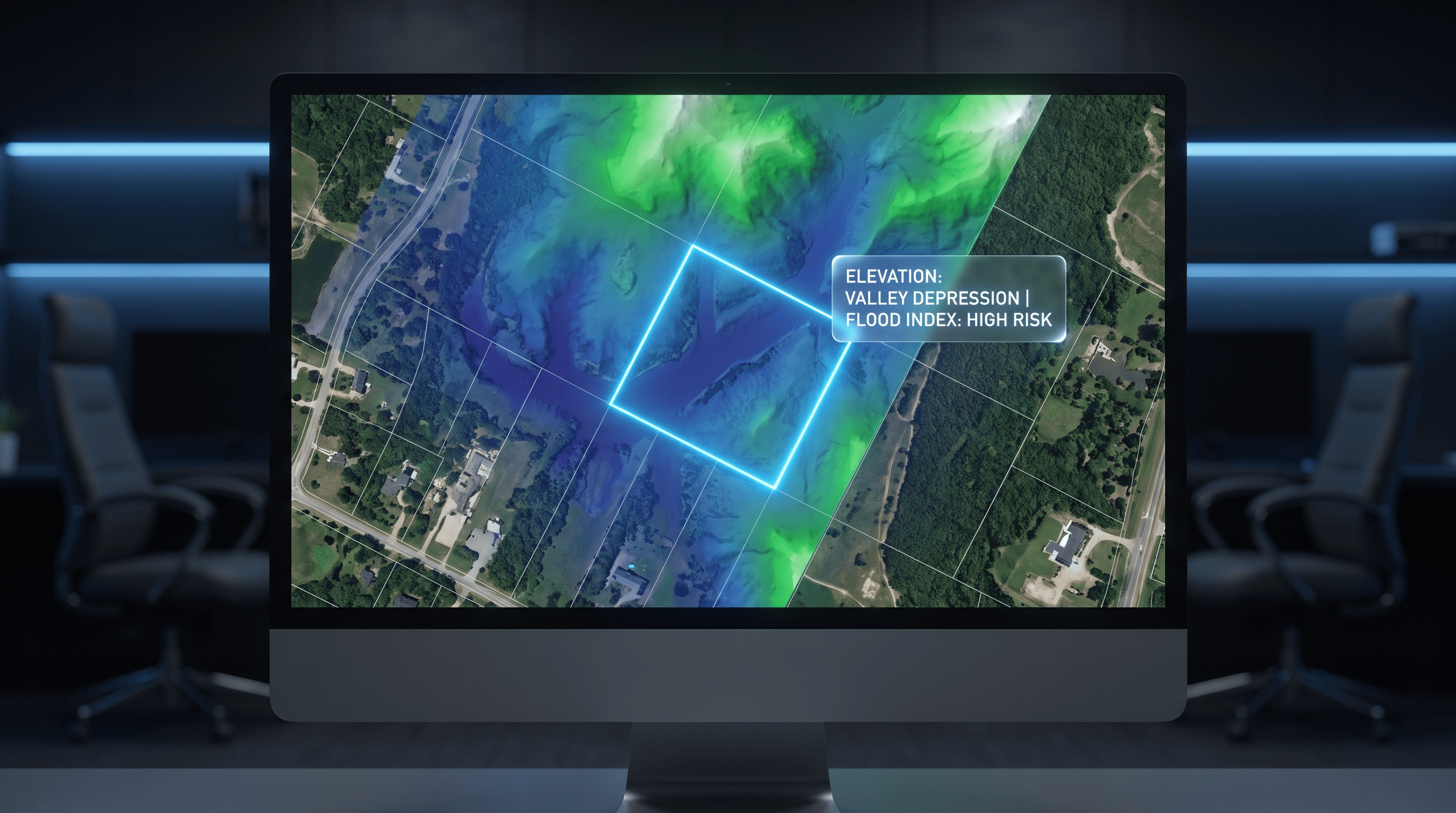
You cannot reliably judge flood risk by standing on a dry plot, because water risk is about the terrain and drainage around it — something only visible from above. This is exactly what TalkingLands Insights is built for.
By dropping the plot's exact Survey Number into our spatial engine, you can overlay the property polygon onto a live, high-resolution satellite map and switch on the Flood Index layer for an instant risk rating.
In the same view, you can activate the Lake Buffer, Rajakaluve, and Topography layers to understand exactly why the risk exists. Instead of guessing in summer and praying through the monsoon, you can mathematically see whether your plot is on safe high ground or in a flood trap before you write the cheque.
1. How do I check if land is in a flood zone in India?
Check the plot's elevation (is it low-lying or in a valley?), its proximity to lakes, tank beds and stormwater drains, the area's flooding history, and monsoon satellite imagery. Cross-check official sources like ISRO Bhuvan and CWC, or — fastest — overlay the survey number on a Flood Index layer in a platform like TalkingLands Insights.
2. Why does land near a lake or tank bed flood?
Cities like Bengaluru were built around interconnected lakes (tanks) linked by drains. Land on a (sometimes dried-up) tank bed or in the valley between lakes sits at the lowest point, so monsoon runoff naturally collects there first.
3. Can I build on flood-prone land?
Sometimes, with heavy engineering like a raised plinth and proper drainage — but if the risk comes from a lake or Rajakaluve buffer, construction is legally restricted and won't be sanctioned. Always confirm the buffer and zoning laws before considering any engineering fix.
4. Does a dry-looking plot mean it's safe from flooding?
No. A summer site visit tells you nothing about monsoon behaviour. Flood risk depends on the surrounding terrain and drainage, which you can only assess through elevation data and satellite imagery.
5. Which government sources show flood-prone areas in India?
ISRO Bhuvan (flood hazard maps), the Central Water Commission (river flood data), the NDMA and state disaster management authorities, and municipal lake/stormwater-drain records.
6. How can I check flood risk without visiting in the monsoon?
Run the plot's survey number through TalkingLands Insights and overlay the Flood Index, lake buffer, Rajakaluve, and elevation layers to see the true risk rating — and the reason behind it — instantly.
7. Is flood risk the same as being in a lake or drain buffer?
Not exactly. Buffer zones are a legal no-build distance around water bodies and drains; flood risk is the physical likelihood of inundation. They often overlap, but you should check both — a plot can flood without being in a buffer, and be legally restricted without obvious visual flooding.



.png)

.png)