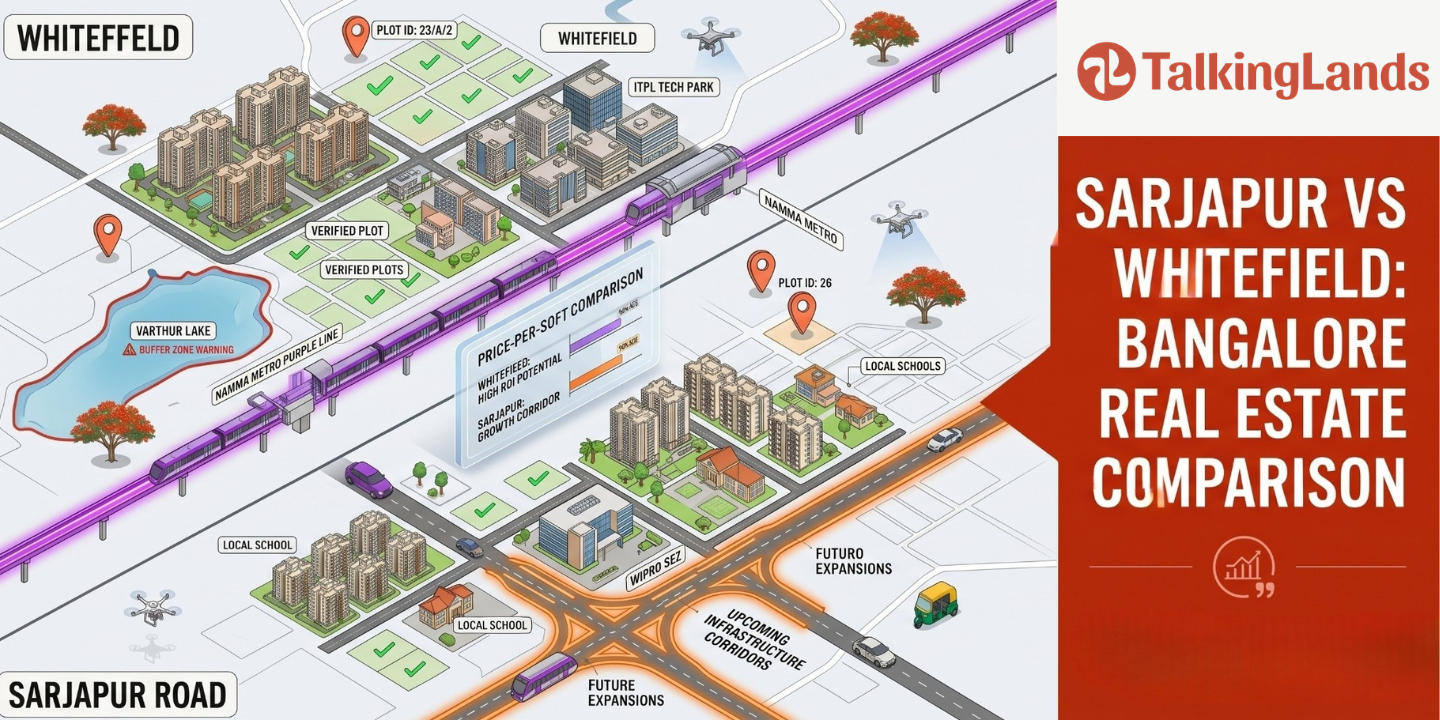
If you work in tech and you're house-hunting in East Bangalore, you're going to hit a wall eventually. It’s the classic sarjapur vs whitefield dilemma.
Both areas are absolute economic engines. Both have massive multinational tech parks, those premium international schools everyone wants their kids in, and a highly cosmopolitan crowd. But if you look under the hood, they are sitting at very different stages of their real estate life cycles.
Dropping a few crores based on a developer’s glossy brochure isn't going to cut it anymore. You need to understand what these markets actually look like in 2026, what the infrastructure pipelines are doing to property values, and the localized risks that brokers conveniently forget to mention. Let's break down the ultimate whitefield vs sarjapur road comparison so you can make a call that actually makes financial sense.
The Ground Reality: Vibe & Market Maturity
Whitefield: The Finished Puzzle
Whitefield is fully baked. What started as a distant tech suburb is now a completely self-sustaining mega-market. Buying property in whitefield today means buying into an established ecosystem. You have massive malls, five-star hotels, and specialized hospitals already functioning. If you have a family and you want immediate comfort without waiting years for the neighborhood to "develop," Whitefield is hard to beat.
Sarjapur Road: The Aggressive Growth Corridor
Sarjapur Road is a different beast entirely. Yes, it has established anchors like the Wipro SEZ, but drive down the stretch and you'll see it's still very much a high-growth construction zone. Its biggest flex is its geography—it connects directly to the Outer Ring Road (ORR), HSR Layout, and Electronic City. Investors love Sarjapur because it’s still evolving, which means the ceiling for property appreciation is arguably higher right now.
Before we get into the heavy numbers, play around with this interactive dashboard to see how the two areas stack up on a macro level:
The Numbers Game: Prices & Rental Yields
You can't calculate your ROI without understanding whitefield property prices against the entry costs of Sarjapur.
- The Whitefield Premium: Because the market is mature, the entry barrier is steep. In 2026, premium Grade-A apartments here easily command between ₹11,500 to ₹16,000 per sq. ft. The trade-off? The capital appreciation is incredibly steady. The best areas in whitefield (like ECC Road or Kadugodi) are pretty insulated from sudden market corrections.
- The Sarjapur Entry Point: Sarjapur gives you a slightly more forgiving entry price, generally sitting between ₹9,500 to ₹13,500 per sq. ft. Because the area is still aggressively absorbing new commercial supply, the year-on-year capital appreciation percentages often outpace Whitefield.
- Who Wins on Rent?: Sarjapur Road currently edges out Whitefield slightly in rental yield (often crossing the 5% mark). Why? Because it acts as a massive residential catchment for the entire ORR IT crowd who want an easier commute to places like Bellandur or Electronic City.
The 2026 Metro Reality Check
Infrastructure dictates property value in Bangalore. Period. By looking at the latest CDP bangalore (Comprehensive Development Plan), the future trajectories become pretty obvious.
- Whitefield's Operational Advantage: Whitefield has already won the metro race. The fully operational Namma Metro Purple Line changed the game, slashing commute times to the CBD. That connectivity is largely why property values here surged so hard between 2023 and 2025. The infrastructure is priced in.
- Sarjapur's Massive Catalyst: If you check the latest bangalore metro corridor map and 2026 updates, Sarjapur is on the brink of its own boom. The Phase 3A Sarjapur-Hebbal line just cleared the State Finance Department in May 2026. Once that and the planned Peripheral Ring Road (PRR) intersections take shape, Sarjapur will fundamentally decongest. Buying here now means you are getting in before the metro is fully operational and priced into the real estate.
Frequently Asked Questions (FAQ)
1. Which gives a better rental yield: Sarjapur or Whitefield?
Sarjapur Road currently offers slightly higher rental yields (often 5%+) compared to Whitefield. This is largely because of its strategic location—it serves as the primary residential hub for the massive ORR tech workforce looking for relatively more affordable housing options close to work.
2. Are whitefield property prices expected to drop?
No, a drop is highly unlikely. Whitefield is a mature market where land is becoming scarce. While the crazy, aggressive price spikes we saw a couple of years ago might level out, the values aren't going backwards. Expect steady, inflation-beating appreciation.
3. Is the metro actually coming to Sarjapur Road?
Yes. As of May 2026, the Phase 3A (Sarjapur to Hebbal) corridor just received clearance from the State Finance Department. Once operational, it will drastically improve connectivity for Sarjapur residents heading toward Koramangala, Hebbal, or integrating with the Blue Line for airport runs.
4. How do I avoid buying a property that floods in these areas?
Because East Bangalore's natural drainage has been heavily disrupted historically, you have to do strict property verification bangalore using digital maps. You need to ensure your specific property sits on a higher elevation and is well outside any rajakaluve bangalore pathways or lake buffer zones. Don't take the builder's word for it—verify the survey number yourself
.png)

.png)