.png)
How to Check Who Owns a Property in Karnataka: Land Ownership Records Explained (2026)
The Seller Who Wasn't the Owner
You find a stunning plot on the outskirts of Bengaluru. The seller seems completely genuine, presents a neat folder of photocopied land records, and shows a signed General Power of Attorney (GPA) from the original family. The price is highly competitive, the token advance is paid, and an agreement is signed.
Months later, when your legal counsel attempts to register the absolute sale deed at the Sub-Registrar’s office, the transaction is abruptly halted. The digital system flags a major violation: the seller standing in front of you is not the actual legal owner listed in the state’s centralized database. The property is ancestral land, two surviving heirs never signed the GPA, and a local bank holds an uncleared mortgage over the entire survey number. Your hard-earned capital is instantly trapped in a multi-year civil court battle.
When dealing with real estate transactions in Karnataka, knowing exactly how to check land ownership is the absolute foundation of secure investing. Assuming that a clean physical paper title or a broker's word equals absolute ownership is an incredibly risky gamble.
Whether you are an individual buyer looking for a villa plot or a commercial developer assembling a new project, this is the definitive 2026 guide to Karnataka's land ownership documents, the critical difference between rural and urban verification, and how to instantly trace records, legal disputes, and spatial risks in one place.
Quick Answer: To check who owns a property in Karnataka, verify five core records: the RTC/Pahani (for agricultural/revenue land), the Khata (for urban property), the Encumbrance Certificate (EC), the Mutation register, and the registered sale deed. You can check these across multiple government portals (Bhoomi, Kaveri 2.0, e-Aasthi)—or you can use TalkingLands Ownership Intelligence to look up owner holdings, ULPIN, court cases, and spatial risk instantly by just entering the survey number.
What Ownership Legally Means: Why the Sale Deed Alone Fails
The most common mistake property buyers make is relying solely on a registered Sale Deed to verify ownership. A Sale Deed is undeniably the primary title document—it is the legal contract that transfers a property from Buyer A to Buyer B.
However, a Sale Deed only proves that a transaction occurred at a specific point in time. It does not prove that the seller still retains absolute, unencumbered rights to the property today.
For instance, a seller could hold a valid registered deed from five years ago but may have secretly mortgaged the plot to a bank last year, or a civil court may have issued an active stay order on the land. Alternatively, the revenue department may have rejected the mutation of that deed due to an underlying boundary dispute.
True legal ownership is only established when the title deed perfectly matches the active revenue registers of the state. If the seller’s name does not show up as the current landholder in the government’s live digital databases, they cannot legally transfer the title to you.
The 5 Records That Prove Ownership
In Karnataka, property ownership is established by a chain of five distinct documents, managed by different government departments.
1. RTC / Pahani (Rural & Revenue Land)
If the plot is agricultural land, a farm plot, or an unconverted revenue site, the absolute source of truth is the RTC (Record of Rights, Tenancy and Crops). This ledger tracks who owns the land, the precise boundaries of the survey number, the breakdown of joint-family shares (Hissa), the type of soil, crops grown, and any active bank liabilities. (Read our deep dive on How to Check RTC/Pahani Online).
2. Khata & Property Tax (Urban & Converted Land)
Once an agricultural land parcel undergoes official DC Conversion and is approved for residential or commercial use, it enters the urban municipal framework. The local municipal corporation or the Greater Bengaluru Authority (GBA) issues a Khata (such as an e-Khata or A-Khata). The Khata identifies the owner responsible for paying property taxes and serves as the legal record for urban properties.
3. Encumbrance Certificate (EC)
The EC is a continuous ledger maintained by the Department of Stamps and Registration. It logs every single legally registered transaction—including past sales, gifts, partitions, release deeds, and bank mortgages—associated with that specific property over a specified block of time (typically requested for 15 to 30 years).
4. Mutation Register (MR)
When a property changes hands via a sale or inheritance, the revenue records must be modified. This process is called mutation. The Mutation Register captures the exact public notices, objector windows, and official entry logs that transitioned the property from the previous owner to the current seller.
5. Registered Sale Deed
The primary, foundational legal document establishing absolute title transfer, registered at the local Sub-Registrar's Office (SRO).
Ownership Record Cheat-Sheet
.png)
How to Check Your Records Online (Government Portals)
If you prefer navigating government systems manually, Karnataka has digitized its land registration framework across several disconnected platforms:
- Checking the RTC via Bhoomi: Navigate to the official Bhoomi portal, select "View RTC and MR," and enter the precise geographic metadata of the property (District, Taluk, Hobli, Village, and Survey Number).
- Checking the EC via Kaveri 2.0: Log into the Kaveri 2.0 system and select "Online EC." Search using the property details to pull an EC dating back to 2004 to check for an unbroken chain of title.
- Checking Urban Khatas via e-Aasthi: For properties within urban limits, access the centralized e-Khata or e-Aasthi portal mapped to the local urban body. Enter the PID or Khata number to verify the active tax assessment records.
How to Match the Owner to the Seller (Spotting Red Flags)
When executing property due diligence, you must treat your documents like a puzzle—every single piece must interlock perfectly. Watch out for these deal-breaking red flags:
- Name Mismatches: The name on the seller’s PAN or Aadhaar card must precisely match the owner name on the current RTC or e-Khata, the latest entry in the Mutation Register, and the primary Sale Deed.
- The GPA Trap: Selling properties via a General Power of Attorney is a major litigation risk. If a seller is using a GPA, verify it was registered at an official Sub-Registrar's office, check for explicit "power to sell" clauses, and confirm the original executant is still alive and hasn't revoked it.
- Land Extent Discrepancies: If the Sale Deed states the seller owns 2 acres, but the live RTC displays their actual share as 1.2 acres, the revenue records take precedence. You are only legally buying 1.2 acres.
- Agricultural Land Sold as Layout Plots: If a broker offers you a site in a residential layout, but the official records still reflect an active RTC classified as agricultural land, the layout is unauthorized.
The Faster Way: TalkingLands Ownership Intelligence
Jumping between the Bhoomi portal for an RTC, Kaveri for an EC, and e-Aasthi for a Khata is tedious. Furthermore, none of these pure-record websites tell you if the plot is physically safe to build on.
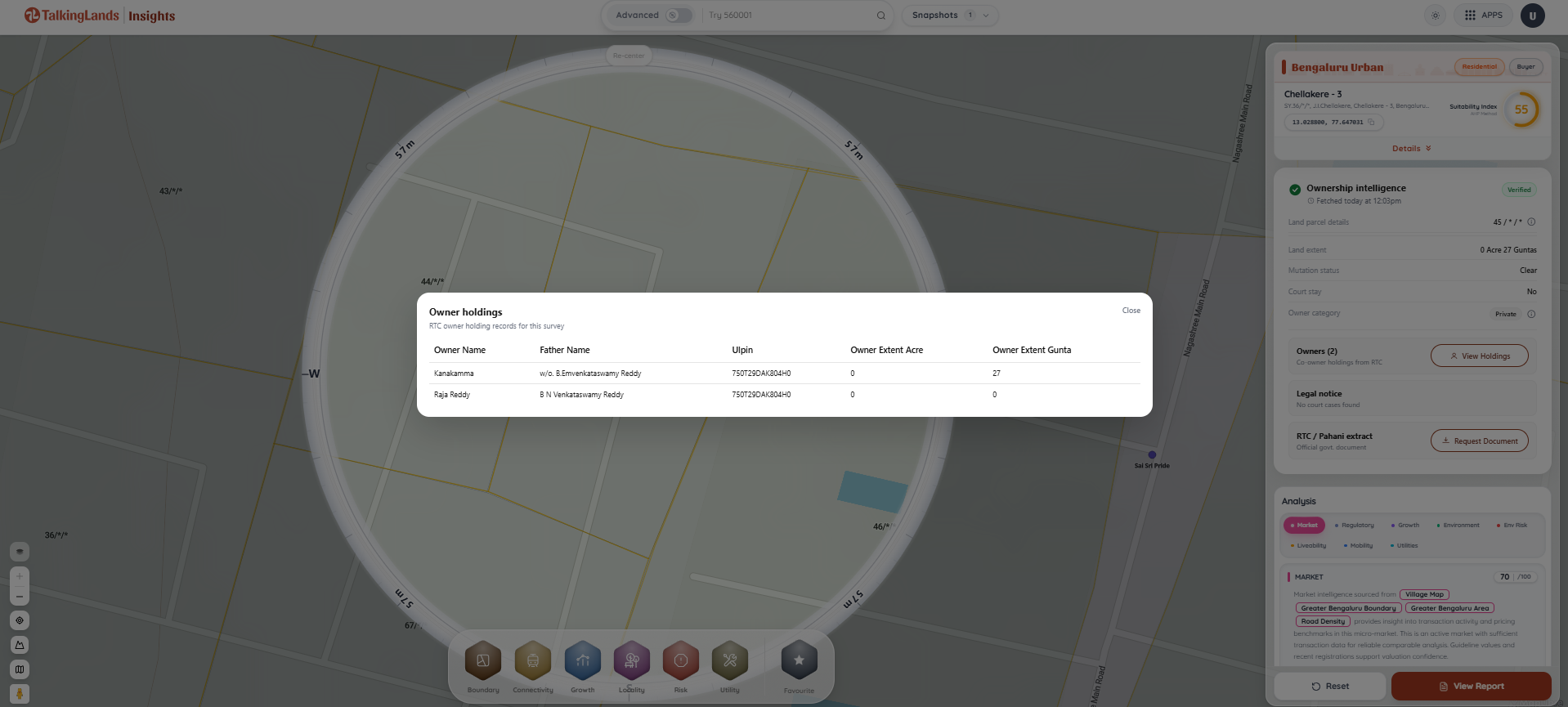
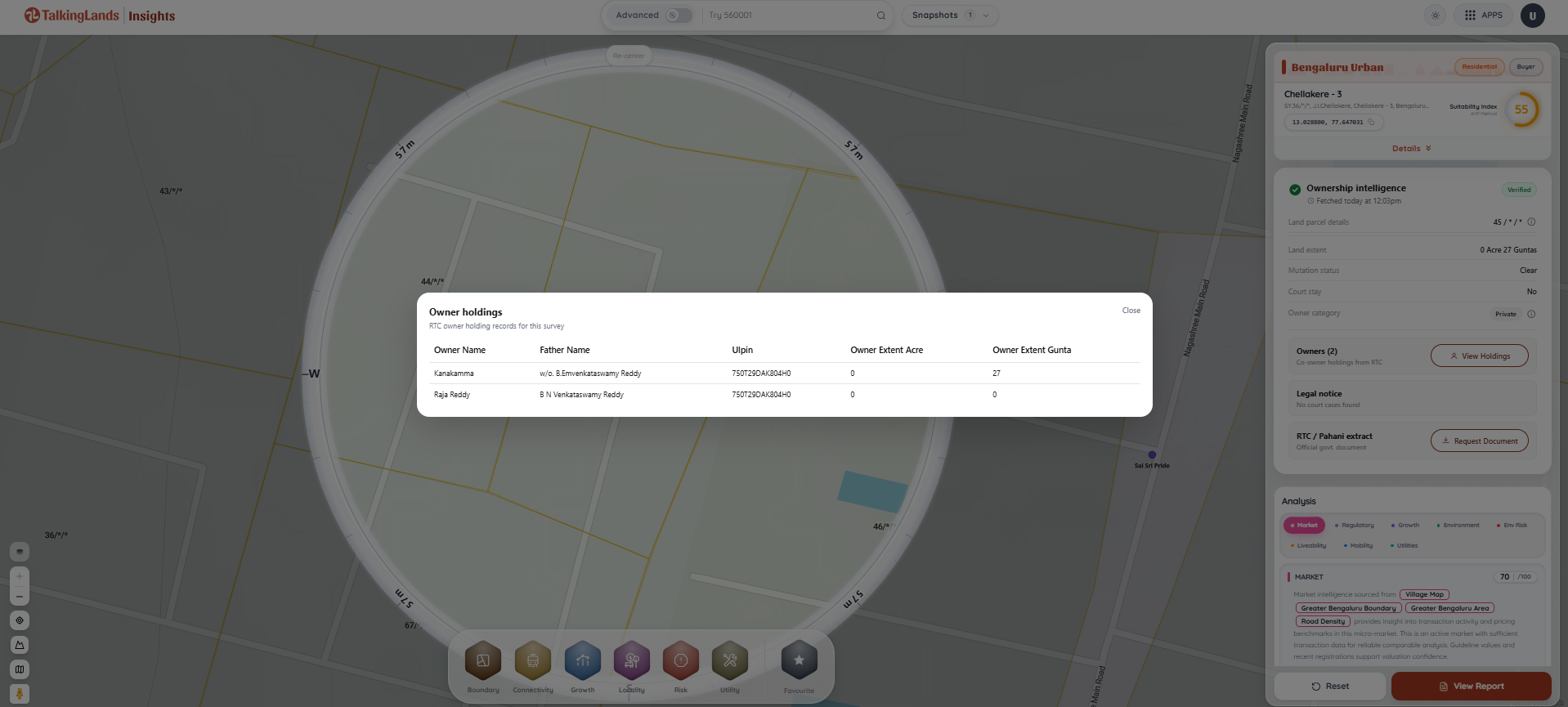
Unlike basic document retrieval sites, TalkingLands Ownership Intelligence brings everything into one unified dashboard. From owner verification to buildability, we give you the complete picture instantly.
For any survey number in Karnataka, TalkingLands provides:
- Live Owner Holdings (RTC Data): See the exact owner's name, father's name, land extent (acres/guntas), and owner category directly from the state's revenue databases.
- Unique Identification: View the official ULPIN (Unique Land Parcel Identification Number).
- Mutation Status: Instantly verify if the revenue department has completed the title transfer.
- Legal & Court-Case Check: A vital layer of security that standard RTCs miss. TalkingLands automatically scans for active litigation tied to the survey number, delivering a clear "No court cases found" or flagging active disputes.
- Official Document Requests: Need the certified copy? You can request the official RTC / Pahani extract directly through the platform.
- Spatial Risk Integration: Ownership is only half the battle. On the exact same screen, you can see if your verified plot clashes with local master plan zoning or sits inside dangerous environmental buffers or hidden risk zones.
You no longer have to wonder if a clear title hides a geographic nightmare.
Frequently Asked Questions
1. How to check land ownership online in Karnataka?
To check ownership online, you can use government portals (Bhoomi for agricultural RTCs, Kaveri 2.0 for ECs and deeds, and e-Aasthi for urban Khatas). Alternatively, you can use TalkingLands Ownership Intelligence to look up owner holdings, mutation status, and court cases instantly using just the survey number.
2. Can I check a property owner's details purely by survey number?
Yes. Both the state's Bhoomi portal and the TalkingLands platform allow you to search for any rural or agricultural land parcel in Karnataka using only its survey number and hissa details. This will instantly show the name of the registered landholder, total land area, and liabilities.
3. What is the difference between an RTC and a Khata?
An RTC (Pahani) is an official revenue department document used exclusively to track ownership, crop data, and liabilities for rural and agricultural land. A Khata (such as an e-Khata) is a municipal property tax account document used to establish ownership for urban, converted, or city-limits properties.
4. What happens if the seller's name does not match the Mutation Register?
If the seller holds a valid registered sale deed but their name hasn't been entered into the Mutation Register and the RTC, the revenue department technically still recognizes the previous owner. Do not proceed with a transaction until the seller completes the mutation process.
5. Why is a registered Sale Deed alone not enough to prove ownership?
A Sale Deed only records a specific transaction that occurred in the past. It does not prove that the property hasn't been mortgaged, litigated, or denotified after that registration date. You must always cross-verify the deed against a fresh Encumbrance Certificate (EC), live revenue records, and a court-case check.
6. Do clean ownership records mean my land is safe to build on?
No. Ownership records only prove who holds the title; they do not indicate physical or geographic restrictions. To ensure the land is legally buildable, you must cross-reference your survey number against spatial master plans (CDP) to clear zoning, lake buffers, and infrastructure acquisition zones using spatial mapping tools.
.png)

.png)