.png)
Buying Property Near a Landfill, STP or Waste Plant: What to Check Before You Buy (2026)
The Plot with the Great Price and the Mysterious Smell
You find a fantastic deal on a residential plot or a luxury apartment on the expanding outskirts of the city. The location is great, the price is oddly competitive, and the developer’s brochure promises a pristine living environment. You visit the site on a breezy weekend morning and everything looks perfect. You pay the advance.
Fast forward six months. You visit the site on a hot, windless weekday evening, and you are hit by a suffocating, putrid stench that forces you to roll up your car windows.
You pull up a satellite map and discover the horrifying truth: your property sits just 500 meters downwind from a 50-acre municipal landfill and a massive Sewage Treatment Plant (STP). The developer cleverly timed your site visit, but you are now permanently trapped in a health hazard where the air is toxic, the groundwater is contaminated, and the resale value of your property is effectively zero.
In the rush to acquire land on the peripheries of rapidly expanding Indian cities, waste management infrastructure is the silent killer of property value. Facilities like landfills and STPs are quietly tucked behind tree lines and highway embankments, invisible from street level.
Whether you are underwriting land for a layout or buying a family home, here is the definitive 2026 guide to understanding waste facility types, the legal buffer rules governing them, real-world examples of how they crash property values, and how to scientifically check your plot's proximity to waste zones before you buy.
Quick Answer: Buying property near a landfill, Sewage Treatment Plant (STP), or solid waste facility carries severe risks regarding toxic odour, groundwater contamination, and plummeting resale value. Under the Solid Waste Management Rules (2016), landfills must maintain mandatory "no-development" buffer zones. While CPCB guidelines often recommend a 500-meter separation from habitation, exact legal distances vary locally. To protect your investment, you must cross-reference your survey number against a specialized spatial map (like the TalkingLands Waste Management layer) to detect invisible waste facilities and check the prevailing wind direction before paying an advance.
Why Waste Facilities Near Property Matter
Assuming that a nearby waste facility is just a "minor nuisance" is a catastrophic financial mistake. Proximity to these zones fundamentally alters the livability and legality of the land.
- Severe Odour & Air Quality: Poorly maintained STPs and open landfills release massive amounts of methane, hydrogen sulfide (the "rotten egg" smell), and volatile organic compounds (VOCs). The smell can travel for kilometers depending on the wind, making outdoor living impossible.
- Health & Groundwater Contamination: Landfills inevitably leak "leachate"—a highly toxic liquid byproduct of rotting garbage—into the surrounding soil. This silently poisons the local aquifers. If you rely on borewells for drinking water, proximity to a dump is a severe health hazard.
- The Permanent Value Crash: Real estate markets penalize proximity to waste brutally. A residential property located within a 1-kilometer radius of a major active landfill or a badly managed STP typically suffers a permanent 20% to 30% discount in resale value compared to similar properties further away.
- Pest and Traffic Issues: Active waste plants generate relentless, heavy truck traffic operating 24/7, destroying local roads and creating severe noise pollution. Additionally, open waste attracts massive populations of rodents, flies, and scavenger birds.
Understanding the Facility Types
Not all water or waste facilities carry the same risk. Some are highly toxic, while others are relatively benign. You must know exactly what sits next to your plot.
Waste Facilities & Buyer Impact
.png)
Buffer and Siting Rules (What the Law Says)
To protect citizens, the central government has established strict siting criteria. The primary legal framework is the Solid Waste Management Rules, 2016 (notified by the Ministry of Environment, Forest and Climate Change).
According to the rules and Central Pollution Control Board (CPCB) norms:
- Landfill Siting: Landfills must be sited far away from habitation clusters, water bodies, and airports (to prevent bird hits).
- No-Development Buffers: The SWM Rules 2016 mandate a "no-development" buffer zone around active solid waste processing and disposal facilities exceeding 5 tonnes per day. While CPCB guidelines frequently recommend maintaining a 500-meter buffer from habitation, the exact legally enforced distance is prescribed on a case-by-case basis by local bodies and State Pollution Control Boards. (Always verify locally).
- STP Norms: Large municipal Sewage Treatment Plants must also observe setbacks from residential zones, though apartment-level STPs have smaller internal setback requirements.
If your plot falls inside one of these notified buffer zones, municipal authorities will outright reject your building plan approval.
The Bangalore Reality: Ghost Dumps & Overflowing STPs
Theory is one thing; reality is another. Bangalore’s rapid expansion often means residential layouts engulf what used to be peripheral waste zones.
- The Landfill Legacy: Areas around Mandur, Mavallipura, and Bingipur served as Bangalore's primary landfills for years. Even though dumping was officially stopped due to massive citizen protests over health crises and unbearable stench, the legacy waste remains. Properties in these belts still suffer from stigmatization and groundwater toxicity.
- The Mega STPs: Large municipal STPs process hundreds of millions of liters of sewage daily. Facilities like the Mailasandra 75 MLD STP in the Vrushabhavathi valley, or the plants near Doddabele, handle immense loads.
- The Lake Buffer Connection: Furthermore, STPs are usually located near the lowest topographical points—lakes and valleys. Buying near an STP often means your plot is simultaneously at risk of breaching a strict Rajakaluve or Lake Buffer zone, compounding your legal risk.
How to Check Waste-Facility Proximity Before Buying
A broker will never voluntarily disclose that a plot is 800 meters from a solid waste processing plant. You cannot rely on a visual site inspection because dense vegetation or commercial buildings often block the line of sight.
You must execute a digital, spatial verification.
What to Verify:
- Absolute Distance: How many meters is the exact edge of your survey number from the boundary line of the landfill or STP?
- Prevailing Wind Direction: In India, winds generally blow Southwest during the monsoon and Northeast during winter. If your plot is directly downwind of an STP based on the prevailing seasonal winds, you will suffer the maximum odour impact.
- Groundwater Contamination Risk: Is the plot topographically downhill from the landfill? If so, leachate will naturally flow toward your underlying aquifers, making borewell usage highly dangerous.
- Legal Buffer Restrictions: Does the municipal master plan enforce a strict no-development buffer around that specific waste zone?
Verify the Complete Spatial Reality Instantly
Do not wait for a foul smell to ruin your investment. You need precise spatial intelligence.
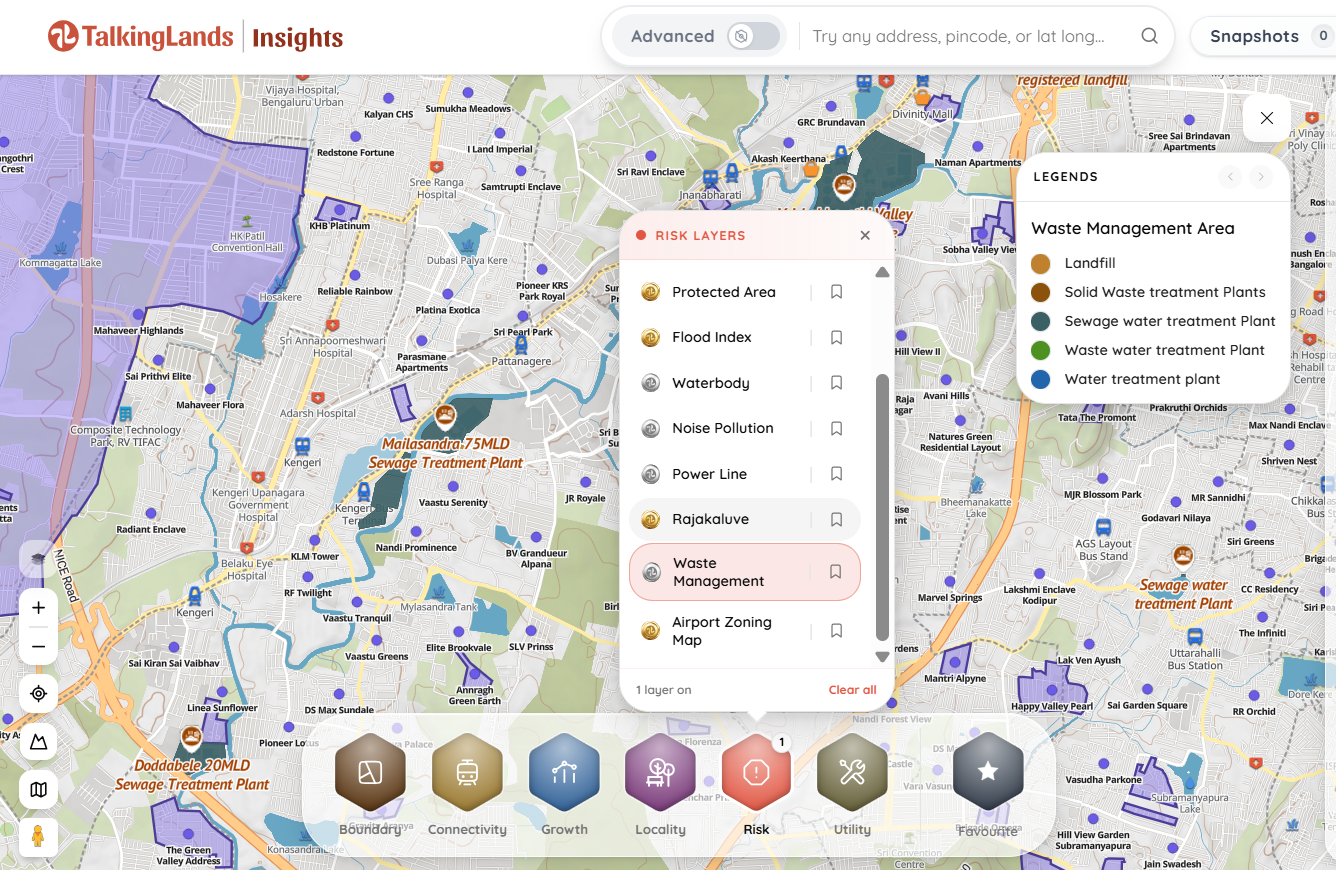
With TalkingLands Insights, verifying your plot’s exposure to waste infrastructure is seamless. By entering your survey number into our advanced mapping workspace, you can instantly overlay the plot's true cadastral boundary onto a live satellite map.
Simply activate the Waste Management layer to immediately reveal hidden landfills, municipal STPs, and solid waste treatment plants nearby. Cross-reference this with our Risk and Buffer layers to ensure you are not buying into a toxic, unbuildable, or heavily stigmatized zone.
-p-2000.png)
Frequently Asked Questions
1. Is it safe to buy a house near a Sewage Treatment Plant (STP)?
If it is a modern, enclosed, and highly maintained water treatment facility, the impact is minimal. However, large, open municipal STPs often suffer from capacity overloads, resulting in severe intermittent odours, mosquito breeding, and a psychological stigma that heavily depresses the resale value of nearby homes.
2. How far should a house be from a landfill?
Under the Solid Waste Management Rules (2016), a mandatory "no-development" buffer must be maintained around active landfills where residential construction is prohibited. While Central Pollution Control Board (CPCB) guidelines frequently recommend a 500-meter separation, the exact legally enforced distance is prescribed on a case-by-case basis by local bodies. However, due to wind carrying toxic odour and dust, experts often recommend a minimum distance of 2 to 3 kilometers for safe residential livability.
3. Will buying near a landfill affect my borewell water?
Yes, significantly. Landfills generate "leachate," a toxic, liquid byproduct of decomposing garbage. If the landfill is unlined or poorly managed, this leachate seeps directly into the ground, permanently contaminating the local groundwater aquifers and rendering borewell water unsafe for consumption.
4. What is the difference between a Water Treatment Plant and a Waste-Water Plant?
A Water Treatment Plant purifies raw water (from rivers or lakes) to make it safe for drinking supply; these are generally safe and odourless to live near. A Waste-Water or Sewage Treatment Plant processes raw sewage and industrial effluent, carrying a much higher risk of foul odours and local contamination.
5. How can I check if there is a landfill near my prospective plot?
Visual inspections are unreliable as waste zones are often hidden from main roads. You should overlay the exact survey number of the plot onto a spatial intelligence platform like TalkingLands and activate the Waste Management layer to visually detect all nearby landfills, STPs, and processing plants on a satellite map.
6. Can I get a building plan approved if my plot is in a waste buffer zone?
No. If your plot's cadastral boundary falls inside a legally notified municipal "no-development" buffer zone surrounding an active landfill or massive solid waste plant, the local planning authority (like the BDA or GBA) will reject your building plan sanction.
.png)

.png)