Key takeaways
- Compare the all-in price of a flat, not the rate per sq ft in the advertisement. In our example, an advertised ₹7,500 per sq ft becomes about ₹9,515 per sq ft all-in.
- Floor rise and PLC are usually charged per sq ft, so they grow with the size of the flat.
- GST on an under-construction flat is 5% without input tax credit, or 1% for affordable housing. A flat sold after the completion certificate does not attract GST.
- Stamp duty and registration go to the state, not the builder, and rates vary by state.
- Under RERA, a builder cannot take more than 10% of the cost before a registered agreement for sale.
- Developers who build the cost sheet as rules in Reveal give every buyer the same, consistent breakup for every unit.
What will this flat really cost you?
Change any number. The example values are illustrative, not a quote. Nothing you type is sent anywhere.
The advertisement says ₹7,500 per sq ft. The agreement says ₹1.12 crore for a 1,250 sq ft flat, and then the registration office asks for another ₹6 lakh. Nothing was hidden; it was just never added up in one place. That is the job of a cost sheet, and this guide shows the standard cost sheet format for a flat, line by line.
What a cost sheet is
A cost sheet (or price breakup) is the builder's written price for one specific unit. It should name the unit, its carpet area and its saleable or super built-up area, and then list every charge that makes up the price. A good cost sheet lets you compare two projects on the same basis: the all-in cost, and the all-in cost per sq ft of the area you actually use.
Watch the area. RERA requires the agreement to state the carpet area, the usable floor area inside the walls. Many price lists still quote a rate on the larger super built-up area, which includes a share of lobbies, lifts and the clubhouse. A rate on carpet area and a rate on super built-up area are not comparable.
The standard cost sheet format, line by line
| Line | How it is usually charged | GST? | What to check |
|---|---|---|---|
| Base price | Rate per sq ft × area | Yes, if under construction | Carpet or super built-up area? |
| Floor rise | ₹ per sq ft for each floor above a starting floor | Yes | The starting floor and the rate |
| PLC | ₹ per sq ft for park-facing, corner or view units | Yes | Is more than one PLC applied? |
| Car parking | Fixed per slot | Yes | Covered or open, allotted slot number |
| Clubhouse and amenities | Fixed | Yes | Is club membership included or extra? |
| Infrastructure | Fixed or per sq ft: power backup, STP, water, electricity connection | Yes | Which items are covered |
| Legal and documentation | Fixed | Check | Is this the builder's fee or a pass-through? |
| Maintenance advance | ₹ per sq ft per month, for 12 to 24 months | Check | From which date it starts |
| Corpus fund | Fixed or per sq ft, a one-time deposit | Check | When it is handed to the association |
| GST | 5% or 1% on the taxable charges | - | The rate and which lines it applies to |
| Stamp duty and registration | % of the property value, paid to the state | No | Your state's current rate |
Put your own numbers into the calculator above. With the example values, the base price is ₹93.75 lakh, the builder's charges bring it to ₹1.06 crore, GST and corpus take it to ₹1.13 crore, and stamp duty and registration make it about ₹1.19 crore: roughly 27% above the advertised rate.
Floor rise and PLC: the two charges that scale
Floor rise is a premium for higher floors. A common pattern is a fixed amount per sq ft for each floor above a starting floor, so a flat on the 8th floor pays seven steps of floor rise on every sq ft. PLC, preferential location charges, is a premium for a better position: park-facing, corner, lake-view or main-road units.
Both are per sq ft, so on a larger flat they add up fast. They are also where negotiation usually starts, because they are set by the builder and not by any law.
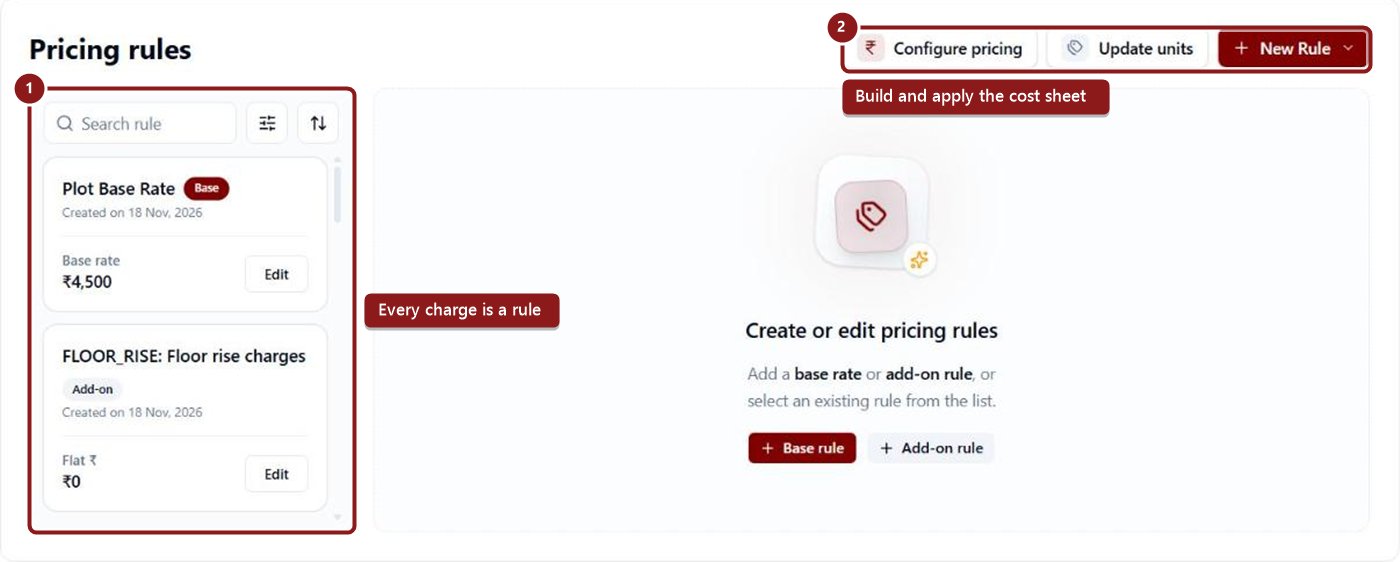
- 1The base rate and each add-on: floor rise, premium (PLC), car parking, clubhouse, utilities, infrastructure, maintenance, corpus, GST, discount and other charges.
- 2Configure pricing builds the cost sheet from these rules; Update units applies it to the inventory.
GST, stamp duty and registration
- GST, under construction: 5% without input tax credit for residential flats, or 1% for affordable housing (carpet area up to 60 sq m in metro cities or 90 sq m elsewhere, and value up to ₹45 lakh). These rates apply from 1 April 2019.
- GST, ready to move: the sale of a completed flat after the completion or occupancy certificate is not a supply under GST, so no GST is charged on the price.
- Stamp duty and registration: paid to the state on the property value. Rates differ by state, by property value and sometimes by buyer category, so use your state's current rate in the calculator.
Booking amount and payment plan
Under Section 13 of RERA, a promoter cannot accept more than 10% of the cost of the apartment as an advance or application fee before entering into a written agreement for sale and registering it. After that, payments follow the schedule in the agreement, usually linked to construction stages. Ask for the payment plan together with the cost sheet, because the same price can be easier or harder to fund depending on the schedule.
How developers build the cost sheet in Reveal
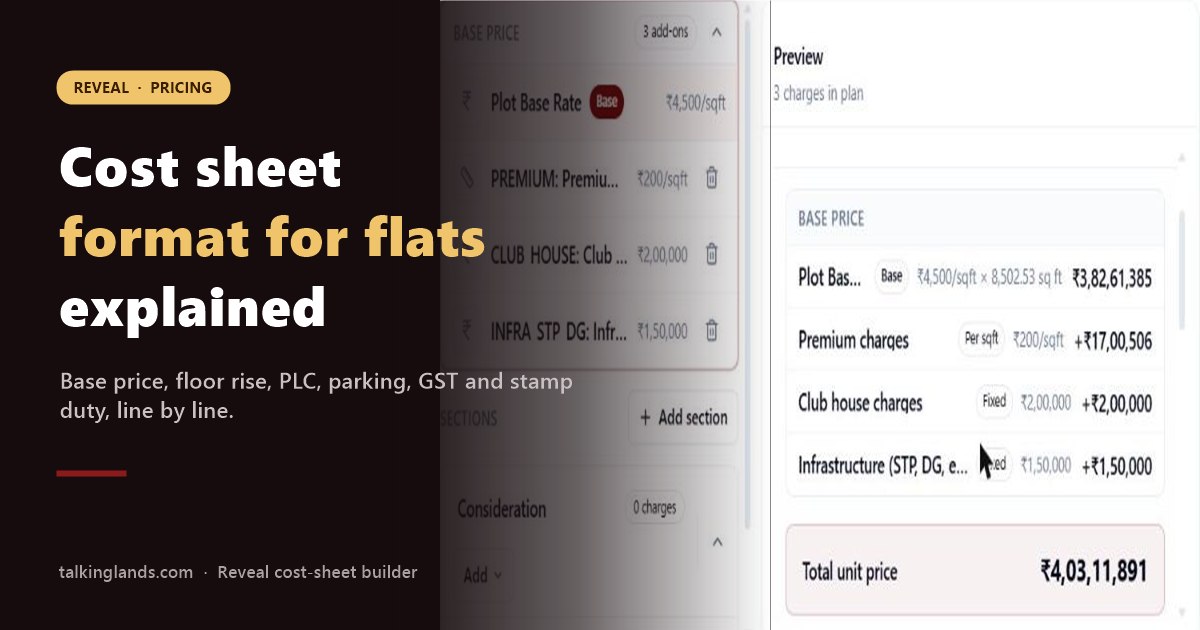
For a developer, the cost sheet is not a PDF; it is a rule that has to give the right price for every unit, every time. In Reveal, you set the base rate and add-on charges once, group them into sections, pick the units they apply to, preview the price for any unit and apply it. The screens below are from a demo plotted project we set up; apartment projects use the same builder with floor rise.
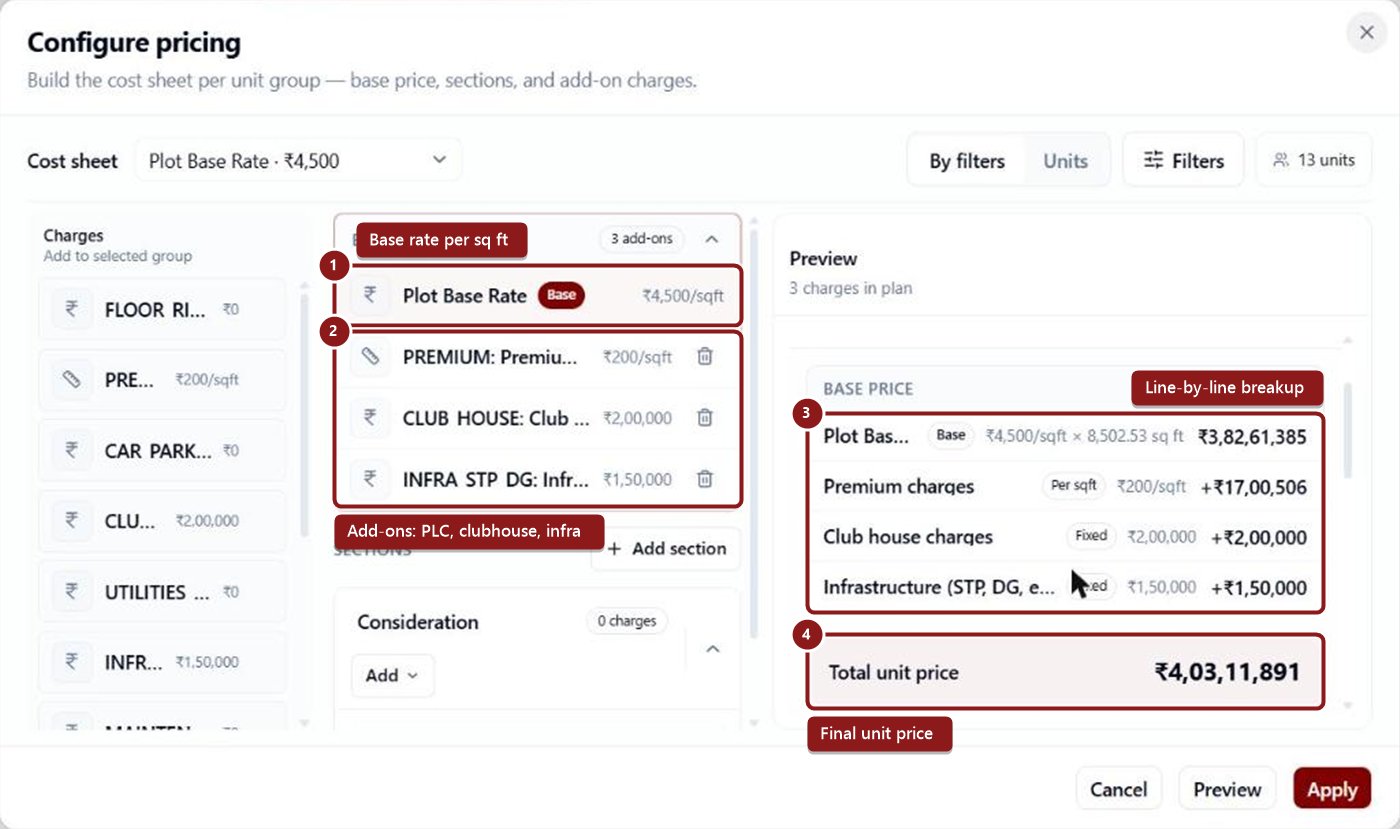
- 1Base rate: ₹4,500 per sq ft.
- 2Add-ons: PLC at ₹200 per sq ft, clubhouse ₹2,00,000 and infrastructure ₹1,50,000.
- 3The breakup for one 8,502.53 sq ft unit: base ₹3,82,61,385 plus ₹17,00,506 PLC plus the fixed charges.
- 4Total unit price: ₹4,03,11,891, the same number the sales team, the buyer and the reports see.
Once applied, the price appears on the unit in the operations table and on the buyer's project page, next to the floor plan and areas.
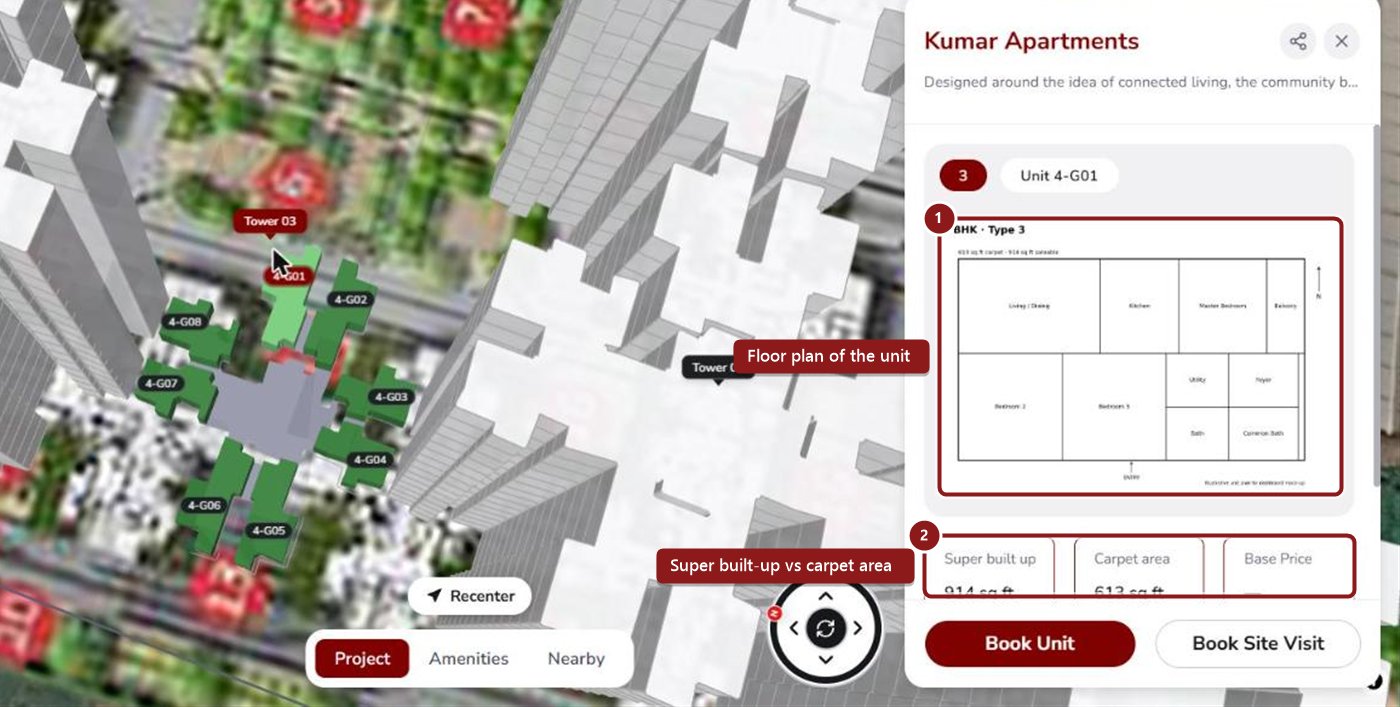
- 1The unit's floor plan.
- 2Super built-up 914 sq ft against carpet 613 sq ft: a 49% difference, which is why the area basis matters.
Questions to ask before you sign
For how developers manage pricing, inventory and bookings together, see our guides to real estate CRM software and real estate sales software.
One cost sheet, consistent for every unit
Reveal turns your price list into rules, previews the breakup for any unit and keeps the same price across sales, the buyer's project page and your reports.
Book a free demoFrequently asked questions
The base price, floor rise and preferential location charges, car parking, clubhouse and amenity charges, infrastructure charges such as power backup and sewage treatment, legal or documentation charges, maintenance advance, corpus fund and GST. Stamp duty and registration are paid by the buyer to the state on top.
Floor rise is an extra charge for higher floors, usually a fixed amount per sq ft for every floor above a starting floor. Because it is per sq ft, it grows with the size of the flat. The starting floor and the rate are set by each developer, so ask for both in writing.
Preferential location charges (PLC) are a premium for units with a better position, such as park-facing, corner, lake-view or main-road units. They are usually charged per sq ft and can apply more than once if a unit has more than one preference.
For under-construction residential flats, GST is 5% without input tax credit, or 1% for affordable housing (carpet area up to 60 sq m in metro cities or 90 sq m elsewhere, and value up to ₹45 lakh). The sale of a completed flat after the completion certificate does not attract GST. Confirm the current rate for your project.
Under Section 13 of RERA, a promoter cannot take more than 10% of the cost of the apartment as an advance or application fee before signing and registering a written agreement for sale.
Many cost sheets show it as an estimate, but stamp duty and registration are paid to the state government, not the builder. Rates vary by state and sometimes by property value and buyer category, so check your state's current rate.
This article is general information, not tax or legal advice. GST and stamp duty rules change; confirm the rates that apply to your purchase with a chartered accountant or lawyer. Calculator values are illustrative. Reveal screens are from a TalkingLands demo account in November 2026.