Key takeaways
- A title search report answers two questions: who owns the land, and can they sell it cleanly.
- Lawyers usually search 30 years of records. Lenders or large land deals may ask for more.
- The RTC, khata and mutation entries are revenue records. They must match the deeds, but they do not prove title on their own.
- The biggest red flags are government or grant land, a missing link in the deed chain, pending cases, missing heirs and an area that does not match.
- In Realm, a survey number's land record shows mutation status, number of owners, owner category and revenue court cases on a satellite map, so you can screen a deal before paying for a full search.
How ready is this land for a lawyer's sign-off?
Tick what you already have for the land you are buying. Nothing you tick is sent anywhere.
Tick the items you already have.
Screen the land record on Realm →Most land disputes in India do not start with a fake document. They start with a real document that was never checked against the one before it: a sale by one brother without the others, a mortgage nobody noticed, or a grant that was never allowed to be sold. A title search report exists to catch these before you pay.
This guide explains what a title search report covers, why lawyers go back 30 years, the documents you need, the red flags that matter most, and how to screen the records yourself on a map before the lawyer starts.
What a title search report is
A title search report (TSR), also called a title opinion or legal scrutiny report when a bank asks for it, is a lawyer's written opinion on a specific piece of land. It does three things:
- Traces the chain of title: every transfer from the oldest deed in the search period to the current owner, by sale, gift, partition, will or inheritance.
- Lists encumbrances and claims: mortgages, leases, court cases, acquisition notices and government rights.
- Gives a conclusion: the title is clear, clear subject to conditions, or defective, with what must be fixed before registration.
It is an opinion based on the documents the lawyer could see. It is not a government certificate and not a guarantee, which is why the quality of the search matters so much.
Why lawyers search 30 years
Thirty years is not a random number. The law presumes that a document 30 years old, produced from proper custody, was properly executed (Section 90 of the old Evidence Act, carried into the Bharatiya Sakshya Adhiniyam, 2023). The Limitation Act also gives the government up to 30 years to bring many claims over land. A clean 30-year chain therefore removes most of the risk that remains in practice.
Treat 30 years as the minimum, not the maximum. Old family land, land that was once a government grant, and large parcels assembled from many owners often need a longer search.
Documents the lawyer needs
Names differ by state. This table uses Karnataka names, with what each record proves and the issue it most often reveals.
| Document | What it shows | Where it comes from | Common issue |
|---|---|---|---|
| Sale deeds and mother deeds | Each transfer of ownership in the chain | Sub-Registrar office, certified copies | A missing link, or a seller who was not the full owner |
| Encumbrance certificate | Registered sales, mortgages and charges for the period | Kaveri Online / Sub-Registrar (Form 15 with entries, Form 16 nil) | A mortgage that was never released |
| RTC (Pahani) | Name in the revenue record, extent, land type | Bhoomi | Extent or name does not match the deed |
| Mutation register (MR) | How and when the name in the RTC changed | Bhoomi / taluk office | A sale that was never mutated |
| Survey sketch, Akarband, tippani | Boundaries and the official area of the survey number | Survey and land records department | Boundaries on the ground differ from the sketch |
| Khata and tax receipts | The municipal or panchayat property account | Local body | Khata in another name, or arrears |
| Conversion order | Permission to use agricultural land for other purposes | Deputy Commissioner's office | Building on unconverted land |
| Family tree, legal heir papers | Everyone with a share by inheritance | Tahsildar, court orders | A heir who never signed |
| Court and revenue case search | Pending or past disputes on the land | eCourts, revenue court records (RCCMS) | A pending case or a stay order |
Our step-by-step guides cover the main records: how to check the RTC online, the mutation record and the encumbrance certificate.
How the search works, step by step
- Fix the land: survey number, village, extent and boundaries, matched to the land on the ground.
- Collect the chain: certified copies of every deed in the search period, oldest first.
- Pull the EC for the whole period and tick every entry against the deeds.
- Match the revenue records: RTCs and mutation entries should follow each transfer.
- Check the land itself: grant conditions, acquisition notices, conversion and zoning.
- Search for disputes: civil and revenue cases, and a public notice in newspapers.
- Write the opinion: clear, conditional or defective, with a list of what to fix.
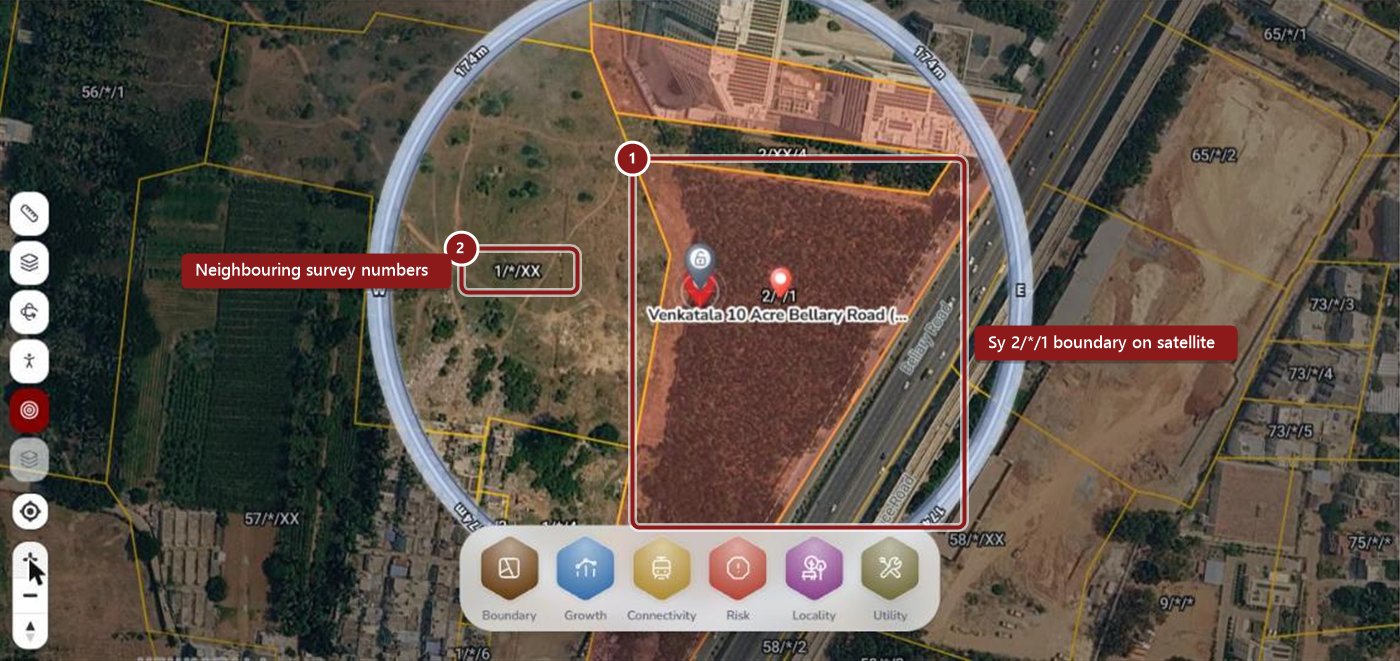
- 1The boundary of Sy 2/*/1. Check that the fence, road and buildings on the ground sit inside it.
- 2Neighbouring survey numbers. Boundary disputes usually start at these edges.
A real example on the map
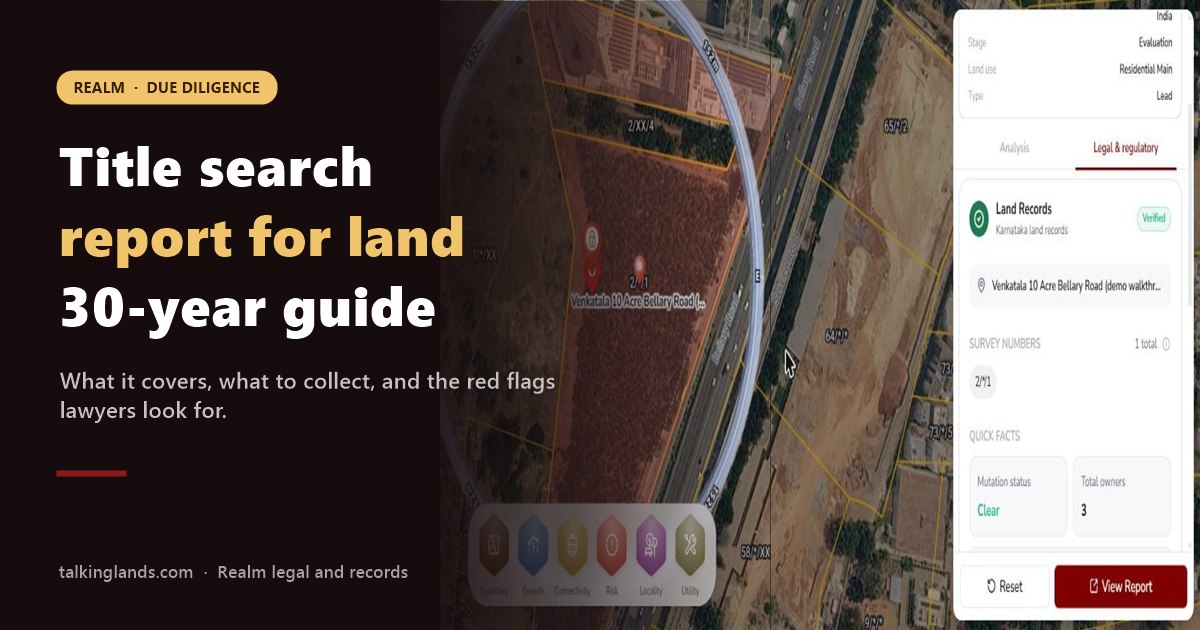
Here is how the first screen of a title search looked for a 10-acre site on Bellary Road in Bengaluru, run in Realm during our walkthrough. Each screen took seconds, and each one gave the lawyer a specific question to answer.
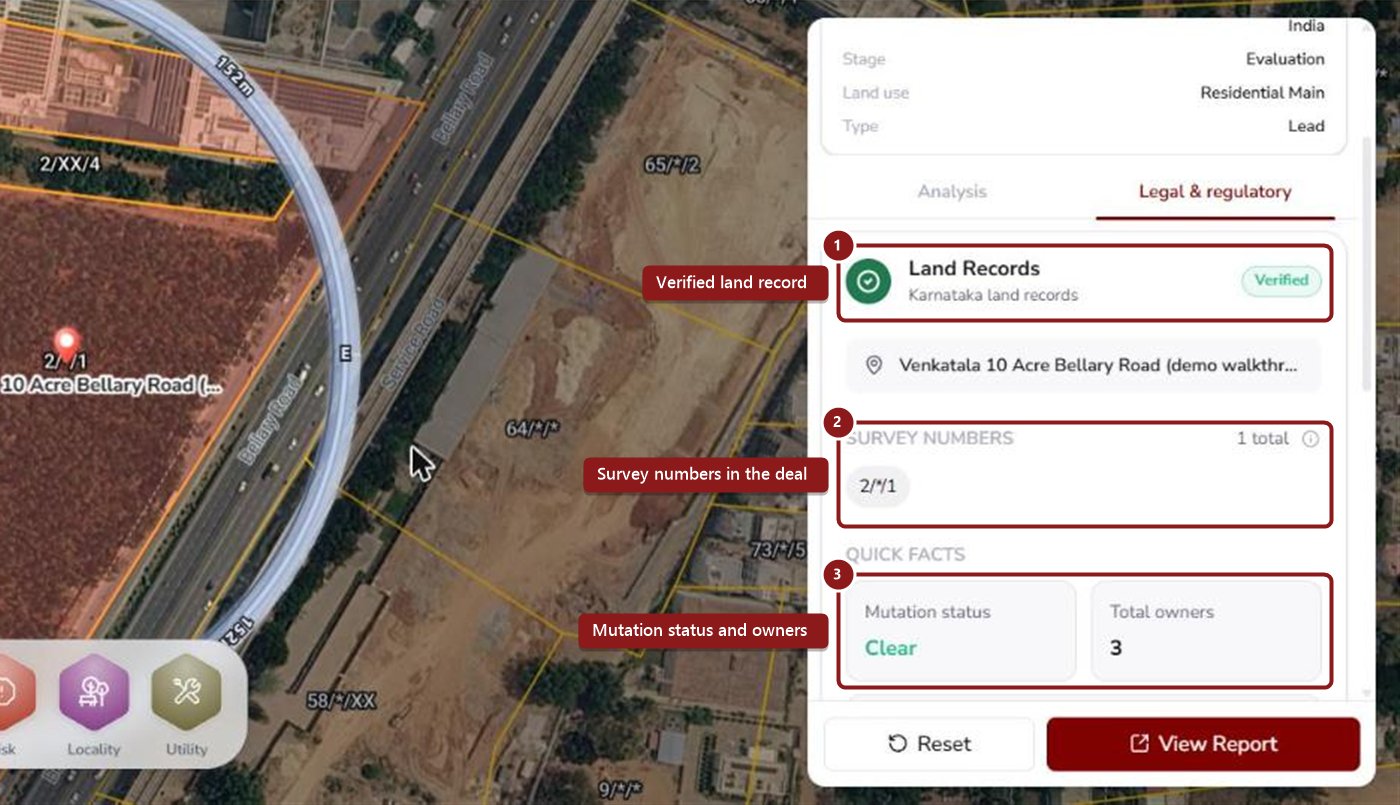
- 1The record is verified against the state land records for this survey number.
- 2Every survey number in the deal is listed. A site built from many numbers needs a chain for each one.
- 3Mutation status is clear and there are 3 owners on record. All three must sign, or the lawyer must explain why not.
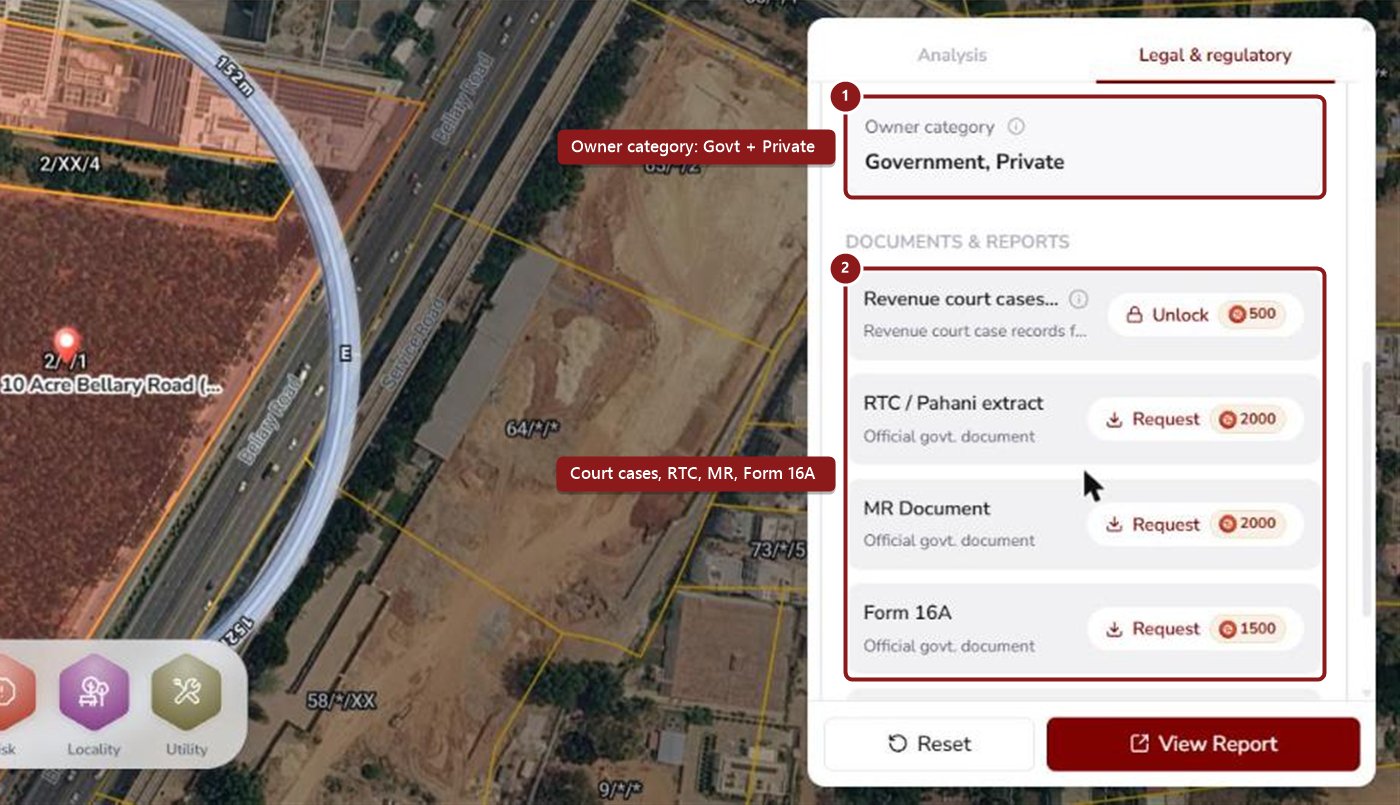
- 1Owner category: Government and Private. Part of this land is recorded in the government's name, which is a question the title search must answer before any advance is paid.
- 2Revenue court cases, the RTC extract, the MR document and Form 16A can be ordered here for the lawyer's file.

- 1Six case entries at the Assistant Commissioner's court, all marked disposed, from 2018 and 2021. Disposed does not mean harmless: the lawyer should read each order, because an order can change who owns what.
In Realm, each of these questions becomes a task on the land lead, so nothing gets lost between the site visit and the lawyer's report.
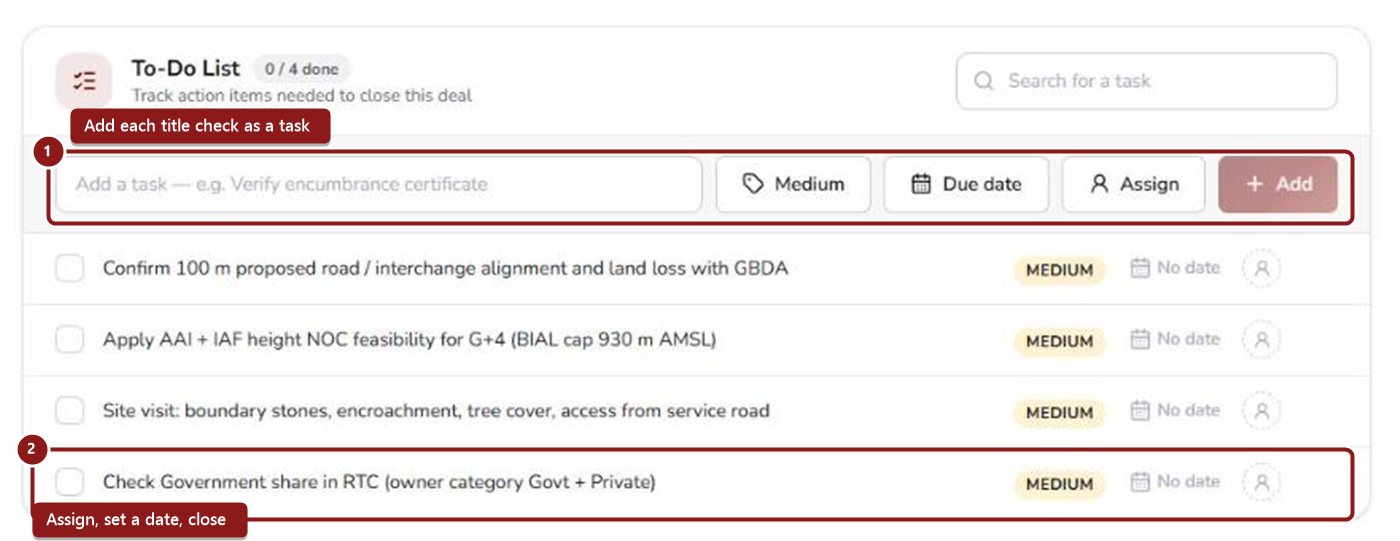
- 1Add each open question as a task, for example "verify encumbrance certificate".
- 2Set a priority, a due date and an owner, and close it when the lawyer answers.
Red flags to catch
For the wider checklist, including zoning, buffers and approvals, see our land due diligence checklist and our guide to property legal verification.
Report, opinion or insurance?
- Title search report or title opinion: written for the buyer, covers the chain and the risks.
- Legal scrutiny report: the same work in the format a lender asks for, written for the bank.
- Title insurance: uncommon for land deals in India. Do not treat it as a substitute for a proper search.
Ask for the report in writing, with the list of documents examined, the period covered and every condition stated plainly. A one-line "title is clear" is not a title search report.
Screen the title before you pay the lawyer
Realm shows the land record, owners, mutation status and court cases for a survey number on a satellite map, and keeps every open question on the land lead.
Book a Realm demoFrequently asked questions
It is a lawyer's written opinion on who owns a piece of land and whether the owner can transfer it cleanly. It traces the chain of title, usually for 30 years, and lists encumbrances, court cases, missing documents and the conditions to fix before the sale.
The law presumes that a document 30 years old, kept in proper custody, was properly executed, and the Limitation Act gives the government up to 30 years for many claims over land. Some lenders and lawyers ask for a longer search, especially for large or old family land.
No. The RTC (Pahani) and khata are revenue and tax records. They show whose name is entered, the extent and the land use, and they must match the deeds, but ownership comes from the chain of registered deeds and lawful succession.
The registered sale deeds and mother deeds for 30 years, the encumbrance certificate for the same period, current and old RTCs, mutation register extracts, the survey sketch, khata and tax receipts, conversion orders if the land is not agricultural, a family tree or legal heir certificate, and any court orders.
It depends on how many transactions are in the chain and how fast the offices supply certified copies. A simple residential plot can take days; old agricultural land with many heirs can take weeks. Ask your lawyer for a written timeline and a list of what they still need.
Yes. In Karnataka you can view RTCs and mutation status on Bhoomi and encumbrance certificates on Kaveri. Realm by TalkingLands shows the land record for a survey number on a satellite map, with mutation status, number of owners, owner category and revenue court cases, so you can screen a deal before paying for a full search.
This article is general information, not legal advice. Always get a written title opinion from a qualified lawyer before you pay an advance or register a sale. The Realm screens shown are from our walkthrough of a TalkingLands demo account in November 2026; land records change, so check the current record for your survey number.